
Health
Ondo records first strike in 2025
The President of the ARD in the state, Olaogbe Kehinde, said the doctors have been overstretched and could no longer work due to non-payment of their arrears and other benefits.

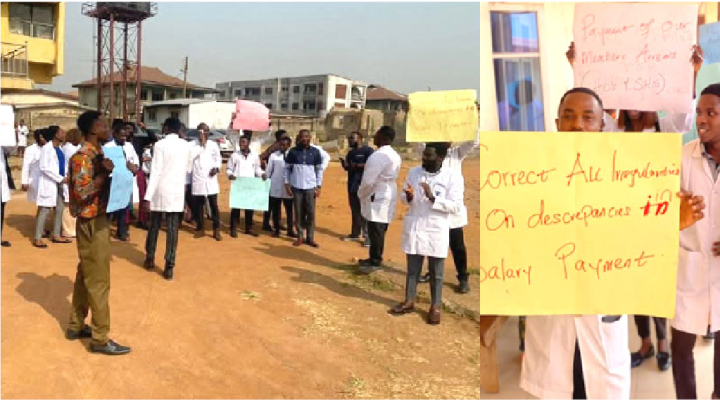
Medical doctors in Ondo State embarked are the first to embarked on strike in 2025.The members of the Association of Resident Doctors (ARD) at the University of Medical Sciences Teaching Hospital (UNIMEDTH) in Ondo State, went on the indefinite strike action today.
Ohibaba.com learned that the resident doctors had earlier on Monday staged a peaceful protest at the facility of the UNIMEDTH in Ondo town to press home their demands.
Among several grievances, the striking doctors cited the correction of irregularities on discrepancies in salary payments and implementation of the new minimum wage scale as part of their demands.
Other demands include payment of all hazard allowance arrears, payment of ARD member’s arrears, and provision of conducive accommodation to resident doctors within the hospital premises and the employment of doctors to increase manpower across the previous departments among others.
In a statement to announce the strike action on Tuesday, the President of the ARD in the state, Olaogbe Kehinde, said the doctors have been overstretched and could no longer work due to non-payment of their arrears and other benefits.
Dr Olaogbe noted that many doctors in the state have resigned from the job while others left without prior notification due to poor conditions of service.
He also explained that a series of ‘save our souls’ letters had been written to the management for review, but all efforts proved abortive.






Health
Fire Razes Ebonyi Ministry of Health Section
” Different vaccines like BCG, penta, HPV vaccine etc that were all stored in that cold room were burnt”.
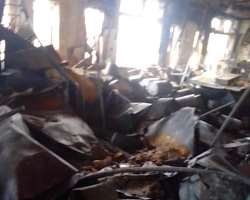
A section of the Ebonyi State Ministry of Health, weekend , was gutted by fire with property worth hundreds of millions of naira destroyed.
The inferno destroyed the cold store housing immunisation and solar units which contained vaccines, vaccine carriers, cold chain boxes, laptops, documents, five refrigerators, two solar refrigerators, 45 solar batteries, inverters, including hospitals beds and foams received from the National Primary Health Care Development Authority (NPHCDA), Abuja, for distribution to local government areas across the state, among others.
The State Commissioner for Health, Dr Moses Ekuma, lamented the disaster and thanked God that no life was lost. He thanked the Commissioner for Power and Energy, the fire service personnel, and the security men who alerted him on time for their prompt response, which made the fire not spread to other parts of the building.
He said, “Different vaccines like BCG, penta, HPV vaccine etc that were all stored in that cold room were burnt”.
Health
Health Workers Protest Against Regulatory Bill
They maintain that all health professions have their regulatory bodies, and that the new bill was seeking to make other health professionals second-class to medical doctors.

Health workers under the Joint Health Sector Unions and the Assembly of Healthcare Professional Associations are protesting against the proposed health sector regulatory bill, which is before the National Assembly.
They said that if allowed to pass, the law would subject every medical profession to the regulation of the Medical and Dental Council of Nigeria.
They maintain that all health professions have their regulatory bodies, and that the new bill was seeking to make other health professionals second-class to medical doctors.
The protesters plan to also go to the National Assembly, where they hope to present their case to lawmakers.
Health
UNIZIK nursing school to review fee hike after students protest
” As for the school fees, yes, there was an increment. We just had a new board and it decided to review the tuition to enable the institution provide the best for the students. They proposed N580,000 to us and we approved it, but there is still room to take another look at it and harmonise things.”

The management of the School of Nursing at the Nnamdi Azikiwe University Teaching Hospital, Nnewi, Anambra State, has pledged to engage the governing board and student leaders to address concerns over the recent increase in tuition fees.
The assurance followed a protest on Tuesday by students of the institution who decried what they described as an astronomical hike in their fees from N90,000 to N580,000.
The PUNCH, reported that the protesting students marched within the school premises carrying placards and chanting solidarity songs, including, “We no go gree, reduce the school fees, we no go gree,” to express their displeasure over the increase.
The fee increment reportedly followed an internal memo issued on January 23 by O.I. Ezejiofor, the Chairman of the Board and Chief Medical Advisory Committee of the NAUTH College of Nursing, announcing an upward review of tuition to facilitate improvements in the institution.
The Chief Medical Director of NAUTH, Prof. Joseph Ugboaja, said that he had been informed about the protest and promised that the management would meet with the relevant stakeholders to resolve the issue.
“I will return to the institution and we will sit with members of the board who proposed the new tuition and also with the students union leadership to sort things out,” Ugboaja said.
“As for the school fees, yes, there was an increment. We just had a new board and it decided to review the tuition to enable the institution provide the best for the students. They proposed N580,000 to us and we approved it, but there is still room to take another look at it and harmonise things.”


Lagos PDP Governorship Aspirant Adeoye Rejects One-Party Dominance

Kwankwaso officially joins ADC in Kano

Just in: Tuggar resigns as Foreign Minister

Tech Expert, Zuckerberg trains with UFC champions, Adesanya, Alexander

Organ Trafficking: Ekweremadu bags 10 years in UK prison

SAINT OBI: Between his marriage and his death
-

 Sports1 day ago
CAF appoints Nigeria’s Samson Adamu as acting secretary general
-

 Business1 day ago
Governor Otti Commissions Ultimum Manufacturing Plant in Aba
-

 Politics2 days ago
JUST IN: Kwankwaso Set to Join ADC on Monday
-

 News1 day ago
President Tinubu at 74, Donates Salaries to Armed Forces Welfare Fund
-

 Politics1 day ago
PDP will contest 2027 polls, says Wike
-

 Business1 day ago
OPay launches new office in Jos
-

 Crime15 hours ago
JUST IN: Terrorists Invade Kaduna Wedding Ceremony, Kill 13 Guests In Late-Night Attack
-

 News17 hours ago
Lagos High Court Embraces Full Digital Transformation with Mandatory E-Filing