
Health
UNIZIK nursing school to review fee hike after students protest
” As for the school fees, yes, there was an increment. We just had a new board and it decided to review the tuition to enable the institution provide the best for the students. They proposed N580,000 to us and we approved it, but there is still room to take another look at it and harmonise things.”


The management of the School of Nursing at the Nnamdi Azikiwe University Teaching Hospital, Nnewi, Anambra State, has pledged to engage the governing board and student leaders to address concerns over the recent increase in tuition fees.
The assurance followed a protest on Tuesday by students of the institution who decried what they described as an astronomical hike in their fees from N90,000 to N580,000.
The PUNCH, reported that the protesting students marched within the school premises carrying placards and chanting solidarity songs, including, “We no go gree, reduce the school fees, we no go gree,” to express their displeasure over the increase.
The fee increment reportedly followed an internal memo issued on January 23 by O.I. Ezejiofor, the Chairman of the Board and Chief Medical Advisory Committee of the NAUTH College of Nursing, announcing an upward review of tuition to facilitate improvements in the institution.
The Chief Medical Director of NAUTH, Prof. Joseph Ugboaja, said that he had been informed about the protest and promised that the management would meet with the relevant stakeholders to resolve the issue.
“I will return to the institution and we will sit with members of the board who proposed the new tuition and also with the students union leadership to sort things out,” Ugboaja said.
“As for the school fees, yes, there was an increment. We just had a new board and it decided to review the tuition to enable the institution provide the best for the students. They proposed N580,000 to us and we approved it, but there is still room to take another look at it and harmonise things.”
Health
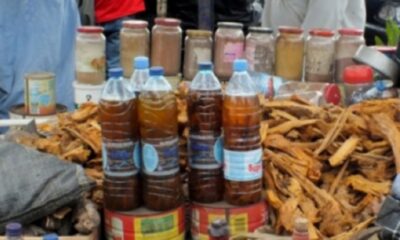
Ondo ‘Monkey Tail’ herbal drink kills 49
The Commissioner for Health in the State, Dr Banji Ajaka, who disclosed this on Wednesday night, said the number of affected persons has now climbed to 170.

A locally produced herbal concoctions known as ‘Monkey Tail’ in Ondo State has killed 49 people .
The Commissioner for Health in the State, Dr Banji Ajaka, who disclosed this on Wednesday night, said the number of affected persons has now climbed to 170.
He explained that the latest deaths were recorded in Irele Local Government Area of the state, where eight persons have died from suspected poisoning.
Ajaka disclosed that health authorities had deployed response teams to Irele LGA and other affected communities to conduct surveillance, manage cases and trace the source of the suspected toxic substance.
Health
Bayelsa deploying 19 doctors, 210 nurses to strengthen primary healthcare centres
The commissioner said the deployment of doctors, nurses and midwives would make primary healthcare centres more attractive to residents and encourage women to seek professional care during childbirth.

| Bayelsa State Commissioner for Health, Prof. Seiyefa Brisibe
The Bayelsa State Government has said it will deploy 19 doctors, 210 nurses and midwives, 185 pharmacy technicians and about 50 laboratory medical technicians to primary healthcare centres across the state to strengthen clinical services at the grassroots.
The State Commissioner for Health, Prof. Seiyefa Brisibe, disclosed this on Friday while speaking on the government’s efforts to improve healthcare delivery at the grassroots during a training organised by the Health Emergency Initiative, under the sponsorship of FIRST E&P, tagged First Respondent First Respondent Training and Medical Intervention Programme.
Brisibe said, “We are deploying 19 doctors, 210 nurses and midwives, 185 pharmacy technicians and about 50 laboratory medical technicians to strengthen the clinical component of our primary healthcare centres.”
He said the deployment was aimed at strengthening the clinical component of primary healthcare centres, which, according to him, were often largely run by community health extension workers and environmental health officers.
The commissioner said the deployment of doctors, nurses and midwives would make primary healthcare centres more attractive to residents and encourage women to seek professional care during childbirth.
Health
Gov Mbah Invest in world-class Enugu International Hospital
The hospital, equipped with state-of-the-art medical equipment and advanced digital and electronic systems, is expected to attract top medical professionals from Nigeria and around the world.

Enugu State Governor, Peter Mbah, says the Enugu International Hospital is designed to provide world-class healthcare services to people across all socioeconomic classes.
The Enugu International Hospital is located at Rangers Avenue, Independence Layout, Enugu.
Mbah stated this during a pre-launch tour of the facility ahead of its official commissioning.
The hospital, equipped with state-of-the-art medical equipment and advanced digital and electronic systems, is expected to attract top medical professionals from Nigeria and around the world.
The governor expressed satisfaction with the quality of the equipment installed at the facility, saying the investment would help position Enugu as a medical tourism hub in Nigeria.
He said the hospital would also help reduce the number of Nigerians travelling abroad for specialist medical treatment while creating an environment that would encourage Enugu-trained medical professionals to return home.
According to Mbah, several Enugu-qualified medical practitioners based abroad have already reached out to express interest in working at the international hospital and contributing to the development of the state’s health sector.
The governor further said the facility would create job opportunities for medical graduates, healthcare professionals and other workers, with the potential to boost economic activity in the state.
During the tour, Mbah inspected several specialist units, including the Precision Oncology and Nuclear Medicine Unit, specialised surgery theatres, intensive care units, advanced diagnostics and imaging, and renal care and dialysis facilities.
He also toured the cancer, heart and vascular, nuclear medicine and molecular imaging, neuroscience, and renal centres.
Accompanied by the Director of the facility, Professor Sam Agwu, and other specialists, the governor received briefings on the various services and specialist care the hospital is expected to provide.
The Enugu International Hospital operates as a comprehensive quaternary care facility with more than 300 beds and was established to provide world-class specialist healthcare.
The facility is expected to strengthen access to advanced medical care, support medical professionals, create employment and contribute to Enugu State’s emergence as a destination for medical tourism.


Macron Hosts Tinubu for Private Dinner at Élysée Palace (Photos)

Madonna Returns To MTV Video Music Awards, After 23 years

Emir Sanusi mobilises Kano People “Buy Dangote Refinery’s Shares Now”

Tech Expert, Zuckerberg trains with UFC champions, Adesanya, Alexander

Organ Trafficking: Ekweremadu bags 10 years in UK prison

SAINT OBI: Between his marriage and his death
-

 International3 days ago
JUST IN: All Occupants Survive as Aircraft Crashes, Catches Fire
-

 Business2 days ago
Naira Exchange Rates To Dollar, Pound, Euro…Wednesday, 16 September 2026
-
 Entertainment2 days ago
EXCLUSIVE: Veteran Nollywood Actor, Olu Jacobs Dies at 84
-

 International3 days ago
Millions affected as floods strike India
-
Entertainment2 days ago
Olu Jacobs: His Life and Times
-
 Health1 day ago
Ondo ‘Monkey Tail’ herbal drink kills 49
-

 Business1 day ago
Nigerians Speak As Petrol sells N1,500/litre
-
 Business23 hours ago
Emir Sanusi mobilises Kano People “Buy Dangote Refinery’s Shares Now”