
News
Lagos High Court Embraces Full Digital Transformation with Mandatory E-Filing


The Federal High Court Lagos Division is set to fully transition to a digital era, as it mandates electronic filing for all new cases starting from April 27, 2026.
In a major push towards modernizing justice delivery, the court announced that manual filing of new cases will cease on April 24, 2026. From April 27 onwards, legal practitioners will be required to file all fresh matters exclusively through the court’s new e-filing platform.
Existing cases filed before the transition date will continue to be processed under the traditional manual system until final judgment is delivered, ensuring no disruption to ongoing litigation.
According to a statement from the court, any understatement of claims or misrepresentation of documents submitted via the platform will attract a penalty of ₦10,000 per filing, in addition to the payment of any outstanding fees.
To gain access to the e-filing system, lawyers must first obtain a Legal Mail account. Law firms are also required to upload their Corporate Affairs Commission (CAC) registration documents when creating their digital profiles.
Oath-related documents will be handled through the dedicated e-Affidavit portal. However, deponents will still be required to physically appear before a Commissioner for Oaths to complete the process.
This initiative forms part of the Federal High Court’s broader digital transformation drive aimed at enhancing efficiency, transparency, and accessibility in the justice system.
Legal practitioners are advised to familiarize themselves with the platform ahead of the deadline to avoid any hitches in filing new matters.
News
FG Withdraw Charges Against PFIPC DG Adeyemi
When the matter was called on Monday, the DPPF notified the court that the AGF, after a proper review of the case file, had found some loopholes that informed his decision to withdraw the charge.


The Federal High Court in Abuja on Monday struck out the eight-count forgery charge brought against the self-styled Director-General (DG) of the alleged “non-existent” Presidential Foreign Investment Promotion Council (PFIPC), Prince Adeniyi Adeyemi.
Justice Mohammed Umar terminated further proceedings in the case following an application by the Federal Government, which was represented by the Director of Public Prosecutions of the Federation (DPPF), Mr. Rotimi Oyedepo, SAN.
It will be recalled that although the charge was originally brought before the court by the police, the office of the Attorney-General of the Federation (AGF) took over the prosecution at the last adjourned date.
When the matter was called on Monday, the DPPF notified the court that the AGF, after a proper review of the case file, had found some loopholes that informed his decision to withdraw the charge.
He told the court that the government had concluded plans to move the case to the High Court of the Federal Capital Territory (FCT) for a fresh arraignment of the defendant.
News
CJN Kekere-Ekun swears in 68 new SANs
During her address at the Supreme Court Complex in Abuja, Kekere-Ekun urged judicial officers to embrace reforms aimed at accelerating the administration of justice, citing the increasing number of cases before the courts.
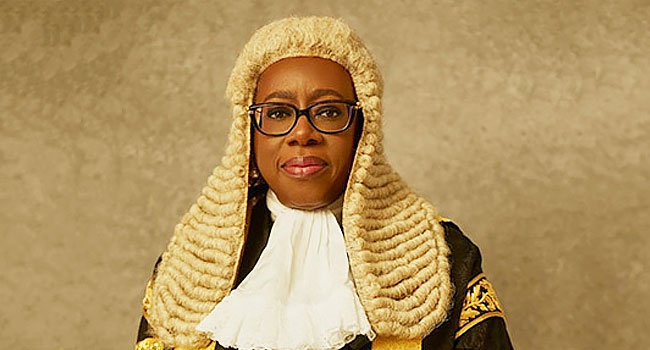
Chief Justice of Nigeria, Justice Kudirat Kekere-Ekun, has sworn in 68 new Senior Advocates of Nigeria (SANs) at the ceremony marking the 2026/2027 legal year.
The Nigerian Television Authority (NTA) reported the development accompanied by a video and photographs shared on its official X handle, on Monday.
During her address at the Supreme Court Complex in Abuja, Kekere-Ekun urged judicial officers to embrace reforms aimed at accelerating the administration of justice, citing the increasing number of cases before the courts.
She also encouraged judges to leverage technology to improve the adjudication of cases.
Reviewing the judiciary’s performance in the year under review, the CJN disclosed that more than 2,000 cases were filed at the Supreme Court, with civil matters accounting for the majority.
Kekere-Ekun also cautioned legal practitioners against discrediting court judgments in the media.

A fire has broken out at a First Bank of Nigeria branch along the busy Abuja-Keffi Road, with thick black smoke billowing from the building this afternoon.
Videos circulating on social media show flames and heavy smoke rising from the structure, identified by multiple eyewitnesses as the First Bank location in the Mararaba/Karu area of the expressway. Bystanders can be seen attempting to douse the blaze with buckets of water amid reports that fire service response was delayed or absent in the initial moments.
The exact cause of the fire remains unconfirmed at this time. There are no immediate reports of casualties, though the full extent of damage to the bank building and any impact on surrounding properties or traffic along the heavily congested Abuja-Keffi corridor is still being assessed.
Emergency responders, including fire service personnel, are expected on the scene. Commuters and residents in the Nyanya-Mararaba-Karu axis are advised to exercise caution as the incident may cause further traffic disruptions on the already busy route.
Further updates will follow as more details emerge from official sources.


AI to eliminate 40% of global jobs – IMF boss

JUST IN: Pope Leo XIV to Undergo Surgery for Early-Stage Lung Nodule

FG Withdraw Charges Against PFIPC DG Adeyemi

Tech Expert, Zuckerberg trains with UFC champions, Adesanya, Alexander

Organ Trafficking: Ekweremadu bags 10 years in UK prison

SAINT OBI: Between his marriage and his death
-

 Business12 hours ago
Naira To Dollar, Pound ,Euro …Rates For Monday, October 12
-

 Business11 hours ago
Nigeria’s ₦33bn Fruit Import Bill Exposes Missed Opportunities in Jos
-

 International1 day ago
‘Up to our people’ to pick leader, Zelenskyy responds to Trump’s pledge for new elections in Ukraine
-

 Opinions19 hours ago
Human Capital Africa Statement For International Day of the Girl Child 2026
-

 Politics10 hours ago
2027: 119 Women Jostle For State’s Governors
-
 Politics6 hours ago
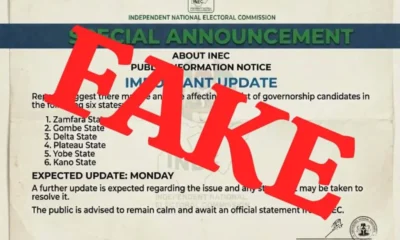
BEWARE: Fake 2027 Gov’ Candidates List Circulating Online — INEC Raises Alarm
-

 International1 day ago
Time for Ukraine to get a new president’, says Trump
-

 News12 hours ago
Forbes Scores GTBank Best Employers 2026