
Business
Cardoso warns excess cash, 2027 election threaten Nigeria’s economic gains
Cardoso expressed the concern during the National Economic Council (NEC) Conference 2026 at the Presidential Villa, themed: “Delivering Inclusive Growth and Sustainable National Development: The Renewed Hope National Development Plan,” Cardoso addressed the “Fiscal and Monetary Outlook 2026–2030: Priorities and Imperatives” panel.

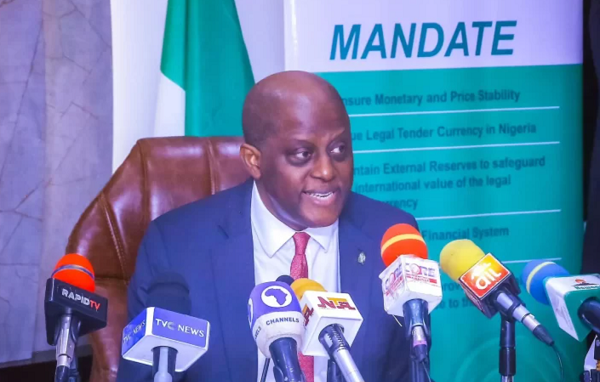
Central Bank of Nigeria (CBN) Governor, Olayemi Cardoso, has warned that excess liquidity and the 2027 election cycle could threaten Nigeria’s hard-won economic stability, urging careful management to protect reforms that have strengthened the economy.
Cardoso expressed the concern during the National Economic Council (NEC) Conference 2026 at the Presidential Villa, themed: “Delivering Inclusive Growth and Sustainable National Development: The Renewed Hope National Development Plan,” Cardoso addressed the “Fiscal and Monetary Outlook 2026–2030: Priorities and Imperatives” panel.
Cardoso said: “The cost of loose monetary policy accessibility, the cost of having to soak up all that liquidity was a problem.
Next slide and persistent inflation. Inflation has served the 34.6% dysfunctional FX market.
You all remember, there’s a huge backlog of over $7 billion and that the parallel market premium exceeded 16% loss of investor confidence.
Everybody took flights, nobody went to hold Naira, and it was a very desperate situation.h
Then, of course, there was direct intervention by the Central Bank, which reached an unprecedented level of 10.93 trillion Naira, which honestly was a huge problem.”
He noted that these interventions “provided short-term support, which many people would argue, but created long-term mandatory distortions, excess liquidity and increased cost of liquidity management.”
Cardoso outlined the three-pillar response that restored stability.
First, “a decisive monetary policy on V set NPR increased by a very aggressive 875 basis points to decisively tackle inflation. And of course, we move back to what we call orthodox monetary policy.
We phase out all quasi-fiscal development finance interventions to focus squarely on price stability, because without that, you have no growth, you have no investment, you have no growth.”
Second, he stressed the importance of transparency and market-driven reforms: “Engineering a market-driven ethics regime, which we’ve been talking about for a long time, unification and price discovery, clearing the FX backlog and institutionalised transparency, which, to my mind, is a very, very key ingredient of managing the FX market.”
Third, Cardoso highlighted fiscal coordination: “Enhanced fiscal coordination, adhering to statutory limits of deficit financing, good ways and means advances to the government, and we had to have a sharp decline in that, from 2.65% in 2023 to 0.69% in 2024.”
The results, he said, are evident across key economic indicators:
“Sustained GDP growth of 3.98%, strong current accounts, for a very long time we haven’t had that $3.42 billion surplus recorded in the third quarter of 2020, by a significant improvement, significant maturation, inflation at 15.15%, banking sector soundness, and growing external reserves of $49 billion as of February 5, 2026.”




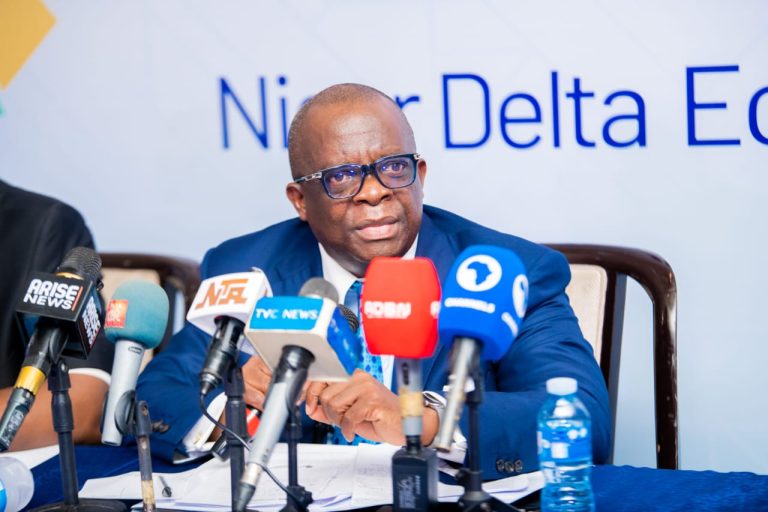
Photo: Ambassador Idaere Gogo Ogan
The Niger Delta Chamber of Commerce, Industry, Trade, Mines and Agriculture (NDCCITMA) has unveiled plans to attract up to five billion dollars structured investments to the oil-producing region in five years.
The Chairman of NDCCITMA, Ambassador Idaere Gogo Ogan, made the disclosure at a pre-summit conference ahead of the Niger Delta Economic and Investment Summit in Port Harcourt, Rivers State.
He said that the initiative would catalyse no fewer than 500,000 direct and indirect jobs as well as spur investments and create wealth.
He said the summit with the theme, “Driving Investment, Innovation, and Industrial Growth in the Niger Delta”, slated for Port Harcourt, would deliberate on investment mobilisation, enterprise growth, industrial expansion, and regional coordination.
Business
Dangote: Middle East crisis might take us back to ‘Work from home’ COVID era
In some countries today, what they’ve done is ask everybody to work from home because they cannot afford it.“I think in Indonesia, they only go to work four days a week.
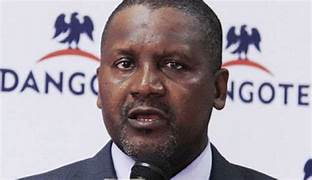
The President of the Dangote Group, Aliko Dangote, has expressed concerns about the ongoing Middle East crisis taking many countries back to the COVID19 era’s work from home.
Dangote stated this on Monday, after a meeting with President Bola Ahmed Tinubu at his residence in Lagos.
While expressing concern about the economic impact of oil price uncertainty, Africa’s Richest man noted that Nigeria and other African countries might be forced to start working from home, just like the COVID19 era.
Dangote called for prayers and international intervention to end the conflict which has affected the price of fuel and other energy sources in the country.
He said, “In some countries today, what they’ve done is ask everybody to work from home because they cannot afford it.“I think in Indonesia, they only go to work four days a week. And they will look at the situation. If it doesn’t improve, they will ask everybody not to go to work anymore. We will do like that time of COVID, where people will now go and work from home,” Dangote said.
It’s not only energy. Some people will try to take a chance and say, ‘Ah, this is an opportunity. So, let me make money. So, if this thing doesn’t de-escalate, it is going to keep going up and governments cannot really now go and add salaries also. So, people will really feel the pinch,” he said.
Dangote explained that the crisis would hit hardest at ordinary Africans operating small businesses, “People who are barbers, people who are doing bread, people who have industries who have to pay their own generator, I mean, you can see what is happening,” he said.
Business
Binance seeks out-of-court settlement in Nigeria tax evasion case
Following submissions from both parties, Justice Nwite adjourned the case until May 12 for a report on settlement talks.
Binance Holdings Limited on Tuesday said it is exploring a resolution of the tax evasion charges filed against it by the Federal Government, signalling a pause in the trial.
Sunday Agaji, the company’s counsel disclosed this before Emeka Nwite of the Federal High Court in Abuja.
Moses Ideho, counsel to the government a deputy director in the legal department of the Federal Inland Revenue Service (now Nigeria Revenue Service), confirmed the development.
Although the matter was slated for continuation of trial, Ideho told the court he had been informed earlier by the defence that the company had approached the tax authority to discuss an out-of-court settlement.
Agaji said discussions were ongoing.
“My lord, parties are exploring settlement. That is essentially where we are,” he said.
Following submissions from both parties, Justice Nwite adjourned the case until May 12 for a report on settlement talks.
( Business Day)


2027: Labour Party says Presidential flag bearer must be a southerner

FG to reopen Enugu–Onitsha expressway March 31

Niger Delta Chamber Investment Summit Targets $5bn, 500,000 Jobs

Tech Expert, Zuckerberg trains with UFC champions, Adesanya, Alexander

Organ Trafficking: Ekweremadu bags 10 years in UK prison

SAINT OBI: Between his marriage and his death
-

 Sports3 days ago
FIFA orders representation of female coaches across all women’s tournaments
-

 Sports2 days ago
Odegbami: Why CAF should return AFCON 2025 trophy back to Senegal
-
 News2 days ago
BUK expels 171 students for admission frauds
-

 News2 days ago
Why I returned to school – Emir Sanusi
-

 Business2 days ago
Moniepoint buys Orda to capture Africa’s $50bn restaurant economy
-

 Entertainment2 days ago
Papa Ajasco rebrands as Bondu Alaska
-
 Entertainment2 days ago
AGN President Jetting to London for UK–Nigeria Creative Roundtable and Awards
-
 News2 days ago
Tinubu renews determination to conquer insecurity nationwide