
News
Ahead of Inauguration: Foreign Guests, Other Dignitaries Arrive Abuja


Foreign guests and other dignitaries have started arriving at the Federal Capital Territory for the inauguration ceremony of the President-elect, Asiwaju Bola Tinubu, who takes over as Nigeria’s President on Monday,
Officials at the Federal Airports Authority of Nigeria confirmed on Saturday that the authority received a memo from the Federal Government on the expected arrival of presidents and other VIPs, who had started arriving at the Nnamdi Azikiwe International Airport, Abuja.
It was also gathered that though foreign nationals had started arriving at Abuja since Monday, the number of visitors coming through the international and presidential wings of the airport increased significantly on Saturday.
A senior Canadian official said the country’s (Canada) delegation would enter Abuja Saturday night.
It was gathered that the Canadian Government would be represented by the Minister of Housing, Diversity and Inclusion, Ahmed Hussen.
Though the time of arrival of the United Kingdom delegation could not be ascertained, our correspondent learnt that the delegation might come in on Sunday. The UK delegation will be headed by the Prime Minister’s Special Envoy for the inauguration.
The delegation includes Minister of State for Development and Africa at the Foreign, Commonwealth and Development Office, Andrew Mitchell; the Prime Minister’s Trade Envoy to Nigeria and Special Envoy on Girls’ Education, Helen Grant, and the British High Commissioner to Nigeria, Dr Richard Montgomery.
From the United States, those on the delegation include; Chargé d’Affaires, US Embassy Abuja, David Greene; United States Representative, California, Sydney Kamlager-Dove, Undersecretary of Commerce for International Trade, US Department of Commerce; Marisa Lago; Commander of US Africa Command, General Michael Langley, and Director, US Trade and Development Agency, Enoh Ebong.
Others are Assistant Secretary of State for the Bureau of African Affairs, US Department of State, Mary Phee; Special Assistant to the President and Senior Director for African Affairs, National Security Council, Judd Devermont, and Assistant Administrator for the Bureau for Africa, US Agency for International Development, Monde Muyangwa.
Speaking on the arrival of VIPs for the inauguration of Nigeria’s 16th President, FAAN’s Head of Corporate Affairs, NAIA, Oluwakayode Adeyeoluwa, told one of our correspondents that a memo was sent to the authority about the high influx of VIPs into Abuja beginning from Saturday.
Adeyeoluwa said, “Of course, we should expect that. Dignitaries and possibly Presidents have started coming, because by the memo that came to my table, it shows that they’ve started arriving.
“They started coming into the country since last week, but it peaked today (Saturday) based on the influx at the international and Presidential wings of the Abuja airport.”
When asked if he had an idea on the Presidents that had already arrived, Adeyeoluwa replied, “No, I didn’t follow-up with that, because those categories of dignitaries will come through the Presidential wing of the airport, and that is not under our jurisdiction.”
India sends delegation
In a related development, the Indian government has sent its Defence Minister, Mr Rajnath Singh, as a Special Envoy of the Prime Minister to attend the inauguration of Nigeria’s President-elect.
The Indian Embassy in Nigeria disclosed in a statement on Saturday that Singh will arrive in Abuja on Sunday for the occasion.
“Mr. Singh is accompanied by a high-level delegation comprising senior officials from the Ministry of Defence and Ministry of External Affairs of India,” the statement partly read.
Heavy security at Eagle Square
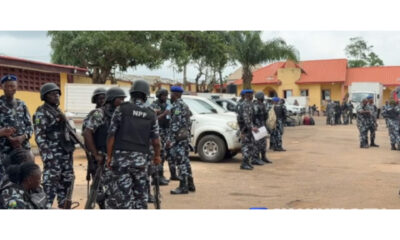
Meanwhile, operatives of the Nigeria Police, the Armed Forces, the Department of State Services, Nigeria Security and Civil Defence Corps and the Federal Road Safety Corps, among others, have taken over Eagle Square, venue of the inauguration.
Military personnel, police officers and other security agents deployed for the match past parade continued their dress rehearsals at the venue.
During a tour of the city centre by one of our correspondents, it was observed that major roads leading to the Central Area of the Federal Capital Territory were partially cordoned off by security operatives.
The Central Business District began to look like a ghost town due to the presence of heavy security operatives. Several helicopters were also seen hovering over the city for aerial surveillance on Friday and Saturday.
Similarly, vehicles belonging to the Presidential Guards Brigade and the Nigeria Police Force were seen moving around the city centre, blaring sirens.
Security at five-star hotels
At the Fraser Suites Hotel, one our correspondents observed the presence of four armed police officers stationed at the entrance and an NSCDC squad car in the parking lot and a couple of military officers in the hotel lobby on Saturday.
Hotel security officers conducted car bomb checks upon entry and also directed guests to go through the metal detectors, as well as put their luggage through the detectors.
Some foreign nationals, believed to be delegates of European and Asian countries were spotted moving in and out of major Abuja hotels. The front desk officer confirmed that the hotel was fully booked and would only be available after the inauguration.
At the Transcorp Hilton, several vehicles both of the Nigeria Police Force and the NSCDC were stationed at the junction of Aguiyi Ironsi Street where the hotel is located.




News
UK court jails Nigerian man for masturbating in front of a woman
British Transport Police said Odutola approached a woman on the train, looked her up and down and became aggressive when she refused to engage with him. He then exposed himself while sitting in a wheelchair and began masturbating while staring at the woman and telling her to “come over”

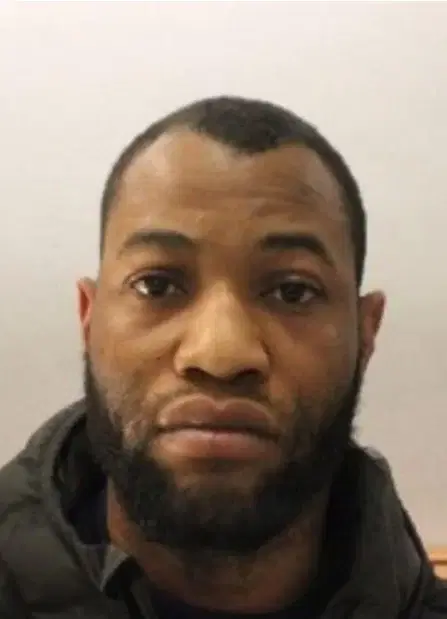
•A Nigerian man and registered sex offender, Babatunde Odutola
A Nigerian man and registered sex offender, Babatunde Odutola has been jailed in the UK after exposing himself and masturbating in front of a woman on a train travelling towards Manchester.
Odutola, 36, of no fixed address, was sentenced to 44 weeks in prison at Manchester Magistrates’ Court on Monday, September 14, after pleading guilty to outraging public decency and breaching a suspended sentence order.
The incident occurred around 7pm on Friday, September 11, on a train travelling through Cheshire towards Manchester Piccadilly railway station.
British Transport Police said Odutola approached a woman on the train, looked her up and down and became aggressive when she refused to engage with him. He then exposed himself while sitting in a wheelchair and began masturbating while staring at the woman and telling her to “come over”.
A fellow passenger intervened and escorted the distressed woman from the carriage.
According to police, CCTV footage showed Odutola continued masturbating as other passengers walked through the carriage.
British Transport Police officers arrested him after the train arrived at Manchester Piccadilly. He was subsequently prosecuted and jailed within 72 hours of the incident
News
Digital Economy Minister Says NDPC Now Properly Functional With New HQ
” An asset recovered on behalf of the Nigerian people has now been returned to productive use for the Nigerian people. That is reform made tangible,” he said .

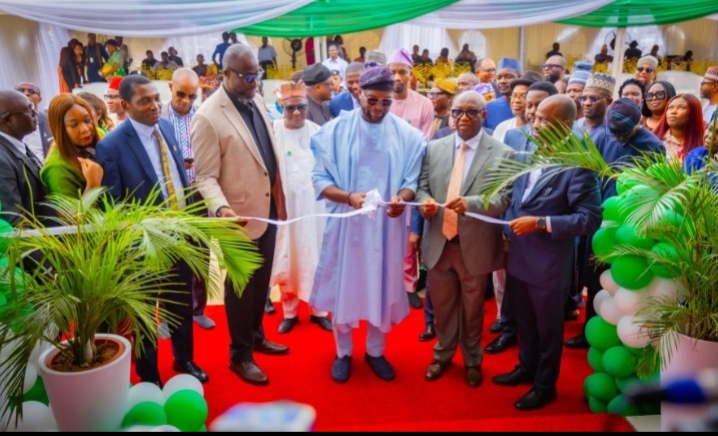
Abuja| NDPC new headquarters commission , Tuesday, 15 September,2026.
An EFCC-recovered property allocated to the Ministry of Communications, Innovation & Digital Economy, has been transformed to the new headquarters of the Nigeria Data Protection Commission (NDPC) in Abuja, as its headquarters.
Speaking during the commissioned ceremony of the building, the Honourable Minister incharge of the ministry, Dr. ‘Bosun Tijani, described the facility as a tangible demonstration of the visionary leadership of President Bola Ahmed Tinubu, and his commitment to building strong institutions that can support Nigeria’s growing digital economy.
The Minister emphasised that said the occasion represented more than the opening of a new office, but a reflection of the administration’s commitment to strengthening the institutions required to protect Nigerians and build trust in the country’s digital economy.
Dr. Tijani said, “Shortly after assuming office in 2023, President Tinubu signed the Nigeria Data Protection Act into law, giving the NDPC the appropriate legal foundation and authority to protect the data and privacy rights of Nigerians.
The President also directed Ministries, Departments and Agencies of the Federal Government to comply with established data protection laws and frameworks, demonstrating that government must lead by example in upholding the standards it expects from citizens and businesses.”
He added, “In the early days of the Commission, it was difficult to ask an institution to protect the data of over 200 million Nigerians and support one of Africa’s largest digital economies without the institutional resources to do so.
President Tinubu recognised this challenge and moved to solve it, approving the resources required for the NDPC to become properly operational and functional, while building towards becoming a sustainable institution in its own right.
He also directed that an EFCC-recovered property be allocated to the Commission as its headquarters.
“An asset recovered on behalf of the Nigerian people has now been returned to productive use for the Nigerian people. That is reform made tangible,” he said .

Boko Haram has strongly denied reports of a ceasefire agreement with the Federal Government and insisted that it will continue its campaign of attacks.
In a statement released by the group, the militants dismissed claims of any truce or negotiated pause in hostilities, describing such reports as false and misleading.
The group reaffirmed its commitment to ongoing operations against government forces and other targets, vowing that its attacks will persist without interruption.
The denial comes against the backdrop of persistent insecurity in the northeast and other affected regions, where the group has maintained a long-standing insurgency.
Security sources note that the latest statement appears aimed at clarifying the group’s position and rejecting any suggestion of dialogue or de-escalation with the authorities.
Military and government officials have not issued an immediate detailed response to the claim, though security operations against the militants remain active. Authorities continue to urge vigilance as the group signals its intention to sustain violence.


CBN, MOF sign pact to align monetary, fiscal policies

Macron Hosts Tinubu for Private Dinner at Élysée Palace (Photos)

Madonna Returns To MTV Video Music Awards, After 23 years

Tech Expert, Zuckerberg trains with UFC champions, Adesanya, Alexander

Organ Trafficking: Ekweremadu bags 10 years in UK prison

