News
WORLD PRESS FREEDOM DAY: NGE Says Press freedom crucial to Democracy, good governance

· Requests NASS to initiate law against abusive, strategic lawsuits
· Salutes journalists working under harsh economic conditions
Nigerian Guild of Editors (NGE) has reaffirmed that media freedom, freedom of expression and access to public information are crucial to democracy and must be at the heart of Nigerian government’s values and actions.
The professional body of editors and media executives in Nigeria also said that it recognizes the crucial role played by journalists, media workers and free/ independent media in protecting the country democracy and advised them not to give up, in spite of the prevailing economic challenges.
In a press statement issued on Thursday to mark this year World Press Freedom Day and signed by its President, Mr. Eze Anaba and the General Secretary, Dr Iyobosa Uwugiaren, the Guild also requested the National Assembly to initiate and adopt a law to protect journalists, who speak out on matters of public interest, especially against abusive and strategic lawsuits, which are regularly initiated to silence them.
This year, the World Press Freedom Day, is dedicated to emphasizing the importance of good journalism amidst the current global environmental crisis.
World Press Freedom Day is observed annually on May 3rd. Established by the United Nations General Assembly in 1993, this day helps to celebrate the fundamental principles of press freedom, assess the state of press freedom throughout the world, defend the media from attacks on their independence, and pay tribute to journalists who have lost their lives in the line of duty.
The day also acts as a reminder to governments of the need to respect and uphold the right to freedom of expression as enshrined in Article 19 of the Universal Declaration of Human Rights. It highlights the importance of a free, independent, and pluralistic media in fostering transparency, accountability and democracy.
‘’In line with the theme of this year celebration, we believe that journalism and freedom of expression are crucial in the context of the current global environmental crisis.
‘’Journalism and freedom of expression help in raising public awareness about environmental issues; holding power accountable; amplifying marginalized voices; promoting transparency and accountability; fostering public debate/engagement, and providing a platform for solutions’’, the editors added.
More importantly, the NGE added that this year’s World Press Freedom Day provides an opportunity for every stakeholder in the media community to continue to drum it to the hearing of both state and non-state actors – about the importance of press freedom and the challenges being faced by journalists, including censorship, harassment, imprisonment and violence. And the urgent need by the government to take deliberate and sustained action to promote press freedom and good journalism in the country.
According to the editors, ‘’The federal government will fundamentally be promoting the enabling environment for media to operate responsibly if it adopts a law to protect persons who speak out on matters of public interest against abusive lawsuits meant to silence them.
‘’The federal government should take a clue from the European Union and other democracies around the world, who have adopted similar laws to protect journalists and media houses against Strategic Lawsuit Against Public Participation (SLAPP suit).
‘’More so, there are still many obnoxious and anti-media laws in our statutory books that are targeted at journalists and media houses. The National Assembly (NASS) must take immediate step to repeal them.’’
The NGE also urged government at all levels, international organizations and civil society organization to protect and promote press freedom; ensure safety and security for journalists/media houses; and ensure that all restrictive laws and policies targeted at the media are repealed.
The NGE added, ‘’We celebrate the courageousness and commitment of journalists across the country, who continue to risk everything to bring us the truth and reliable/credible information. We also acknowledge the growing threats to press freedom – from violence and censorship to disinformation and economic pressures.
‘’We pay tribute to the journalists who have lost their lives or faced persecution, and we stand in solidarity with those under threat or attack and those who continue to work under very harsh economic conditions.’’
The editors said that they will continue to advocate for press freedom, freedom of expression and access to information, adding that they are crucial to good governance, democratic societies and fundamental human rights.


Former Delta State Governor Dr. Emmanuel Eweta Uduaghan is dead. He passed away on the morning of Monday, October 19, 2026, at the age of 71, after a period of illness.
A family statement announced his death, describing it as a devastating loss. Uduaghan, a medical doctor, served as Delta State Commissioner for Health (1999–2003) and Secretary to the State Government (2003–2007) before becoming governor from 2007 to 2015. He was known for contributions to infrastructure and human capital development in the state.
Delta State Governor Sheriff Oborevwori has expressed deep sadness over the passing. In a condolence message, he described Uduaghan as a detribalised leader whose service left a lasting mark on Delta State.
Oborevwori extended heartfelt condolences to Uduaghan’s wife, Roli, his children, the Uduaghan family, the Itsekiri nation, and the people of Delta State, praying for the peaceful repose of his soul.
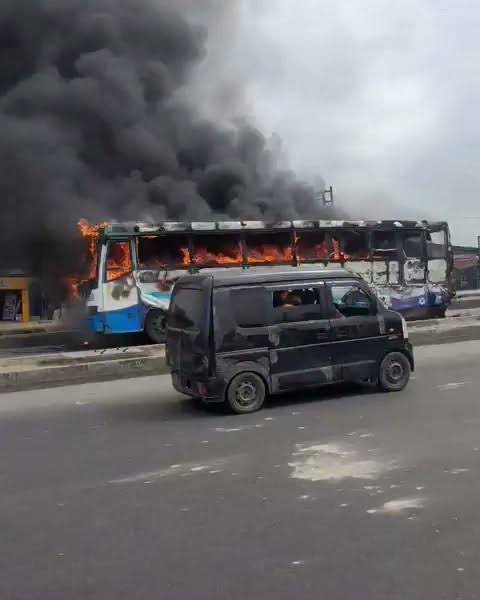
An angry mob has set a Bus Rapid Transit (BRT) bus on fire after it reportedly crushed a commercial motorcyclist to death at Ogolonto Bus Stop along Ikorodu Road in Lagos State.
The incident occurred on Friday, October 16, 2026. Eyewitness accounts and social media reports indicate that the motorcyclist was riding alone along the restricted BRT lane when the collision happened. He died at the scene.
Enraged residents and youths then attacked the bus driver and set the vehicle ablaze. Police officers and officials of the Lagos Neighbourhood Safety Corps (LNSC), who were nearby, intervened promptly and rescued the driver unharmed.
The identity of the deceased motorcyclist and the exact circumstances of the crash had not been officially confirmed at the time of filing this report. It was also unclear whether any arrests had been made in connection with the burning of the bus.
News
ARISE News Wins Seven Honours At Nigerian Broadcasters Merit Awards
The awards recognised the network’s achievements in television journalism and programming, with ARISE News winning the Best TV Channel (Viewer’s Choice) category.


• ARISE News Anchor and host of What’s Trending Ojy Okpe was named Best Newscaster (TV – Female)
ARISE News has emerged as one of the major winners at the just ended Nigerian Broadcasters Merit Awards (NBMA).
ARISE News won seven honours across television broadcasting, news reporting, presentation and production during the ceremony.
The awards recognised the network’s achievements in television journalism and programming, with ARISE News winning the Best TV Channel (Viewer’s Choice) category.
The network’s flagship breakfast programme, The Morning Show, also won the Best TV Talk Show award, further strengthening its recognition in television broadcasting.
ARISE News Anchor and host of What’s Trending Ojy Okpe was named Best Newscaster (TV – Female).
Rufai Oseni was named Nigerian Broadcaster of the Year (Male), while Vimbai Mutinhiri-Ekpeyong received the Nigerian Broadcaster of the Year (Female) award.
The recognition extended to the network’s newsroom, with Ovieteme George winning Best TV News Reporter (Male) for his contributions to television news reporting.
Behind the camera, Sam Adeyemi received the Best Camera Operator/Cinematographer award, recognising his work in television production and visual storytelling.


Mbappé wins Onze d’Or award for 2025/26 season

Ronaldo Gets 30-Day Suspension For Portugal Camp Walkout

JUST IN: Ex-Delta Gov Uduaghan Dies at 71, Oborevwori Mourns

BREAKING: Lagos Govt Declares Today, Thursday Work-Free to Mark 2026 Ìṣẹ̀ṣe Day

Tech Expert, Zuckerberg trains with UFC champions, Adesanya, Alexander