
Business
Taiwan Seeks Better Ties with Nigeria, following Tinubu’s St. Lucia Visit
We, the people and Government of Taiwan, wholeheartedly congratulate H. E. President Tinubu for his visions and concrete actions of extending Nigeria’s connection with the Caribbean Island state, just like Taiwan has made diplomatically with St. Lucia.


•Andy Yih-Ping Liu
TAIWAN’S Representative/ Head of Mission in Nigeria Andy Yih-Ping Liu has congratulated Nigeria’s fresh diplomatic engagements with St. Lucia and the Caribbean States.
Liu, in a statement yesterday, asserted that President Bola Ahmed Tinubu’s most successful state visit to the Caribbean nation of Saint Lucia was truly a landmark achievement in Nigeria’s diplomacy.
The statement reads: “We, the people and Government of Taiwan, wholeheartedly congratulate H. E. President Tinubu for his visions and concrete actions of extending Nigeria’s connection with the Caribbean Island state, just like Taiwan has made diplomatically with St. Lucia.
“Taiwan (ROC) and St. Lucia, as well as three other Caribbean island nations, St. Kitts and Nevis, St. Vincent and the Grenadines, and Haiti, have long established diplomatic relations with full-fledged embassies setting in each other’s capitals.
“Our diplomatic presence of embassies, together with Development and Technical Aid of medical, agricultural, women and youth empowering, trade and investment strengthening, sustainable development, etc., have truly assisted St. Lucia as well as other Caribbean nations to grow well economically and socially.”
Liu noted that during President Tinubu’s visit, he would have toured some facilities jointly developed by the Taiwanese government and St. Lucian authorities.
“We’re proud to offer our helping hands that produce fruitful results, and we certainly welcome wholeheartedly that Nigeria will also be joining this humanitarian and economic collaborations in the Caribbean area.
“We are extremely delighted to witness President Tinubu graciously receiving the conferment of Knight Commander of the Order of Saint Lucia (K.C.O.S.L.) in recognition of his efforts to strengthen ties between Africa and the Caribbean.
This has showcased His Excellency’s visionary exploration and escalation of Nigeria’s ever-growing international status, and his grand movements in deepening the collaboration with the Organisation of Eastern Caribbean States (OECS).
“Prime Minister Philip Pierre, that H. E. President Tinubu has met in St. Lucia, visited Taiwan to attend President Ching-Te Lai’s inauguration ceremony on May 20th, 2024.
Also, St. Lucia’s Senate President Madam Alvina Reynolds, that President Tinubu has also met, visited Taiwan to attend our National Day Celebrations on October 10th, 2024.
All these have demonstrated how cordially the diplomatic relations between Taiwan and St. Lucia have been, and our bilateral cooperation have truly showcased Taiwan is such an indispensible and healthy partner for St. Lucia, as well as other Caribbean nations.
“Taiwan (ROC) has survived the heavy pressure from across the Taiwan Strait, and flourished outstandingly in the world, both democratically and economically on nation building.
“We the Taiwanese people are privileged to share our advanced know-how and technology to any country globally, so that we can work together in weathering through all sorts of challenges.
It is therefore, once again, we would like to congratulate dearly for President Tinubu’s diplomatic achievements in his landmark State Visit to St. Lucia, and also sincerely express our goodwill for any future strengthening of Nigeria-Taiwan relations, either in this great nation of Nigeria or in our shared diplomatic allies of St Lucia and the Caribbean states.
“Taiwan remains humble and ready to share its vast knowledge with Nigeria in various fields of comparative advantages, and we would appreciate deeply that His Excellency President Tinubu and Nigeria to view and regard Taiwan as a most advanced and developed, healthy partner, to build substantial relations, like what we have contributed and collaborated in Saint Lucia,” he said.
Business
History of Naira Revaluation and Devaluation (1973–2026) (Part 2)
A distinction must be made between a temporary appreciation in the exchange rate and a sustained recovery in the currency’s purchasing power.

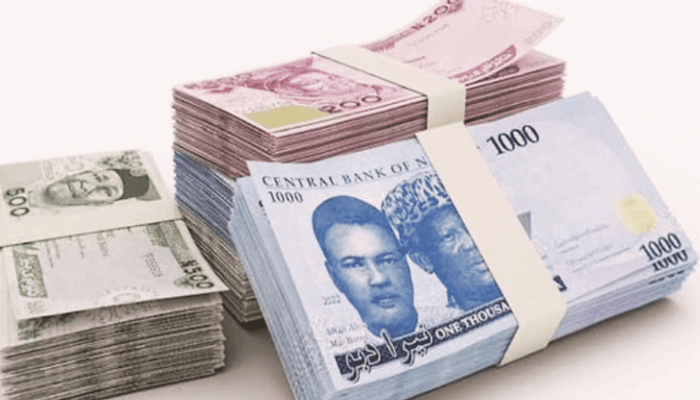
Timeline: 1989-2015
This week, we commenced a focus on the history of the Nigerian currency -the Naira, and why it rises and crashes. Continue reading:
- 1989–1992: Exchange-Rate Liberalisation
- The government continued experimenting with foreign-exchange arrangements.
- In 1989, bureaux de change were introduced to expand access to foreign currency.
- On March 5, 1992, Nigeria unified the official exchange rate with the parallel-market rate, moving the official rate from approximately ₦10.56 to ₦18 per dollar.
- The authorities subsequently moved towards a more fully market-determined exchange rate.
- These changes represented attempts to establish a more realistic exchange rate and narrow the gap between official and parallel-market prices.
- 1993–1995: Exchange-Rate Revaluation and Policy Reversals
- This period illustrates why an official strengthening of the naira does not necessarily mean the currency has recovered its underlying economic strength.
- In 1993, the government returned to a more controlled exchange-rate system.
- An IMF account records that the official rate was pegged at approximately ₦24.90 per dollar before being adjusted to around ₦22 per dollar.
- The naira was subsequently maintained at approximately ₦21.90 per dollar under the administered system.
- Although these changes strengthened the official rate relative to the immediately preceding auction rate, access to foreign currency remained constrained and exchange-rate distortions persisted.
- In 1994, the government further tightened control over foreign exchange and fixed the rate at approximately ₦22 per dollar.
- In 1995, the authorities introduced the Autonomous Foreign Exchange Market (AFEM), returning to a system in which market forces played a greater role in determining the exchange rate.
- Important distinction: An official revaluation can strengthen a published exchange rate without guaranteeing that individuals and businesses can obtain foreign currency at that rate.
1999–2009: Continued Depreciation, With a Temporary Recovery
Nigeria returned to civilian rule in 1999, but the naira continued to face pressure.
According to the CBN’s historical exchange-rate data, the average official exchange rate moved approximately as follows:

Chart: Naira To Dollar Exchange Rate 1999-2009
The naira experienced sustained depreciation during much of this period, although there were episodes of relative stability.
Nigeria’s dependence on crude oil, foreign-exchange demand and the management of external reserves remained important influences on the currency.
A distinction must be made between a temporary appreciation in the exchange rate and a sustained recovery in the currency’s purchasing power.
(Part 1): 1973-1986
The history of the Nigerian naira is marked by two major developments: periods when the currency gained value or was officially strengthened, and prolonged periods when it lost value against major international currencies, particularly the US dollar.
Since its introduction in 1973, the naira has undergone several exchange-rate policy changes, including fixed exchange rates, currency devaluations, foreign-exchange market liberalisation, attempts to unify exchange rates and market-driven depreciation.
The Central Bank of Nigeria (CBN) has played a central role in managing these changes.
- Introduction of the Naira in 1973
Nigeria introduced the naira on January 1, 1973, replacing the Nigerian pound.
The conversion rate was:
£1 Nigerian pound = ₦2.
₦1 = 10 shillings under the old currency system.
₦1 = 100 kobo.
The new currency was introduced during a period of expanding oil revenues and economic growth.
Nigeria initially maintained a relatively strong, managed exchange rate, supported by foreign-exchange controls and the country’s oil earnings.
The introduction of the naira was a currency change, not a devaluation.- The 1970s: A Relatively Strong Naira
During the 1970s, rising oil revenues strengthened Nigeria’s foreign-exchange position.
The government maintained a controlled exchange-rate system, initially linking the naira to the US dollar before moving to a basket of currencies representing major trading partners in 1978.
The oil boom provided foreign exchange for imports, infrastructure and public expenditure.
However, Nigeria’s dependence on crude oil revenues left the economy vulnerable to fluctuations in international oil prices.
Key development: The naira benefited from a relatively strong external position, although its exchange rate was managed by the authorities rather than determined by an unrestricted market.- The Early 1980s: Mounting Pressure on the Naira
The economic situation deteriorated in the early 1980s as oil revenues weakened and foreign-exchange shortages intensified.
Nigeria faced several economic challenges:
• Declining oil receipts.
• Rising import bills.
• Pressure on foreign reserves.
• Growing external debt and trade arrears.
• Increasing demand for foreign currency.
The government maintained controls on foreign exchange, but the official rate became increasingly disconnected from the rate at which foreign currency could be obtained in the parallel market.
This created pressure for exchange-rate reform.
The crisis set the stage for the introduction of the Structural Adjustment Programme (SAP) in 1986.- 1986: Major Naira Devaluation Under SAP
September 26, 1986, marked a turning point in the history of the naira.
Under the military government of General Ibrahim Babangida, Nigeria introduced the Second-Tier Foreign Exchange Market (SFEM) as part of the Structural Adjustment Programme.
The objective was to allow market forces to play a greater role in determining the naira’s exchange rate.
According to an International Monetary Fund account, the naira’s value was discounted by approximately 66 per cent at the inaugural SFEM auction.
The exchange rate moved from about ₦1.60 per US dollar under the previous administered rate to approximately ₦4.60 per dollar at the initial auction.
Why was the naira devalued?
The policy was intended to:
•Reduce the overvaluation of the naira.
•Improve the allocation of scarce foreign exchange.
•Encourage non-oil exports.
•Improve the competitiveness of Nigerian products.
•Reduce distortions in the foreign-exchange market.
However, the weaker currency also increased the naira cost of imported goods and production inputs.
The 1986 reform began a prolonged period of exchange-rate adjustments.- …To be continued
Business
Obasanjo Accuses Tinubu : “You Made Every Nigerian Poor By 300% Naira Devaluation”
The former President also rejected the argument that Tinubu needed more time to complete his reforms, saying he did not see the economy improving.
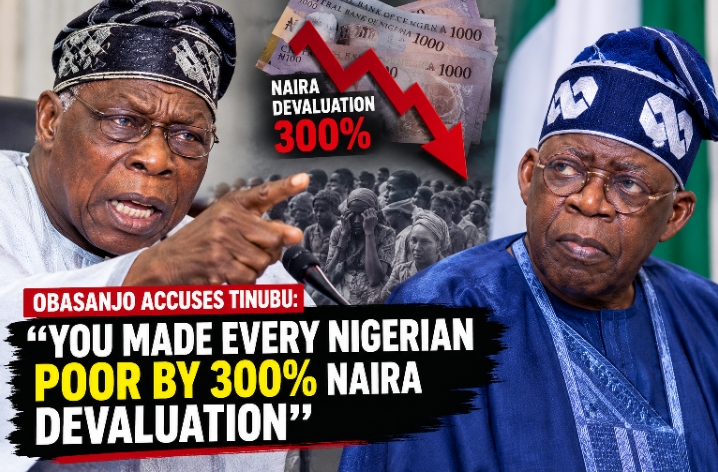
Image: AI generated
Former President Olusegun Obasanjo has accused President Bola Tinubu of making every Nigerian poor by 300 per cent through the devaluation of the naira.
Obasanjo spoke on Wednesday during the Financial Times Africa Summit 2026 in London, United Kingdom.
He said that the naira lost its value overnight due to economic reforms undertaken by the Tinubu administration in 2023.
“We do not live in isolation as a country. We interact with the rest of the world. And overnight, you devalue the currency by 300 per cent. The naira went from N500 to a dollar to N1,500 to a dollar. What that meant was that every Nigerian is made poor by 300 per cent.”
Obasanjo said that had made Nigeria “the poverty capital of the world,” which he said meant the country had the largest number of poor people in the world.
“You cannot say to me that that is good for Nigeria. You cannot say to me that that is good for us in any sense,” he noted.
The former President also rejected the argument that Tinubu needed more time to complete his reforms, saying he did not see the economy improving.


History of Naira Revaluation and Devaluation (1973–2026) (Part 2)

EBOLA: Lagos Heightens Watch at Airports After Abuja Case

JUST IN: Four Pilots Die After Mid-Air Collision of Military Planes in Philippine

BREAKING: Lagos Govt Declares Today, Thursday Work-Free to Mark 2026 Ìṣẹ̀ṣe Day

Tech Expert, Zuckerberg trains with UFC champions, Adesanya, Alexander

Organ Trafficking: Ekweremadu bags 10 years in UK prison
-

 Business3 days ago
Naira To Dollar, Pound, Euro… Today October 23
-
 Business3 days ago
Obasanjo Accuses Tinubu : “You Made Every Nigerian Poor By 300% Naira Devaluation”
-

 Entertainment3 days ago
JUST IN: Nollywood Veteran Francis Duru Dies at 57 After Brief Illness
-
 Business3 days ago
History of Naira Revaluation and Devaluation (1973–2026)
-

 News3 days ago
JUST IN: 1 Dead, 3 Rescued in Fadeyi Building Collapse, Lagos
-

 Business3 days ago
CBN Licences Abbey Bank to Start Full Commercial Banking in November 2026
-
 Politics2 days ago
2027 presidential election: Tinubu’s Northern test begins today
-
 Health2 days ago
Ebola patient in Abuja showing signs of recovery – FG