
International
ECOWAS Leaders Meet In Abuja As Region Struggles With Coups

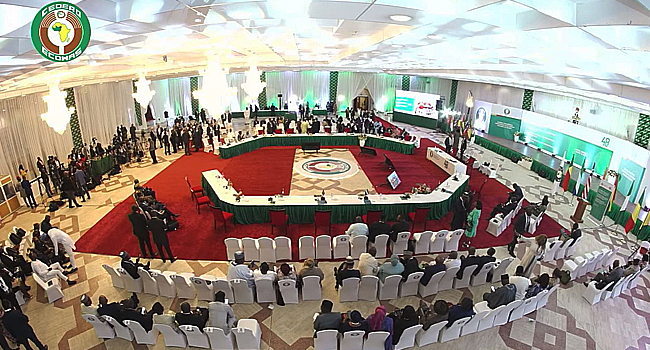
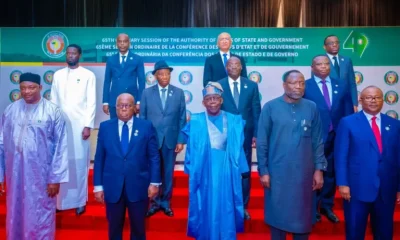
West African leaders meet on Sunday for talks with the region in deepening crisis, after four countries fell under military rule and with risks growing from Sahel jihadist conflicts.
After coups in Mali, Burkina Faso, Guinea and Niger since 2020, the Economic Community of West African States (ECOWAS) bloc also saw member states Sierra Leone and Guinea-Bissau claim attempted coups in recent weeks.
A French military withdrawal from the Sahel — the region along the Sahara desert across Africa — is increasing concerns over conflicts spreading south to Gulf of Guinea states Ghana, Togo, Benin and Ivory Coast.
“These military coups are not only based on fake narrative and false justifications; they are also a driver of insecurity in the region,” ECOWAS commission president Omar Touray said in a meeting before the summit.
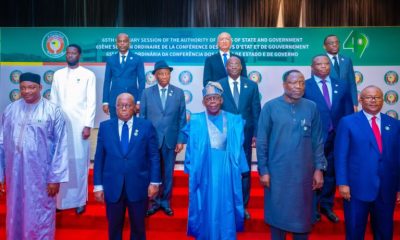
ECOWAS leaders will meet in Nigeria’s capital Abuja for an ordinary summit where they will discuss delayed transitions back to civilian rule for Mali, Burkina Faso, Guinea and Niger.
Nigeria’s President Bola Ahmed Tinubu is current chair of ECOWAS and US Assistant Secretary of State for African Affairs Molly Phee will also be at the meeting to discuss how to support Niger’s return to democratic rule and Sahel security.
Niger — a key Western partner in the fight against Sahel militants — has demanded French troops based there leave, while the US still has military personnel in the country.
ECOWAS members have imposed tough economic sanctions on the military regime in Niger, whose troops ousted President Mohamed Bazoum in July.
Mediator
ECOWAS has demanded Bazoum’s immediate return to the presidency, but the military junta has kept him in detention and says it may need up to three years for a return to civilian rule.
Earlier this month, Nigeria said it was asking the Niger regime to free Bazoum and allow him to fly to a third country, as a step to opening talks on lifting sanctions.
But Niger’s military leaders rejected that option and have asked Togo’s President Faure Gnassingbe to act as a mediator.
Before Sunday’s ECOWAS meeting, Niger’s military leader General Abdourahamane Tiani visited Togo on Friday with some of his ministers.
ECOWAS has also left on the table the last option of a military intervention in Niger though analysts say that appears increasingly unlikely.
Transitions back to democracy and elections have also been stalled or left uncertain in Mali, Burkina Faso and Guinea.
After French troops began leaving the region, military regimes in Niger, Mali and Burkina, struggling with jihadist violence, hardened their positions and joined forces in an Alliance of Sahel States.
Last month, armed attackers stormed military posts, prisons and police stations in another ECOWAS member Sierra Leone, in what the government called a coup attempt that killed 21 people.
A week later Guinea-Bissau also denounced an attempted coup, with fighting between the national guard and special forces of the presidential guard.
AFP






The Kenyan government has given foreign nationals operating businesses in the country 90 days to regularise their immigration status, work permits, business registrations and licences, following remarks by President William Ruto that triggered panic in immigrant communities and fears of xenophobic violence.
State House Spokesperson Hussein Mohamed announced the “orderly regularisation exercise” on Tuesday, saying relevant government agencies would work with foreign embassies to facilitate compliance. “Every person conducting business in Kenya is required to comply with applicable immigration, work-permit, registration and licensing requirements,” Mohamed said. Requirements will be administered “fairly, consistently and without discrimination” during the period. After the 90 days, the rules will be enforced “firmly and strictly in accordance with the law and due process.”
The move comes after Ruto’s comments last week that foreigners should not operate as hawkers or run small shops, which were widely seen as responding to complaints from Kenyan traders about competition in the informal sector. The remarks sparked anxiety, particularly among Burundian nationals who dominate street vending in parts of Nairobi. Hundreds queued at the Burundi embassy seeking travel documents amid concerns of a crackdown and possible attacks similar to recent xenophobic violence in South Africa. There were reports of at least one shop attack and instances of harassment or intimidation.
Mohamed explicitly warned that no individual or group has authority to harass, intimidate, threaten or interfere with foreign nationals or their businesses, stressing that enforcement is the sole responsibility of authorised state agencies. “Legitimate concerns about economic opportunity can never justify discrimination, excuse lawlessness or sanction violence,” the statement said. Kenya would remain “an open, secure and welcoming country” while protecting opportunities for its citizens, especially in the micro and small-enterprise sector.
Citizens of East African Community countries are eligible for free work permits, though many have not completed formal registration. The government has also directed that the Local Content Bill currently before Parliament be expanded to create a clearer framework identifying activities that may be reserved for Kenyans while protecting the rights of foreigners lawfully entitled to work, invest or trade.
The 90-day window is intended to allow an orderly process rather than immediate closures, offering temporary relief to affected communities while signalling stricter future enforcement.
International
Global media leader Annecchino dies at 55
Widely recognised as a transformative figure in global media, he was known for his strategic vision, entrepreneurial drive and ability to steer major organisations through periods of sweeping change.


|•Raffaele Annecchino
Raffaele Annecchino, the former President and CEO of Paramount International has died at the age of 55.
Widely recognised as a transformative figure in global media, he was known for his strategic vision, entrepreneurial drive and ability to steer major organisations through periods of sweeping change.
His career spanned more than 25 years at Paramount and ViacomCBS, starting in a commercial role in Madrid before rising to lead the company’s international operations across Europe, the Middle East, Africa, Latin America and Asia.
As CEO of Paramount International, Annecchino oversaw the company’s pivot from broadcast to digital, spearheading the international rollout of Paramount+, the global expansion of Pluto TV, and the creation of the SkyShowtime joint venture with Comcast.
He also built long-standing partnerships with major industry players, including Sky, Canal+, MultiChoice and Viaplay, and helped grow networks such as MTV, Nickelodeon, BET and Channel 5 in the UK, while backing production hubs across Africa, Asia, Europe and Latin America.
International
Meet The highest paid world leader
Lawrence Wong will see an increase of 1.4 million Singapore dollars ($1.1m; £818,000) in his annual pay package. He has said he will donate this pay increase to charity over the next five years.

•Lawrence Wong / BBC
Singapore’s government says it will raise the annual salaries of its ministers and other office holders, including its prime minister who is the highest paid political leader in the world.
Lawrence Wong will see an increase of 1.4 million Singapore dollars ($1.1m; £818,000) in his annual pay package. He has said he will donate this pay increase to charity over the next five years.
Wong said that raising the pay of ministers was necessary to attract better talent.
The government has previously argued that paying ministers high salaries deters corruption.
But the move has attracted criticism in Singapore where there is deep concern about job security and the rising cost of living.
Even before his pay raise kicks in, Wong is still by far the highest paid world leader.
He currently receives an annual salary of S$2.2m and will now see his pay go up by more than 60% to S$3.6m ($2.8m).
Next is Hong Kong chief executive John Lee, who earns about $719,000, followed by Switzerland’s president Guy Parmelin with $606,000.
US president Donald Trump earns $400,000 a year, while British PM Andy Burnham takes in $230,000.
On Tuesday, Wong acknowledged that Singapore ministers’ salaries have attracted scrutiny given that they were much more than what most citizens earn. The median monthly income in the country is S$5,775.
(BBC)


Bamanga Tukur, former Adamawa gov, ex-PDP Chair dies at 90

Bayelsa deploying 19 doctors, 210 nurses to strengthen primary healthcare centres

Albert Horsfall, Ex-SSS Director-General dies

Tech Expert, Zuckerberg trains with UFC champions, Adesanya, Alexander

Organ Trafficking: Ekweremadu bags 10 years in UK prison

SAINT OBI: Between his marriage and his death
-
 Politics3 days ago
Benue Politician,Terhemba Shija Vows To Bring Back Home Over 900,000 in IDP Camps
-
 News3 days ago
Police arrest 46 for obstruction of Obi’s convoy in Benue
-
 News3 days ago
JUST IN: One Dead, Many Feared Trapped as Two-Storey Building Collapses in Lagos
-
 Politics3 days ago
Trump promises $5,000 ‘dividend’ to U.S. citizens if Republicans win midterms
-

 News3 days ago
Lagos Confirms 6 Diphtheria Cases, Says no Outbreak
-

 Business3 days ago
Brent Holds Above $101bp
-
 Entertainment3 days ago
Rema to release new single ‘Oh No’ Friday
-
 Politics3 days ago
I will concede defeat if 2027 election is credible — Obi