
International
Over 15 Protesters Languish In Lagos Prison Three Years After #EndSARS – Amnesty

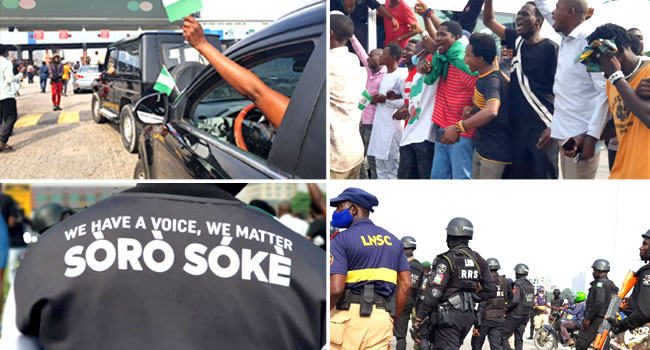
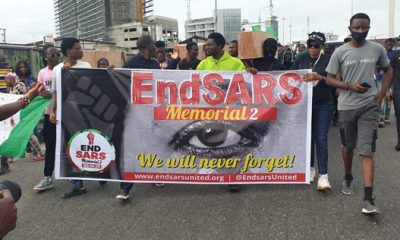
Amnesty International has said that a total of fifteen protesters arrested in 2020 are still being arbitrarily detained three years after the #EndSARS protest that took Nigeria by storm.
According to a statement by the international non-governmental organisation on the third anniversary of the protest, the majority of the protesters are in Kirikiri Medium Correctional Centre and Ikoyi Medium Security Correctional Centre in Lagos without trial.
It noted that the Nigerian authorities have filed trumped-up charges including theft, arson, possession of unlawful firearms, and murder against many of the protesters, adding that some of those detained alleged that they had been subjected to torture.
“Our investigation shows the Nigerian authorities’ utter disdain for human rights. Three years in detention without trial is a travesty of justice. This shows the authorities’ contempt for due process of law. The protesters must be immediately and unconditionally released,” said Isa Sanusi Director of Amnesty International Nigeria.
Seven #EndSARS protesters – Daniel Joy-Igbo, Sodiq Adigun, Sunday Okoro, Olumide Fatai, Oluwole Isa, Shehu Anas, and Akiniran Oyetakin – arrested in Lagos in 2020, are being arbitrarily held in Kirikiri Medium Correctional Centre, Amnesty International said.
Daniel Joy-Igbo, a Beninois #EndSARS protester arrested in Lagos in October 2020, who has also been detained at the Bar Beach Police Station, the State Criminal Investigation Department in Panti, and at a SARS facility in Ikeja, told Amnesty International:
“Since my arraignment in December 2020, I have been locked up in the prison without trial. Since then, there has been no adjourned date for my case. I have not been taken to court since December 2020.”
Sodiq Adigun, also arrested in October 2020, who was previously detained at the State Criminal Investigation Department in Panti, told Amnesty International:
“Let the government release me. I have been detained since 2020 without trial. I am innocent. My life has been shattered. I need my liberty.”
Eight #EndSARS protesters – Segun Adeniyi, Onuorah Odih, Jeremiah Lucky, Gideon Ikwujomah, Irinyemi Olorunwanbe, Quadri Azeez, Olamide Lekan and Sadiq Riliwan – have been detained without trial in Ikoyi Medium Security Correctional Centre in Lagos since 2020.
“All those detained solely for taking part in peaceful #EndSARS protests must be released immediately and unconditionally,” said Isa Sanusi
Torture in detention
The Amnesty International report added that many peaceful #EndSARS protesters have been subjected to torture and other ill-treatment while in detention since 2020.
They include Oluwole Isa, currently held in Kirikiri Medium Correctional Centre, who told Amnesty International how he was tortured while in detention at the SARS facility in Ikeja:
“I was tied with a rope. They bent me backwards and tied my hands and legs together at my back. An iron rod was passed in between my tied legs and hands. With the iron road, I was suspended on an iron bar. Then, they started beating me with a machete and wooden batons. They were forcing me to admit that I was involved in vandalism during the #EndSARS protests. When I could not bear the torture anymore, I told the Inspector that I would confess. At that point, I was almost going to die. He brought me down; I still have the scar of the machete cut on my throat …”
Resurgence of police brutality
The report by Amnesty International also noted that despite consistent claims of carrying out comprehensive police reforms in the aftermath of #EndSARS protests, Nigeria’s police continue to routinely commit violations of human rights, including extrajudicial killings, harassment, arbitrary detention, and extortion with almost absolute impunity, said Amnesty International Nigeria.
The organisation said in the past year alone, it has documented the unlawful killing of at least six people by law enforcement officers.
These include 31-year-old Gafaru Buraimoh, who was killed in Lagos on 6 December 2022, and Onyeka Ibe, who was killed on 5 April 2023 in Delta state for refusing to pay a N100 bribe.
Other cases include Faiz Abdullahi, who died in police custody in Kaduna on 30 July 2023 following torture during interrogation, and 17-year-old student Abdullahi Tukur Abba, who died in hospital after allegedly being tortured in police custody in Yola Adamawa state on 5 August 2023.
“Any changes that followed the #EndSARS protests are fast disappearing, as police brutality is again becoming a daily part of life for people across Nigeria. The recent cases of extrajudicial killings and extortion show that the police are not ready to conduct their duties in compliance with international human rights standards. Reforming the Nigeria police force will continue to be a distant dream if impunity remains part of policing operations,” said Isa Sanusi Director of Amnesty International Nigeria.
Amnesty International in its release, admonished the Nigerian authorities to take concrete and effective measures to end police impunity, including by giving clear directives to the police not to violate human rights, adding that those suspected of violating human rights should be brought to justice in fair trials and without recourse to the death penalty.
It called for genuine reforms to be initiated to end widespread human rights violations by the police, as Nigerians have an obligation to ensure that torture and other ill-treatment are not carried out under any circumstances.
Background
On 8 October 2020, Nigerians took to the streets protesting atrocities by the notorious Special Anti-Robbery Squad (SARS) which was a unit of the Nigeria Police established to fight violent crimes.
While number of casualties of the #EndSARS protest has always been contentious, a leaked memo by the Lagos State government earlier in the year revealed the approval of N61,285,000 for the mass burial of 103 persons identified as 2020 EndSARS victims.
According to Amnesty International, at least 12 peaceful protesters were killed in Alausa and Lekki Lagos by security operatives 20 October 2020. It added that at least 56 people have died across the country during the protests.
It said victims include protesters and thugs who were allegedly hired by the authorities to confront the protesters. In many cases, law enforcement and security forces used excessive force in an attempt to control or stop the protests.
However, in its explanation to its leaked memo dated July 19, 2023, the Lagos government maintained that the victims to be buried were not from the controversial Lekki Tollgate shooting.
The government argued that the victims were from incidents of violence that occurred in the aftermath of the EndSARS protests.




The Kenyan government has given foreign nationals operating businesses in the country 90 days to regularise their immigration status, work permits, business registrations and licences, following remarks by President William Ruto that triggered panic in immigrant communities and fears of xenophobic violence.
State House Spokesperson Hussein Mohamed announced the “orderly regularisation exercise” on Tuesday, saying relevant government agencies would work with foreign embassies to facilitate compliance. “Every person conducting business in Kenya is required to comply with applicable immigration, work-permit, registration and licensing requirements,” Mohamed said. Requirements will be administered “fairly, consistently and without discrimination” during the period. After the 90 days, the rules will be enforced “firmly and strictly in accordance with the law and due process.”
The move comes after Ruto’s comments last week that foreigners should not operate as hawkers or run small shops, which were widely seen as responding to complaints from Kenyan traders about competition in the informal sector. The remarks sparked anxiety, particularly among Burundian nationals who dominate street vending in parts of Nairobi. Hundreds queued at the Burundi embassy seeking travel documents amid concerns of a crackdown and possible attacks similar to recent xenophobic violence in South Africa. There were reports of at least one shop attack and instances of harassment or intimidation.
Mohamed explicitly warned that no individual or group has authority to harass, intimidate, threaten or interfere with foreign nationals or their businesses, stressing that enforcement is the sole responsibility of authorised state agencies. “Legitimate concerns about economic opportunity can never justify discrimination, excuse lawlessness or sanction violence,” the statement said. Kenya would remain “an open, secure and welcoming country” while protecting opportunities for its citizens, especially in the micro and small-enterprise sector.
Citizens of East African Community countries are eligible for free work permits, though many have not completed formal registration. The government has also directed that the Local Content Bill currently before Parliament be expanded to create a clearer framework identifying activities that may be reserved for Kenyans while protecting the rights of foreigners lawfully entitled to work, invest or trade.
The 90-day window is intended to allow an orderly process rather than immediate closures, offering temporary relief to affected communities while signalling stricter future enforcement.
International
Global media leader Annecchino dies at 55
Widely recognised as a transformative figure in global media, he was known for his strategic vision, entrepreneurial drive and ability to steer major organisations through periods of sweeping change.


|•Raffaele Annecchino
Raffaele Annecchino, the former President and CEO of Paramount International has died at the age of 55.
Widely recognised as a transformative figure in global media, he was known for his strategic vision, entrepreneurial drive and ability to steer major organisations through periods of sweeping change.
His career spanned more than 25 years at Paramount and ViacomCBS, starting in a commercial role in Madrid before rising to lead the company’s international operations across Europe, the Middle East, Africa, Latin America and Asia.
As CEO of Paramount International, Annecchino oversaw the company’s pivot from broadcast to digital, spearheading the international rollout of Paramount+, the global expansion of Pluto TV, and the creation of the SkyShowtime joint venture with Comcast.
He also built long-standing partnerships with major industry players, including Sky, Canal+, MultiChoice and Viaplay, and helped grow networks such as MTV, Nickelodeon, BET and Channel 5 in the UK, while backing production hubs across Africa, Asia, Europe and Latin America.
International
Meet The highest paid world leader
Lawrence Wong will see an increase of 1.4 million Singapore dollars ($1.1m; £818,000) in his annual pay package. He has said he will donate this pay increase to charity over the next five years.

•Lawrence Wong / BBC
Singapore’s government says it will raise the annual salaries of its ministers and other office holders, including its prime minister who is the highest paid political leader in the world.
Lawrence Wong will see an increase of 1.4 million Singapore dollars ($1.1m; £818,000) in his annual pay package. He has said he will donate this pay increase to charity over the next five years.
Wong said that raising the pay of ministers was necessary to attract better talent.
The government has previously argued that paying ministers high salaries deters corruption.
But the move has attracted criticism in Singapore where there is deep concern about job security and the rising cost of living.
Even before his pay raise kicks in, Wong is still by far the highest paid world leader.
He currently receives an annual salary of S$2.2m and will now see his pay go up by more than 60% to S$3.6m ($2.8m).
Next is Hong Kong chief executive John Lee, who earns about $719,000, followed by Switzerland’s president Guy Parmelin with $606,000.
US president Donald Trump earns $400,000 a year, while British PM Andy Burnham takes in $230,000.
On Tuesday, Wong acknowledged that Singapore ministers’ salaries have attracted scrutiny given that they were much more than what most citizens earn. The median monthly income in the country is S$5,775.
(BBC)


Dangote Refinery IPO: SEC Warns Investors, ‘Don’t Pay Into Wrong Hands’

Again, Desmond Elliot begs political mentor,Gbajabiamila , “I’m sorry, Daddy”
Dangote at IPO Listing, Charges Public,”I don’t want to be called richest man in Africa”

Tech Expert, Zuckerberg trains with UFC champions, Adesanya, Alexander

Organ Trafficking: Ekweremadu bags 10 years in UK prison

SAINT OBI: Between his marriage and his death
-
 News2 days ago
Bamanga Tukur, former Adamawa gov, ex-PDP Chair dies at 90
-
 Business21 hours ago
Filling Stations Selling Petrol, Diesel Higher Driven By Global Crude Prices
-
 Business18 hours ago
Naira Exchange Rates To Dollar, Pound , Euro… September 14
-
 Business19 hours ago
Dangote Refinery’s IPO Officially Opens Today On NGX
-
 Business17 hours ago
Dangote at IPO Listing, Charges Public,”I don’t want to be called richest man in Africa”
-
 Politics15 hours ago
Again, Desmond Elliot begs political mentor,Gbajabiamila , “I’m sorry, Daddy”
-
News10 hours ago
Dangote Refinery IPO: SEC Warns Investors, ‘Don’t Pay Into Wrong Hands’