Business
Aliko Dangote Celebrates African Young Global Leaders
President, and Chief Executive Officer of the Dangote Group, Aliko Dangote, learned about the Forum of Young Global Leaders (YGLs) and the tremendous potential of this unique World Economic Forum community to develop the next generation of African leaders from all parts of society, at the World Economic Forum Annual Meeting 2011 in Davos, Switzerland.
The Young Global Leaders programme is an accelerator for a dynamic community of exceptional young people from all over the world with the vision, courage, and influence to drive positive change in the world. This philosophy aligned neatly with Aliko Dangote’s vision for an Africa whose people are healthier, better educated, and more empowered through enhanced opportunities for social change through strategic investments that improve health and wellbeing, promote quality education and broaden empowerment opportunities for individuals and communities.

He, therefore, through Aliko Dangote Foundation, (ADF) partnered with the Forum to establish the Aliko Dangote African Fellowship programme to guarantee the full engagement of young African leaders from small and medium enterprises (SMEs) and non-business entities who might otherwise not be able to participate in the Forum’s Young Global Leaders Community. The fellowship covers the cost of their participation at World Economic Forum and YGL-led events for 6 years for each Fellow.
Now in the twelfth year of collaboration with the WEF YGL programme, the Aliko Dangote (WEF Africa YGL) Fellows continue to represent the continent on the global stage and give back to their communities in a multiplicity of impactful ways. The partnership has ensured a richness in the diversity of the YGL community – adding an important African perspective, inspiring impact, and making sure that all voices have a chance to be heard where global decisions are debated, discovered, and made.
Since the start of the WEF YGL programme 20 years ago, the World Economic Forum nominates up to two hundred exceptional young leaders under 40 for a six-year period of membership. Following the partnership with Dangote 12 years ago, the programme has included 15-20 young leaders from sub-Saharan Africa following a rigorous selection process. At any one time, the African YGL Community consists of around eighty active members, 75% of whom are eligible for the Dangote Fellowship.
Fatima Aliko Dangote, ED Dangote Industries, expressed pride at the diversity and high proportion of female fellows in the 2023 Cohort, where the nine chosen YGLs represent the media/arts/entertainment, technology & innovation, health, and government sectors.
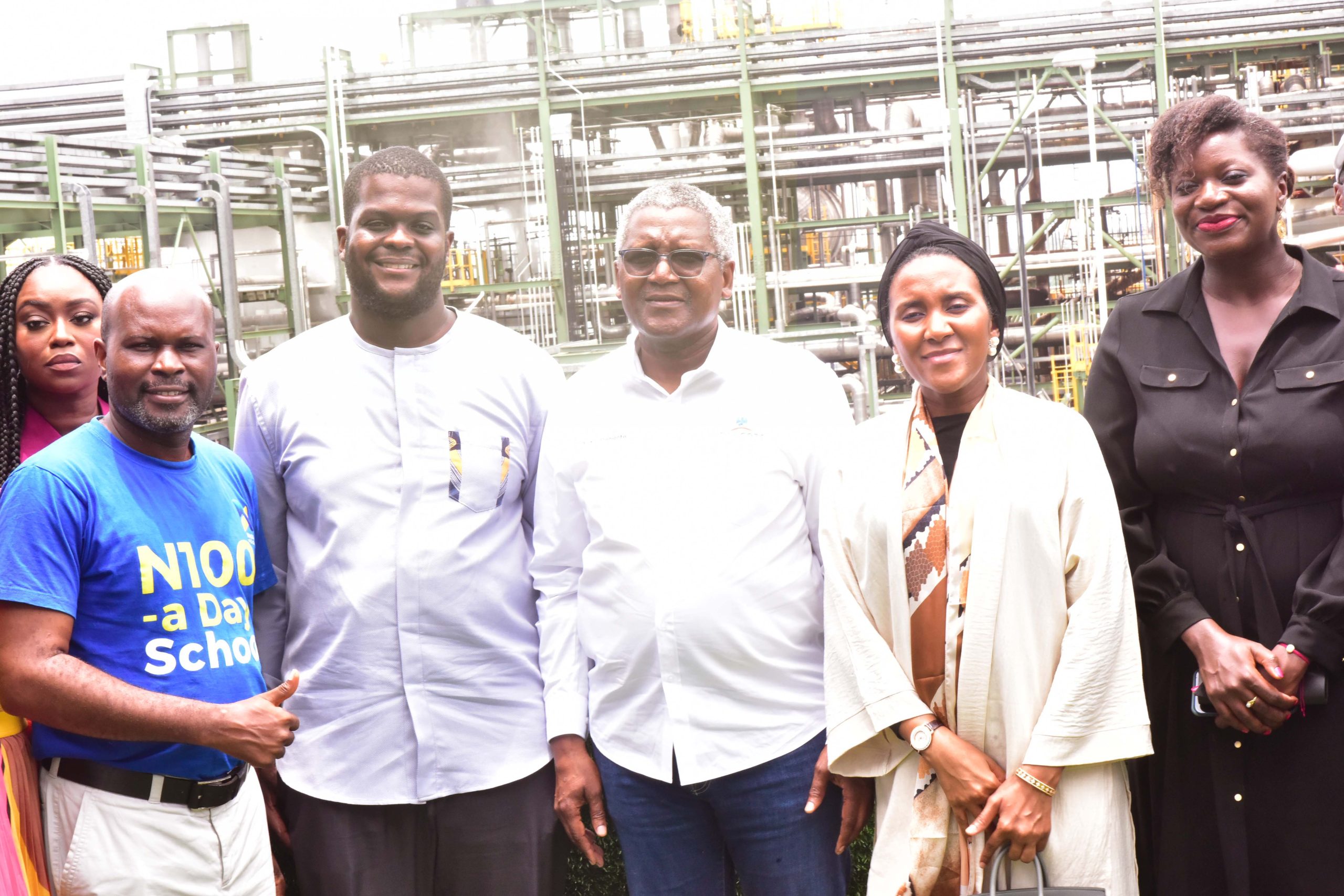
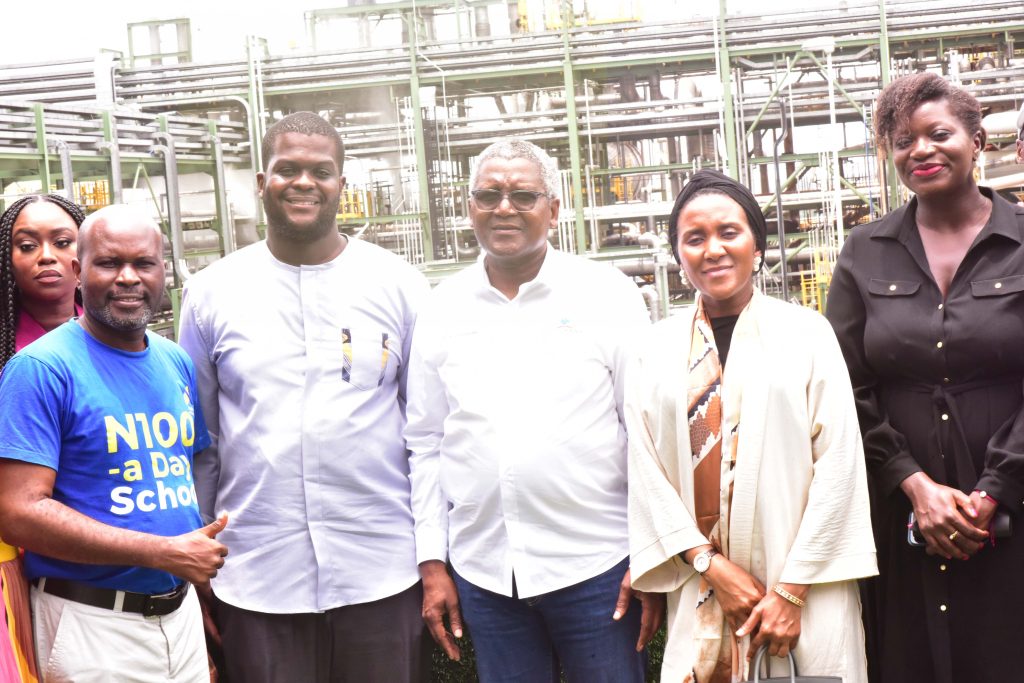
The ADF-YGL Lagos Convening which took place on September 8th, was an excellent opportunity for the participating current and alumni YGL Africa Fellows to meet and interact with their patron, Alhaji Aliko Dangote at the site of his most ambitious project to date; the multi-billion-dollars Petroleum complex at Lekki. They were able to interact with Alhaji Aliko Dangote and senior executives of Dangote Group and be inspired by his vision and engage in informal conversation about their journey as YGLs and the impact the community has had on their personal and professional development.

After a tour of the Fertilizer and the Refinery complex, the immensely impressed alumni’ were full of praise for their mentor, describing him as “the best hope for Africa”.
Aliko Dangote YGL Alum and Executive Director, of African Youth Initiative Network, Victor Ochen from Uganda, said he was extremely impressed with what he saw at the refinery and that the aggressive investment in the project has shown how much faith Aliko Dangote has in the African continent. While lauding Dangote’s investment drive, he also appreciated him for his generosity in providing financial means for him to participate in forum events he otherwise would have been unable to do.
According to him: “I am so happy with what Dangote is doing in Nigeria and Africa as a whole. This is a man that is investing in the youth through his foundation and employing tens of thousands of Africans, in his various plants. I am so humbled to be here, and to learn from the expertise of this man whom God has blessed our continent with…I thank Dangote for his generosity, which has provided many young African leaders, regardless of the country, the much-needed financial means to participate in YGL events. Without the support of ADF, our active participation would not have been possible.”

In the same vein, Fatoumata Ba from Senegal, said this trip to the Refinery has further fueled her ambition to put in all it takes into what she does and make Africa proud the way Dangote is doing. Ba, a Tech Entrepreneur & VC Investor is currently the Founder & Executive Chair of Janngo Capital and Chairwoman of the Board of Auchan in Africa. Explaining what she does and how YGL has impacted her positively, she said her company, Janngo is Africa’s largest gender equal tech fund and is backed by top-tier African & International strategic and financial investors; a journey that was made possible through her participation in the YGL programme.
She said: “Being a YGL has not only been a great opportunity to amplify our dreams but also an opportunity to promote a culture of peace and growth. We are committed to developing and representing Africa with integrity.”
Managing Director/CEO of the Aliko Dangote Foundation (ADF), Zouera Youssoufou, thanked Dangote for his continuous support of the YGLs, and assured him that his investment is not in vain, as the young global leaders are achieving exploits in their respective fields and living up to the expectations of being true African future leaders.
Dangote encouraged the YGLs to put in their best in their various fields and not be discouraged when setbacks occur, because those are to be expected. He encouraged them to continue raising their ambition for our continent because “Nothing is Impossible”.
Business
Nigeria’s economy may be back from the brink — The Economist
Improvements in macroeconomic stability are restoring investor confidence.
• President Bola Tinubu
A spate of painful reforms is beginning to show results.
When nigeria returned to civilian rule in 1999, Olusegun Obasanjo, the elected president, set out to clean up the economy after years of mismanagement by military governments.
Initially dismissed by critics, by the end of his second term Mr Obasanjo’s liberal policies had tamed inflation, spurred investment and raised annual gdp growth to around 7 percent.
It didn’t last. Over the past decade gdp per person has fallen.
Yet evidence is now mounting that another stretch of “golden years”, as one analyst calls the period following Mr Obasanjo’s liberalisation, may be on the cards.
In the past two and a half years Bola Tinubu, who in Mr Obasanjo’s day was the governor of Lagos and was elected president in 2023, has been enacting his own set of structural reforms.
As he gears up to run for a second term in 2027, they may be starting to pay off.
It is difficult to overstate the mess Mr Tinubu inherited.
When he took office in 2023, the country’s central bank had $7 billion (equivalent to 1.4% of gdp at the time) in obligations it could not meet, prompting international investors to flee en masse.
The bank’s credibility had been dented by a recklessly loose monetary policy, its mismanagement of dwindling foreign-exchange reserves and efforts to maintain an unsustainable tiered exchange-rate system.
Poverty has risen. But it looks as though Mr Tinubu’s bitter medicine is helping.
In 2022 alone the cash-strapped government spent some $10 billion, equivalent to 2.2% of gdp, on a ruinous fuel subsidy.
To fix things, Mr Tinubu’s government got on with a package of drastic structural reforms. It abolished the fuel subsidy and abandoned that multi-tiered system of dollar-pegged exchange rates, largely allowing the naira to float.
The Central Bank aggressively tightened monetary policy to curb the resulting bout of inflation.
The government also moved to improve security in the Niger Delta and offered a range of tax incentives to investors to boost dwindling oil production.
Nearly three years on, Nigeria’s 230 million people, especially the poor and the middle class, are still reeling from increases in fuel and food prices.
Poverty has risen. But it looks as though Mr Tinubu’s bitter medicine is helping.
The annual inflation rate, which hit a nearly 30-year high of 34.8% in December 2024, fell to 15.2% in December 2025.
Growth is returning.
The IMF expects the economy to expand by 4.4% in 2026.
Following two steep devaluations in 2023, the naira has stabilised (see chart).
The Central Bank’s foreign-exchange reserves have risen to $46 billion, their highest level in seven years.
Improvements in macroeconomic stability are restoring investor confidence.
On January 22nd Shell, a British company, said it hopes in 2027 to finalise plans, with partners, to develop a $20 billion offshore oilfield that has been sitting untapped for over 20 years.
Exxon Mobil, an American firm, has committed $1.5 billion to deep water development until 2027.
Local business leaders are more upbeat, too.
Oil-and-gas production is rising, much of it driven by local firms plugging leaks and improving output in onshore projects in the Niger Delta, which has become safer thanks to Mr Tinubu’s focus on security there.
All this should give the government some fiscal breathing room, particularly as the cheaper naira begins to raise the competitiveness of Nigeria’s non-oil exports such as cocoa and cashew nuts.
Recent reforms to taxation and tax collection, Mr Tinubu’s latest project, should help improve revenues further in the coming years.
Falling inflation should eventually begin to ease the cost-of-living pain.
However, even optimists have plenty of reasons to be cautious.
Savings from the fuel subsidy have largely been spent on servicing the public debt, which is still rising as the government continues to borrow against future sales of oil to fund its deficit.
Currently, some 60% of revenues are consumed by debt service.
On January 20th Nigeria’s finance minister said the government hoped to borrow less this year, but current budget projections suggest that is not realistic.
“The government is broke.
There’s nothing to invest in the future, that’s the truth,” says Esili Eigbe of Escap, a Nigerian consultancy.
Unless the government cuts civil-service salaries, another big chunk of spending, or is able to restructure loans to make them cheaper, the extra revenue from recent tax reforms looks unlikely to be available for improving infrastructure or to pay for public health care and education.
“They’ve brought the deficit down, but they don’t seem to show any greater ability to get capital projects out of the door,“ says David Cowan, an economist at Citi, an American bank.
All this means that it will take a long time for ordinary Nigerians, who until now have mostly borne the pain of Mr Tinubu’s reforms, to feel any benefit.
Buying food has been a particular struggle, not just for the 42% of Nigerians who live on less than $3 a day, the World Bank’s definition of extreme poverty, but also for the urban middle class.
The price of a kilo of rice has nearly quadrupled since May 2023, while wages have barely budged.
Even though inflation is now falling, many still struggle to afford enough to eat.
Mr Obasanjo’s reforms in the early 2000s aimed to increase economic dynamism and improve people’s lives by attracting fresh capital investment into newly privatised sectors.
By the end of his second term in 2007, domestic companies were worth $85 billion, up from $3 billion in 1999.
Mr Tinubu, by contrast, has so far focused on restoring stability and reviving the country’s ailing oil-and-gas sector. To bring about more golden years for Nigerians, he needs to go beyond that. ■
Credit: The Economist
Business
FOBTOB seeks fresh dialogue over ban on alcohol in sachets and PET bottles
Therefore, while NAFDAC states that factories will not be shut down, the policy will result in economic shutdown, particularly for indigenous manufacturers and informal-sector participants.
Food, Beverages and Tobacco Senior Staff Association (FOBTOB) said on Thursday that the NAFDAC’s blanket ban on satchets alcohol is economically destructive.
FOBTOB, there call out for a fresh dialogue comprising the stakeholders in the industry, the National Assembly, the Federal Ministry of Health, NAFDAC and Civil society organizations to engage in open, transparent, and evidence-based dialogue aimed at crafting policies that protect public health without destroying livelihoods or creating regulatory contradictions.
Reacting to a press release issued by the Director-General of the National Agency for Food and Drug Administration and Control (NAFDAC) today regarding the enforcement of a ban on alcoholic beverages packaged in sachets and small containers below 200ml, FOBTOB President, Jimoh Oyibo, disclosed that while the association acknowledge and fully supports the shared objective of protecting children, adolescents, and vulnerable populations from the harmful use of alcohol
“We must express deep concern that the approach adopted by NAFDAC is disproportionate, economically disruptive, and inconsistent with broader regulatory and public health realities in Nigeria,” he said.
PUBLIC HEALTH IS IMPORTANT — BUT POLICY MUST BE BALANCED AND EVIDENCE-BASED
No reasonable stakeholder disputes that excessive alcohol consumption is harmful.
However, public health challenges require holistic, data-driven, and enforceable solutions, not blanket prohibitions that fail to address root causes.
Alcohol abuse among minors is primarily a challenge of effective enforcement, parental responsibility, public education, and social regulation, rather than one of packaging format.
The size of an alcohol container does not in itself, confer safety, nor does increasing pack sizes prevent access by minors.
The global public health evidence consistently demonstrates that behavioural regulation, age-restriction enforcement, education-driven interventions, and appropriate sanctions are more effective in addressing underage alcohol consumption than blanket product bans.
NAFDAC’S CLAIM ON UNINTERRUPTED COMPANY OPERATIONS – CONTRADICTED BY EVIDENCE
Notwithstanding representations made by affected stakeholders, access to these depots has not been restored by NAFDAC, and this is affecting normal business operations negatively.
As a labour union, the livelihoods of our members will be adversely affected by the closure of manufacturers’ depots.
We have compiled records of these enforcement actions for reference and ongoing engagement, which are presented alongside this article.
ECONOMIC AND SOCIAL CONSEQUENCES CANNOT BE IGNORED
For many indigenous distillers, blenders, and distributors, sachet and sub-200ml packaging does not constitute a marginal segment of their operations but rather is the foundation of the core business model.
These packaging formats were intentionally developed to serve low-income consumers, informal retail channels, and rural markets where considerations such as affordability, portability, and unit pricing determine demand.
Also, the claim that the policy only affects “two packages” does not fully convey the magnitude of the impact.
In operational terms:
Production lines are configured specifically for sachet and small-format bottling.
Distribution networks are optimized for high-volume, low-unit sales
Retail reach is largely dependent on maintaining affordability at the lowest price points.
For many small and medium-scale operators, this transition will not be financially attainable.
Therefore, while NAFDAC states that factories will not be shut down, the policy will result in economic shutdown, particularly for indigenous manufacturers and informal-sector participants.
The ban on sachets and small containers below 200ml also risks tilting the market in favour of larger, better-capitalized multinational players who can absorb retooling costs and pivot to premium pack sizes.
Smaller local producers, who rely overwhelmingly on sachet sales, are disproportionately harmed, raising concerns about market concentration and unfair competitive outcomes.
Public health and economic survival are not mutually exclusive.
Nigeria deserves policies that are balanced, humane, enforceable, and fair.
The solution lies in moderation, education, and enforcement, not in policies that punish many while failing to address the real drivers of abuse.
SIGNED BYJIMOH OYIBONATIONAL PRESIDENT FOOD, BEVERAGE AND TOBACCO SENIOR STAFF ASSOCIATION (FOBTOB
Business
We ban alcohols in retail satchets for national interest – Prof Adeyeye
Placing a label to read not for children on the sachets and the small containers will not work. It cannot be enforced because of the peculiarity of the society.
The National Agency for Food and Drug Administration and Control (NAFDAC) declared on Thursday that it only ban alcohol in sachet and small containers less than 200ml, and didn’t close down any company in the sector.
“The aim of the ban is to protect vulnerable population such as children and the youth,” said Prof Mojisola Christianah Adeyeye, Director-General, NAFDAC, asserting:”This ban is not punitive; it is protective.”
In a statement , the NAFDAC DG, emphasised that the ban was in line with the recent directive of the Senate of the Federal Republic of Nigeria, and backed by the Federal Ministry of Health and Social Welfare, underscores the agency’s statutory mandate to safeguard public health and protect vulnerable populations particularly children, adolescents, and young adults from the harmful use of alcohol.
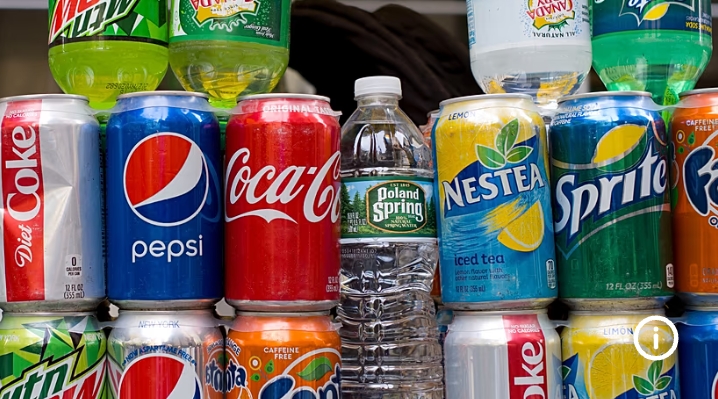
The proliferation of high-alcohol-content beverages in sachets and small containers less than 200 ml has made such products easily accessible, affordable, and concealable, leading to widespread misuse and resultant addiction among minors and some commercial drivers.
This public health menace has been linked to increased incidences of domestic violence, road accidents, school dropouts, and social vices across communities.
Placing a label to read not for children on the sachets and the small containers will not work. It cannot be enforced because of the peculiarity of the society.
Many parents dont know their children take alcohol in sachet because the pack size can be easily concealed and the sachet is cheap. History of six years of moratorium given to manufacturers to reconfigure their product lines:
In December 2018, NAFDAC, the Federal Ministry of Health, and the Federal Competition and Consumer Protection Commission (FCCPC) signed a five-year Memorandum of Understanding (MoU) with the Association of Food, Beverage and Tobacco Employers (AFBTE) and the Distillers and Blenders Association of Nigeria (DIBAN) to phase out sachet and small-volume alcohol packaging by January 31, 2024.
The moratorium was later extended to December 2025 to allow industry operators to exhaust old stock and reconfigure production lines.
NAFDAC emphasizes that the current Senate resolution aligns with the spirit and letter of that agreement and with Nigeria’s commitment to the World Health Assembly Global Strategy Resolution to Reduce the Harmful Use of Alcohol (WHA63.13, 2010), to which Nigeria is a signatory since 2010.
The ban on sachet packaging and PET botttle less than 200 ml is to make it difficult for children to get to alcohol and its consumption.
NAFDAC approves alcohol in bigger pack sizes. The small size of the sachet makes it easier for underage to conceal from parents and teachers.
Report from schools show that children conceal the sachets. A teacher recently reported that a student said he couldnt take exam without taking sachet alcohol.
It is aimed at safeguarding the health and future of our children and youth by not allowing alcohol in small pack sizes.
The decision is rooted in scientific evidence and public health considerations. We cannot continue to sacrifice the wellbeing of Nigerians for economic gain.
The health of a nation is its true wealth.NAFDAC reiterates that only two packages of alcoholic beverages are affected by this regulation – spirit drinks packaged in sachets and small-volume PET/glass bottles below 200ml.
The Agency calls on all stakeholders, including manufacturers, distributors, and retailers, to comply fully with the phase-out deadline, as no further extension will be entertained beyond December 2025.
The Agency will continue to work collaboratively with the Federal Ministry of Health and Social Welfare, the Federal Competition and Consumer Protection Commission (FCCPC), and the National Orientation Agency (NOA) to implement nationwide sensitization campaigns on the health and social dangers associated with alcohol misuse.
NAFDAC remains resolute in its mission to ensure that only safe, wholesome, and properly regulated products are available to Nigerians.
-
Business2 days agoNigeria’s economy may be back from the brink — The Economist
-
News3 days agoNECA Urges Immediate Halt to NAFDAC’s Renewed Enforcement of Sachet Alcohol Ban
-
Politics2 days agoINEC Recognises Nenadi Usman-Led Caretaker Committee as Authentic Leadership of Labour Party
-
News2 days agoWike begs court to jail striking FCTA Workers
-
Politics2 days agoAPC extends electronic membership registration to February 8
-
News3 days agoSenate makes a caricature of Abuja-Kaduna train, revives probe panel headed by Adams Oshiomole
-
News2 days agoSharia: Indonesian couple caned 140 times for sex and alcohol offences
-
International2 days agoSouth Africa kicks out Israel’s ambassador Ariel Seidman