
Business
New Premium Rates For Motor Insurance Adversely Affecting Manufacturers – MAN


The Manufacturers Association of Nigeria (MAN) says that the new premium rates for motor insurance is seriously affecting its member companies.
The new premium rates for motor insurance in the country was introduced by the National Insurance Commission (NAICOM) in December 2022, but took effect from January 1, 2023.
NAICOM had in a circular dated December 22, 2022, signed by its Director, Policy and Regulation, Dr. L.M. Akah, and addressed to all insurance institutions stated that the upward adjustment of rate was pursuant to the regulator’s exercise of its function of approving rates of insurance premium under the Section 7 of NAICOM Act 1997, and other extant laws.
Under the new template for motor insurance premium, third party insurance policies inclusive of ECOWAS brown card (EBC) had been reviewed.
The commission noted that effective January premium on private motor shall be N15, 000, while Third Party Property Damage (TPPD) which is the limit of claims an insured can enjoy on the policy shall be N3, 000.
Also, under the private category, Own Goods shall henceforth attract a new premium of N20,000 and TPPD of N5, 000 while staff bus will be subjected to a new premium of N20, 000, and TPPD of N3, 000.
For the commercial category, the insurance regulator stated that trucks/general cartage shall attract N100, 000 premium and TPPD of N5, 000.
Also, special type insurance will attract N20,000 premium and TPPD of N3,000 while tricycle will attract N3,000 premium rate and N2,000 in TPPD. Motorcycle will also pay N2, 000 premium and N1, 000 as TPPD.
The commission further stated that comprehensive motor insurance policy premium rate shall not be less than five per cent of the sum insured after all rebates/discounts.
The commission also warned that failure by insurance firms to comply with the directive shall attract appropriate regulatory sanction.
Seven months down the lane, Segun Ajayi-Kadir, the Director-General of MAN , said that the exorbitant new premium rates for motor insurance is taking a toll on manufacturing companies, especially the operators in Motor Vehicle & Miscellaneous Assembly sectoral group .
He noted that in the second quarter of 2023, the sector recorded an index score of 46.7, showing that the operators exhibited further loss of confidence as they fell below the 50-point benchmark in the period under review.



Business
Meta set to charge WhatsApp Business messages from October 1
For example, a Nigerian fintech company sending 500,000 chargeable utility messages could incur about $5,050 in fees from Meta alone, excluding charges that may come from third-party providers or software platforms used to manage the messaging service.

Businesses using Meta’s WhatsApp Business Platform will begin paying for certain messages sent to customers from October 1, 2026, under a new pricing structure announced by the company.
The change applies to organisations that use the WhatsApp Business Platform, formerly known as the WhatsApp Business API, to manage customer communication on a large scale.
Regular WhatsApp users and small businesses using the standard WhatsApp Business app are not the main targets of the new charges.
Under the revised system, the amount businesses pay will depend on the type of message being sent.
Utility messages, including payment alerts, order confirmations and other service-related updates, will cost about $0.0101 per message, while marketing messages will attract a higher fee of approximately $0.062 each.
Although the individual charges appear relatively small, companies that send large volumes of messages could see their communication expenses rise significantly.
For example, a Nigerian fintech company sending 500,000 chargeable utility messages could incur about $5,050 in fees from Meta alone, excluding charges that may come from third-party providers or software platforms used to manage the messaging service.
Business
Dangote Refinery Suspends Petrol Sales To Lagos Depots
Dangote Refinery is prioritising markets where imported products are either unavailable or less dominant, rather than adding more supply to Lagos, which receives substantial volumes of imported petrol.

Dangote Petroleum Refinery has suspended coastal sales of Premium Motor Spirit (PMS) to depot owners and importers in Lagos.
People familiar with the refinery’s operations said that the move is deliberate, aimed at redirecting locally refined petrol to areas where imported supply is scarce.
The suspension is ongoing. A source said: “The suspension of coastal sales to Lagos is still ongoing. It is aimed at redirecting products to locations where imported products are unavailable. Lagos has quite some imported petrol.”
Dangote Refinery is prioritising markets where imported products are either unavailable or less dominant, rather than adding more supply to Lagos, which receives substantial volumes of imported petrol.
The strategy is intended to ensure locally refined petrol reaches areas where it is most needed.
The decision comes amid concerns at the refinery over the volume of imported petrol entering Nigeria.
According to data available to the refinery, imported PMS accounted for about 43 per cent of total petrol supplied into Nigeria in July
Business
Naira Exchange Rates Friday, August 28
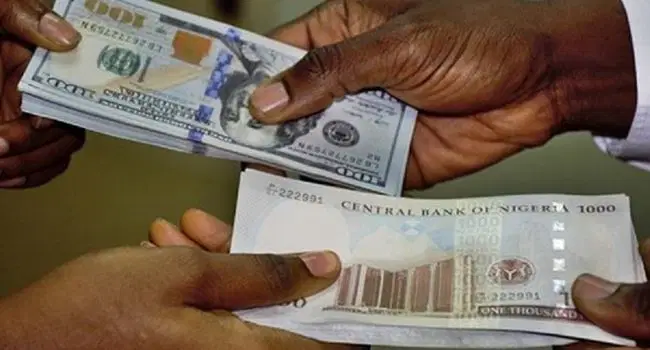
Today, the Naira Black Market exchange rate for 1 Great British Pound (GBP) is 1900 Naira. This means that you can get 1900 Naira for every 1 Pound that you exchange.
How much is 100 pounds in naira today?
At the current black market rate of 1900 per pound, 100 British Pounds = 190,000 Naira.
BLACK MARKET RATES
US Dollar (USD) Buy ₦1,405 Sell ₦1,410
Great British Pound(GBP) Buy ₦1,900 Sell: ₦1,920
EURO (EUR) Buy ₦1,595 Sell ₦1,615
Canadian Dollar (CAD) Buy ₦1,020 Sell ₦1,080
South African Rand (ZAR) Buy ₦75 Sell ₦90
Ghana CEDI (GHS) Buy ₦95 Sell ₦110
West African CFA Buy ₦2, 300 Sell ₦2, 400
CENTRAL AFRICAN CFA Buy ₦2,150 Sell 2,250
CBN Exchange Rates
US Dollar (USD) ₦1,338.59
Great British Pound (GBP) ₦1,820.34
EURO (EUR) ₦1,560.12
Swiss Franc (CHF) ₦1,664 91
Chinese Yuan (CNY) ₦199.19
Japanese Yen (Yen) ₦8.40
West African CFA (XOF) ₦2.39
West African Unit Account (WAUA) ₦1,843.17
Saudi Riyal (SAR) ₦356 51
South African Rand (ZAR) ₦83.72


Police confirm Kogi APC Chairman’s Murder by Bandits

President Tinubu Orders Comprehensive Forensic Audits of MDAs, IPPIS

Wushishi, National Population Commission’s Chairman, Dies

Tech Expert, Zuckerberg trains with UFC champions, Adesanya, Alexander

Organ Trafficking: Ekweremadu bags 10 years in UK prison

SAINT OBI: Between his marriage and his death
-

 Business3 days ago
Naira Exchange Rates Thursday, August 27
-
 News3 days ago
NIGCOMSAT To Procure Two New Communication Satellites
-

 Sports3 days ago
NFF President Gusau, other board members resign Over DSS Probe
-
 News3 days ago
Gunmen abduct Dangote Cement senior driver in Ogun
-

 News3 days ago
Troops Resist Terrorists At Sokoto Barracks
-

 News3 days ago
FG commissions 37 electric buses for civil servants
-

 Crime2 days ago
JUST IN: Terrorists kill 4, abduct others in Gorau after boat tragedy
-

 News2 days ago
City Boy Movement: FTSE’s Nigeria frontier market restoration validates Tinubu’s reforms