
Business
MAN Supports 15% Import Tariff on Petrol and Diesel


A Step Towards Strengthening Local Content and the Patronage of Made-in-Nigeria Preamble
The Manufacturers Association of Nigeria (MAN) has commended the Federal Government for its recent approval of a 15% import tariff on petrol and diesel.
In a press release signed by Segun Ajayi-Kadir, Director-General Manufacturers Association of Nigeria, the association recognised gesture as a strategic step and patriotic policy that aligns with the Nigeria First agenda and MAN’s long-standing advocacy for local content development and patronage of Made-in-Nigeria.
It is heartening that this is coming less than one Month after the 53rd AGM of MAN with the theme: Nigeria First: Prioritizing Patronage of Made in Nigeria Products.
The association said the strategic policy has reassured domestic manufacturers that Government is attentive to the imperatives of growing indigenous manufacturing.
It exemplifies governments commitment to halting the perennial bleeding of our patrimony; asserting the sovereignty of the great country; guaranteeing energy sufficiency and security, and improving the overall wellbeing of Nigerians in this regards.
This is a sure step in the promotion of local value addition, strengthening domestic refining capacity, conserving foreign exchange, and advancing Nigeria’s long-term industrialisation objectives.
MAN’s Position:
1. Unfettered implementation of the domestic supply of crude and enshrined in the PIA. This will ensure the Naira for crude arrangement that will ensure effective and reliable supply of crude to the local refineries and reduce the pressure on our scarce foreign exhange.
It will also attract more investors, including the holders of the 30 refininery licenses to commit resources in the sector.
2. There is no better path to fixing Nigeria’s economy than protecting local industries, encouraging local patronage, fostering value addition, and promoting industrial development anchored on local content.
3. Nigeria is blessed with enormous oil resources. Unfortunately, scarce forex in billions of dollars is still being spent on importing refined petroleum.
Supporting local refining capacity through appropriate policy tools will conserve scarce foreign exchange, improve the stability of the Naira, and foster a more favourable macroeconomic environment for investment.
In view of above, MAN duly:
i. recognises the importance, significance, and necessity of the approval of the 15% import tariff on petroleum products — petrol and diesel.
ii. Acknowledges that the tariff is a rightful, deliberately designed policy instrument intended to protect and encourage domestic producers, curb dumping, and create a stable environment for local refiners to thrive.
iii. Notes that the tariff will accelerate operational readiness of domestic refineries, thereby reducing disruptions and stabilising energy supply to industries.
iv. Supports the 15% import tariff as an industrial policy instrument that will:
• Encourage the utilisation of local refining capacity and promote backward integration across the energy value chain.
• Conserve foreign exchange by reducing the nation’s dependence on imported refined petroleum products.
• Strengthen the manufacturing base through a more stable and predictable fuel supply.
• Generate employment opportunities, build technical expertise, and strengthen industrial linkages between refineries and manufacturers.
• Promote local content development and stimulate demand for Nigerian engineering, fabrication and logistics services.
v. MAN views this policy as a vital step in achieving energy independence and industrial sustainability, both of which are prerequisites for Nigeria’s economic transformation.
Call for Transparent and Balanced Implementation:
While supporting the 15% tariff imposition, MAN calls for transparent, efficient, and well-coordinated implementation to ensure its benefits reach both industry and consumers, safeguard competitiveness, and prevent unintended cost burdens.
Specifically, MAN calls for:
i. Transparent price monitoring: Government and regulators (PPPRA, NMDPRA, FCCPC) should closely monitor domestic pricing to prevent excessive mark-ups or anti-competitive behaviour.
ii. Stable transition period: During the initial months of implementation, the government should support local refiners to ensure adequate fuel availability and prevent supply shocks or speculative hoarding, particularly with the festive period approaching.
iii. Reinvestment of tariff revenue: Proceeds from the import duty should be reinvested into energy infrastructure, refinery efficiency, and power support schemes for industries, including credit facilities for industrial energy transition and renewable adoption.
iv. SMIs support measures: Provide targeted incentives or rebatesfor small and medium manufacturers reliant on diesel-powered generators during the transition period.
v. Support the development of more local refineries: The government should create an enabling environment and provide targeted incentives to attract investment in additional modular and conventional refineries, thereby strengthening domestic refining capacity, promoting competition, and ensuring long-term energy security.
vii. Ensure stakeholder harmony in the energy sector: The government should foster continuous engagement among refiners, marketers, regulators, and consumers to prevent disputes, ensure policy coherence, and sustain market stability.
viii. Move speedily to fully privatize the government owned refinery as it is evident that we may never succeed in restoring them to functionality under the current dispensation.
Selling off the refineries will stop the commitment of our scarce financial resources to an evidently irredeemable venture.
MAN acknowledges this major step in the implementation of Nigeria First policy of government. We are committed to supporting the Federal Government’s Nigeria First policy direction, especially on local content development and home grown industrialisation.
MAN believes that this tariff will accelerate the country’s journey toward energy sovereignty, industrial competitiveness, and sustainable economic growth — all anchored on the strength of Made-in-Nigeria.
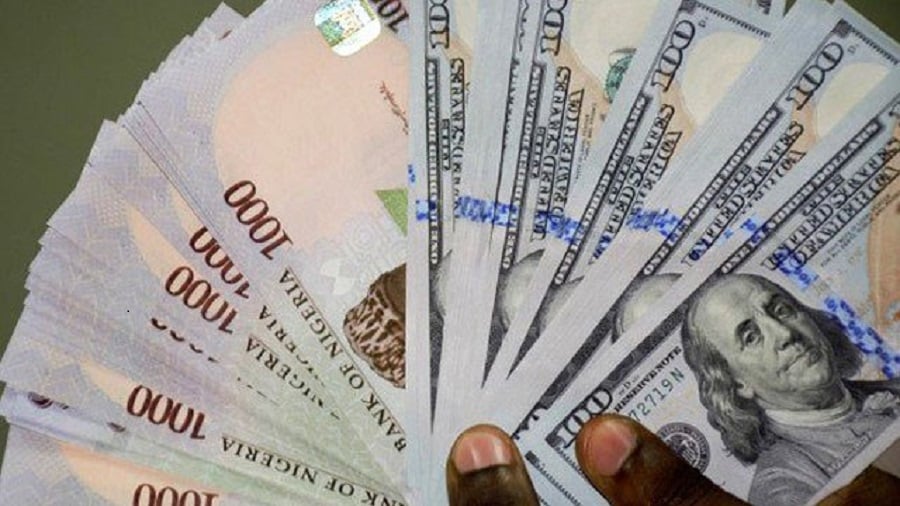
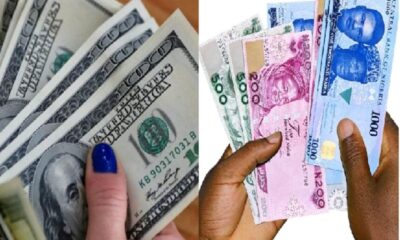
BLACK MARKET RATES
US DOLLAR (USD) Buy ₦1,416 Sell ₦1,423
GREAT BRITISH POUND (GBP) Buy ₦1,890 Sell: ₦1,910
EURO (EUR) Buy ₦1,590 Sell ₦1,610
CANADIAN DOLLAR (CAD) Buy ₦1,020 Sell ₦1,080
SOUTH AFRICAN RAND (ZAR) Buy ₦75 Sell ₦90
UAE DIRHAM Buy ₦350 Sell ₦370 CHINESE YUAN Buy ₦190 Sell ₦205
GHANA CEDI (GHS) Buy ₦95 Sell ₦110
WEST AFRICAN CFA Buy ₦2, 300 Sell ₦2, 400
CENTRAL AFRICAN CFA Buy ₦2,150 Sell 2,250
AUSTRALIAN DOLLAR Buy ₦800 Sell ₦900
CBN Exchange Rates
US DOLLAR (USD) ₦1,357. 65
GREAT BRITISH POUND (GBP) ₦1,834.04
EURO (EUR) ₦1,567.00
SWISS FRANC (CHF) ₦1,671. 98
JAPANESE YEN (JPN) ₦8.53
CHINESE YUAN (CNY) ₦201. 34
WEST AFRICAN CFA (XOF) ₦2. 39
WEST AFRICAN UNIT ACCOUNT (WAUA) ₦1,858.02
SAUDI RIYAL (SAR) ₦361.62
SOUTH AFRICAN RAND (ZAR) ₦84.23
Business
Traders shut down Enugu ‘s Obollo-Afor market over N25,000 haulage levy
However, Chairman of ESIRS, Emmanuel Nnamani, in a letter to the traders, said the haulage levy was not paid by traders buying or selling goods in the markets, but was applicable strictly to truck drivers plying interstate routes.

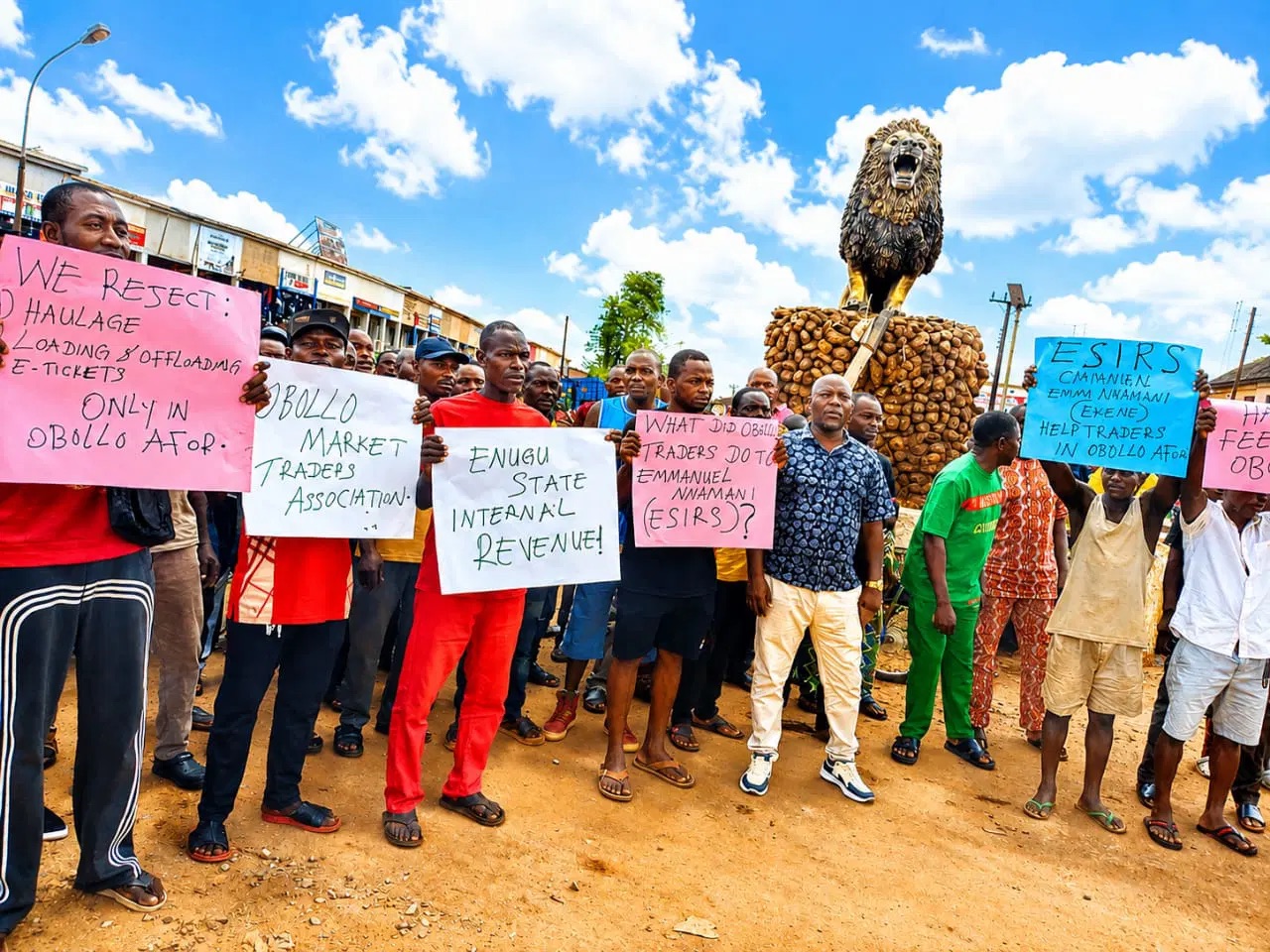
All shops and markets at Obollo-Afor, Udenu Local Government Area of Enugu State were shut yesterday, as traders staged a peaceful protest against alleged selective collection of a N25,000 haulage levy in the market.
The traders, who locked their shops and took to the streets in large numbers, carried placards with various inscriptions, alleging that the Enugu State Internal Revenue Service (ESIRS) had singled out Obollo-Afor Market for the collection of N25,000 haulage fee on every truckload of goods loaded or offloaded in the market.
However, Chairman of ESIRS, Emmanuel Nnamani, in a letter to the traders, said the haulage levy was not paid by traders buying or selling goods in the markets, but was applicable strictly to truck drivers plying interstate routes.
Addressing officials of the Udenu Local Government Council at the council secretariat, where the protesters marched to present their grievances, Chairman, Obollo-Afor Market Traders Association, Charles Eze, lamented that truck operators bringing foodstuffs, building materials, and other commodities to the market had stopped coming because of the levy.
Business
Nigeria’s oil production dropped by 4% in July – NUPRC
“In the month under review, the daily peak production of crude oil and condensate was 1.78mbpd, while the lowest daily production was 1.57mbpd.”

The Nigerian Upstream Regulatory Commission (NUPRC) data has shown Nigeria’s average daily oil production fell by four percent in July, 2026.
According to the NUPRC, Nigeria produced 1.505 million barrels per day (bpd) of crude oil and 0.17 million bpd of condensate, bringing the combined daily production to 1.67 million bpd.
The commission said the country met and exceeded its Organisation of the Petroleum Exporting Countries (OPEC) quota of 1.5 million bpd for the third consecutive month.
“In the month under review, the daily peak production of crude oil and condensate was 1.78mbpd, while the lowest daily production was 1.57mbpd.”


HAPPENING NOW: Security Beefed up at INEC Office in Osun Ahead of Saturday’s Governorship Election

Gov Mbah Invest in world-class Enugu International Hospital

Committees hit the ground running for 8th Kwara State Sports Festival

Tech Expert, Zuckerberg trains with UFC champions, Adesanya, Alexander

Organ Trafficking: Ekweremadu bags 10 years in UK prison

SAINT OBI: Between his marriage and his death
-
 Business2 days ago
FG approves tax waivers for 4,000 electric vehicles
-

 Business2 days ago
Azikel Refinery in Bayelsa Set To Add 25,000 bpd To National Capacity
-
 Business2 days ago
Guaranty Trust Bank doubles naira card international spending limit to $40,000
-
 Business2 days ago
Naira Exchange Rates Thursday, August 13
-

 Business2 days ago
Nigeria’s oil production dropped by 4% in July – NUPRC
-

 Sports2 days ago
Katsina United player declared dead found alive in mortuary
-

 Business3 days ago
Naira Exchange Rates Wednesday, August 12
-

 Sports2 days ago
NBA’s Los Angeles Lakers to be sold for $12.5bn – Report