
Business
EITI Seeks Stakeholders Commitment To New Standards For The Sector


The Chair of the Board, Extractive Industries Transparency Initiative (EITI), Helen Clark, has called on the stakeholders in the sector to show commitment in strengthening transparency and the implementation of EITI goals.
She made the call during the launch of a new standard for the extractive industries at the just ended EITI 2023 global conference in Dakar, Senegal, themed “Transparency in Transition.”
At the event, hosted by the government of Senegal at the Centre International de Conférences Abdou Diouf, Diamniadio, and which drew participants from across the globe, she said that the new standard focuses on beneficial ownership transparency as a key anti-corruption mechanism in the extractive sector.
The key players in the industry deliberated on different areas bordering on key issues plaguing the institution in promoting transparency and accountability in the extractive industry, benefits of disclosing contract from energy in the extractive and energy transition.
Highlights of The New Standard
• A new requirement to request full disclosure of beneficial ownership by politically exposed persons (PEPs), regardless of their level of ownership.
This is intended to ensure that any amount of ownership by PEPs is publicly disclosed, and if implemented effectively, will act as an important mechanism to detect conflicts of interest, for example in the awarding and management of licences.
• The Standard now encourages EITI implementing countries to adopt a threshold of 10% or lower for beneficial ownership reporting.
In extractives, a high-risk sector for corruption, it has long been acknowledged that low thresholds are important for understanding ownership, for example of a small percentage stake in a very large extractives company.
• Requirements for information to be disclosed when state-owned enterprises (SOEs) hold beneficial ownership or control. The Standard now specifies the key information that is required: the name of the state, level of ownership, and detail about how ownership or control is exerted.
Given the prominent role of state-owned enterprises in the extractive sector, when combined with the EITI requirement on PEP disclosure, this represents a significant strengthening of the potential for the EITI Standard to deliver anti-corruption impact.
• Requirement 2.6e) also encourages SOEs to disclose beneficial ownership information for their agents, intermediaries, suppliers or contractors.
•The Standard now contains additional requirements to support the disclosure of full ownership chains where beneficial ownership is held indirectly.
This comprises a new requirement to disclose the legal ownership of entities as well as beneficial ownership, and is coupled with an encouragement for companies to disclose their ownership structure and full ownership chain.
• Finally, the Standard now encourages the EITI multi-stakeholder groups to review the comprehensiveness and reliability of beneficial ownership information disclosed through stock exchange filings for listed extractives companies, although it does not require any action if the data is not found to be reliable.
This remains an issue for actors wishing to understand ownership and control in listed companies in the extractive sector, as in practice there is wide variation in the availability of information from different stock exchanges.
Together, these new developments in the 2023 EITI Standard signal the continued strengthening of the ambitions of the EITI and its work to embed beneficial ownership transparency.
The transition from fossil fuel to renewable energy took the center stage of the discussion.






Business
TIME Names Moniepoint CTO Felix Ike Among 50 Global Executives of the Year
In its citation, TIME said Ike “has helped to establish the business as one of Africa’s leading financial platforms.


TIME magazine has named Felix Ike, co-founder and Chief Technology Officer of Nigerian fintech Moniepoint, to its inaugural Executives of the Year: Tech and Data list.
Ike is the only executive representing an African company among the 50 leaders selected for the 2026 list.
The list, unveiled on Tuesday, September 22, recognises chief information officers, chief technology officers, chief data officers and chief product officers whose decisions are shaping how major organisations deploy technology and use data.
Moniepoint is also the only African company represented on the inaugural list.
Ike was named alongside executives from Netflix, CrowdStrike, Dell, Duolingo, AT&T, OpenAI, Anthropic, Shopify and Reddit, among others.
In its citation, TIME said Ike “has helped to establish the business as one of Africa’s leading financial platforms.
“The recognition follows Moniepoint’s inclusion in TIME’s 2025 list of the 100 Most Influential Companies, giving the Lagos-founded fintech another global distinction.

Black Market Rates
₦1382DOLLAR (USD)
₦1855POUND (GBP)
₦1545EURO (EUR)
1000 DOLLAR (CAD)
₦70 RAND (ZAR)
370DIRHAM (AED)
190YUAN (CNY)
₦100G.CEDI (GHS)
₦2350 CFA F.(XOF)
₦2250 CFA F.(XAF)
₦850 AUSSIE (AUD)
Official CBN Exchange Rates
DOLLAR (USD)₦1328.67
POUND (GBP)₦1758.36
EURO (EUR)₦1511.63
SWISS FRANC (CHF)₦1605.45
JAPANESE YEN (JPN)₦8.38
CFA FRANC (XOF)₦2.31
WEST AFRICAN UNIT OF ACCOUNT (WAUA)₦1808.03
CHINESE YUAN (CNY)₦197.92
SAUDI RIYAL (SAR)₦353.86
SOUTH AFRICAN RAND (ZAR)₦81.09
Business
Djibouti, Ethiopia and Dangote to build $660 million petroleum pipeline
In Kenya, Dangote and the government are due to break ground on a new 700,000-barrel-per-day crude oil refinery in Lamu next week.
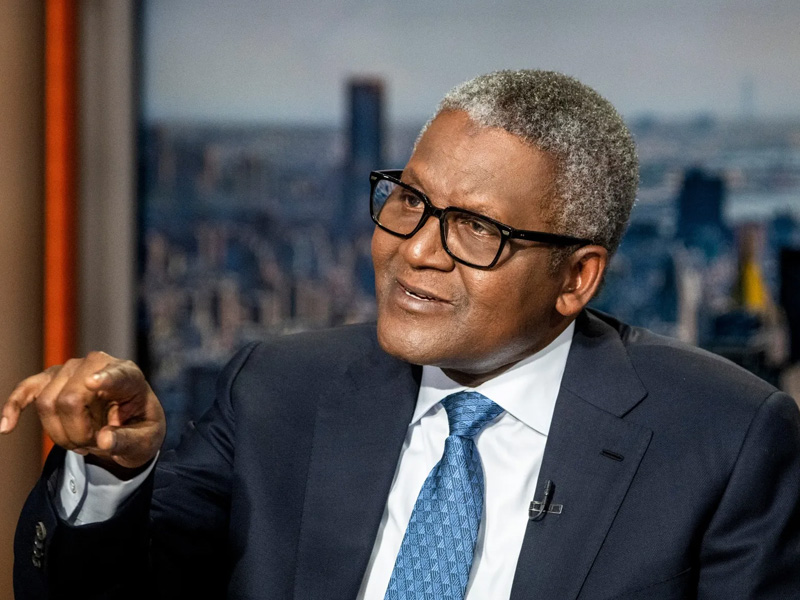
Ethiopia, Djibouti and Nigerian billionaire Aliko Dangote plan to build a $660 million refined petroleum pipeline that will connect Ethiopia and Djibouti, a spokesperson in Ethiopian Prime Minister Abiy Ahmed’s office said on Thursday.
The project will include a 120-km (75-mile) pipeline, as well as approximately 375,000 cubic metres of storage capacity at Damerjog in Djibouti and 800,000 cubic metres at Dewele in Ethiopia, the spokesperson told Reuters, adding it should become operational within 18 months.
Abiy said on his X account the project will be developed through a partnership between Ethiopian Investment Holdings and the Dangote Group, which separately is already building a $4 billion fertiliser pipeline and power plant, and a polypropylene packaging facility, in Ethiopia.
The project aims to reduce logistics costs and delays along the Ethiopia-Djibouti transport corridor, Abiy said.
Developers say the infrastructure will strengthen energy security and improve supply chain resilience for the two countries, he said.
Abiy is on a visit to Djibouti and made the announcement alongside its president, Ismail Omar Guelleh, and Dangote.
In Kenya, Dangote and the government are due to break ground on a new 700,000-barrel-per-day crude oil refinery in Lamu next week.


Congo military plane crash kills 13, including three officers

Manchester City Faces Expulsion For Breaching 114 EPL Financial Rules

TIME Names Moniepoint CTO Felix Ike Among 50 Global Executives of the Year

Tech Expert, Zuckerberg trains with UFC champions, Adesanya, Alexander

Organ Trafficking: Ekweremadu bags 10 years in UK prison

SAINT OBI: Between his marriage and his death
-
 Business3 days ago
FG Engages Stakeholders On Nigeria’s Rice Value Chain
-

 Business3 days ago
Naira To Dollar, Pound , Euro Rate Wednesday September 23
-

 Business3 days ago
Airtel Money Targets October Listing On London Stock Exchange
-
 Business2 days ago
MAN Urges CBN To Consider CRR Cut Next Phase of Monetary Easing
-

 Crime2 days ago
JUST IN: Zamfara LG Chairman Freed After 61 Days in Captivity
-

 Business3 days ago
Cardoso Says Multiple FX Windows Cost Nigeria 3% of GDP, Higher Than Fuel Subsidy
-

 Sports2 days ago
FIFA names Nigerian referee among 81 officials for U-17 World Cup
-

 News2 days ago
VP Shettima, Gov Mbah to address Over 500 editors on 2027 election issues