
News
Ansaru Terrorists court trials adjourn until September 5 as Lawyers and Defendants absent today
The US government had placed a $5 million bounty on Mohammed Usman in 2012, designating him as one of three Nigerian “specially designated global terrorists.


Justice Emeka Nwite of the Federal High Court in Abuja has condemned the decision of a terrorism suspect to skip trial, describing the action as ‘unfortunate.’
This remark by the judge is in respect of Mohammed Usman also known as Khalid Al-barnawi, allegedly link to Ansaru the splinter group of Boko Haram.
Al-barnawi and four others-Mohammed Saleh, Umar Bello, Mohammed Salisu and Yakubu Nuhu- are alleged to have conspired to carry out terrorist activities between 2011 and 2013 in several northern Nigerian states, including Sokoto, Kebbi, Bauchi, Borno, and Gombe.
During Tuesday’s court session, the prosecution, led by Dr. Alex Izinyon (SAN), informed the court that proceedings were due to continue with a trial-within-a-trial phase.
However, he noted with concern the absence of the first defendant, Mohammed Usman, and his counsel.
Lawyers for two other defendants were also not present.
Dr. Izinyon revealed that Usman’s lawyer claimed to be away in Enugu and had promised to send a representative, who did not appear.
He described the no-show and lack of communication as disrespectful and contrary to the court’s efforts to expedite the long-running case which has been on since 2017.
In response, Justice Nwite expressed his dissatisfaction with the absence, emphasizing the importance of an expeditious hearing.
He warned that the court would not tolerate defendants absence from the proceedings.
The judge instructed the parties to collaborate and clarify the reasons behind the absence to prevent further delays.
He then adjourned the case until September 5 and 12 for the continuation of evidence from the third prosecution witness and the playback of relevant videos as part of the trial within a trial.
The US government had placed a $5 million bounty on Mohammed Usman in 2012, designating him as one of three Nigerian “specially designated global terrorists.
“Ansaru, ideologically linked to al-Qaeda in the Islamic Maghreb, is accused of targeting Westerners and carried out a notable attack on a maximum-security prison in Abuja in 2012, freeing dozens of inmates.




Nigeria’s First Lady, Senator Oluremi Tinubu, has clarified that the Federal Government’s support for small-scale traders extends beyond ‘akara’ sellers to include tomato and pepper sellers across the country.
Speaking at an event, Mrs. Tinubu emphasized the government’s commitment to empowering various categories of informal traders and food vendors.
“Not only ‘akara’, FG also supports tomato, pepper sellers,” she stated.
The First Lady’s remark appears to address recent discussions and criticisms regarding government intervention programmes for petty traders. She highlighted that initiatives aimed at supporting small businesses cover a wide range of essential food items and vendors, including those dealing in tomatoes and peppers, which are staple commodities in Nigerian markets.
Mrs. Tinubu reassured citizens that the administration remains focused on inclusive economic support for vulnerable groups and market women. She noted that such interventions are designed to cushion the effects of economic hardship and promote self-reliance among small-scale entrepreneurs.
The statement has sparked reactions on social media, with many commending the First Lady’s direct engagement while others called for more visible and widespread implementation of the support programmes.
News
Insecurity: NSCIA fumes “Enough is Enough” over attacks on Islam and Muslims in Nigeria
The warning was contained in a statement by the NSCIA’s Public Affairs Officer, Abbas Jimoh, on behalf of the council led by its President-General and Sultan of Sokoto, His Eminence Alhaji Muhammad Sa’ad Abubakar.
Photo: Sultan of Sokoto Muhammad Sa’ad Abubakar III
The umbrella body of Muslims community in Nigeria (Nigerian Supreme Council for Islamic Affairs (NSCIA) has warned the Federal Government and security agencies to act before Muslims ‘run out of patience’.
According to the NSCIA,the community’s continued restraint amid what it described as persistent attacks, profiling and marginalisation should not be mistaken for weakness.
The warning was contained in a statement by the NSCIA’s Public Affairs Officer, Abbas Jimoh, on behalf of the council led by its President-General and Sultan of Sokoto, His Eminence Alhaji Muhammad Sa’ad Abubakar.
The NSCIA also called on the government to ensure that those responsible for what it described as heinous crimes in Kaduna and Benue states were brought to justice without delay.
“While the NSCIA continues to appeal to Muslims for continuous restraint, it is imperative that government and security agencies should act decisively before the Muslims run out of patience in the light of persistent attacks and unbridled marginalization,” the council said.
The council urged the authorities to rein in what it described as persistent attacks on Islam and Muslims in public spaces, saying that was essential to preserving peace and national cohesion.
“The barrage of open assaults on the integrity of Islam and the Muslims in public spaces should be checked in the interest of peace and order. Enough is enough,” the statement added.
News
NYSC to be headed by civilians under new reforms
To give legal backing to the reforms, the Federal Executive Council directed the Attorney-General of the Federation, in collaboration with the Ministry of Youth Development, to amend the NYSC Act and its regulations to facilitate the immediate implementation of the approved changes.

The Federal Government has approved sweeping reforms to the National Youth Service Corps, NYSC, announcing that the scheme will now be headed by a civilian instead of a military officer.
The approval was announced to State House correspondents after the FEC meeting presided over by President Bola Tinubu at the Presidential Villa, Abuja.
To give legal backing to the reforms, the Federal Executive Council directed the Attorney-General of the Federation, in collaboration with the Ministry of Youth Development, to amend the NYSC Act and its regulations to facilitate the immediate implementation of the approved changes.
The Minister of Youth Development, Ayodele Olawande, said that the reforms would also introduce professional training programmes for corps members to enhance their employability and entrepreneurial skills.
He explained that the NYSC would retain its one-year service duration while incorporating flexible, skills-based training programmes into the service year.
Under the new framework, he said, the scheme would remain civilian-led, while the Nigerian military would continue to be responsible for the security of corps members nationwide.


BREAKING: Court Grants Sowore N200 Million Bail, With Fresh Conditions

Lagos NSCDC Parades Five Suspected Vandals, Two Foreigners From Togo

FG Supports Tomato, Pepper Sellers Too, Not Just ‘Akara’ — Remi Tinubu

Tech Expert, Zuckerberg trains with UFC champions, Adesanya, Alexander

Organ Trafficking: Ekweremadu bags 10 years in UK prison

SAINT OBI: Between his marriage and his death
-

 Health1 day ago
WHO Confirms 1,300 deaths in Europe heatwaves
-

 News1 day ago
JUST IN: Two Trucks, Car Collide on Lagos Expressway, Several Injured
-
 News3 days ago
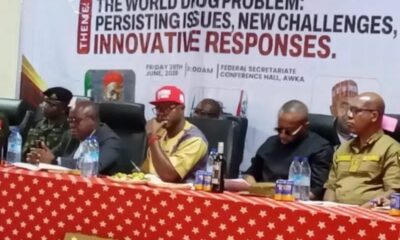
NDLEA, Army, NAFDAC, Agunechemba, Others Rally Against Drug Abuse in Anambra
-

 Business1 day ago
Naira Exchange Rates Monday, 29 June 2026
-

 Politics1 day ago
2027: Atiku Alleged Plot To Keep ADC Off Ballot
-

 News3 days ago
Sanwo-Olu Addresses PSP Operator’s Challenges , Announces Measures to Boost Waste Management (Photos)
-

 News1 day ago
FG bans motorcycles, tricycles on Lagos-Calabar Coastal Highway
-

 News2 days ago
SGF Akume Condemns Killing of MACBAN Chairman in Benue