News
Emefiele loses bid to stop $4.5bn, N2.8bn fraud trial

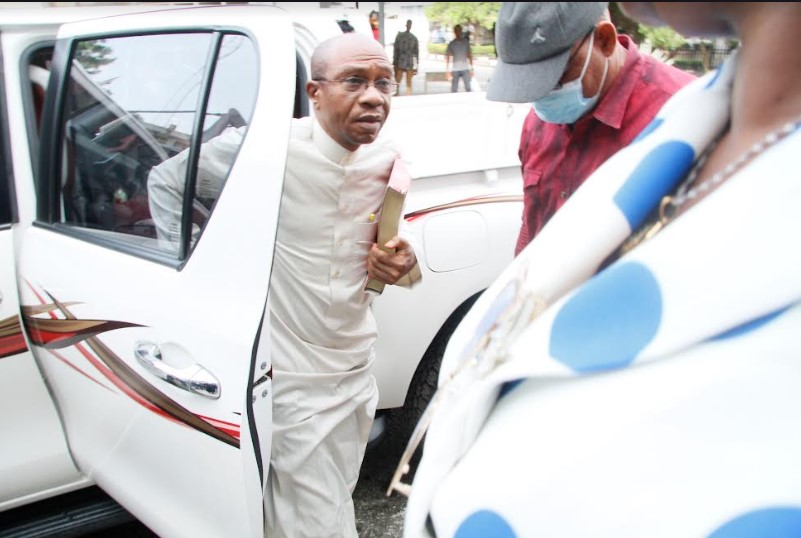
Former governor of the Central Bank of Nigeria, Godwin Emefiele has lost the chance to stop the $4.5bn, N2.8bn fraud trial after the Lagos State Special Offences Court, on Wednesday, dismissed an application filed by the former governor, challenging the court’s jurisdiction to entertain the fraud charges brought against him by the Economic and Financial Crimes Commission.
Justice Rahman Oshodi, in his ruling, held that the court had the jurisdiction to try Emefiele and his co-defendant, Henry Omoile.
The judge, however, struck out four of the 26 counts filed by the EFCC against the defendants for lack of jurisdiction.
Justice Oshodi explained: “Allocation of foreign exchange without reason is not defined as an offence under any written law. The objection to counts one to four succeeds and is hereby struck out.
“The objection challenging the court’s territorial jurisdiction over counts eight to 26 fails and is hereby dismissed.
“The prosecution has established sufficient territorial nexus in this case.
”The judge subsequently adjourned the case for trial continuation on February 24, 2025.
The EFCC had arraigned Emefiele on 26 charges, bordering on abuse of office and illegal allocation of $4.5bn and N2.8bn.
At the last adjourned date on December 12, 2024, Emefiele’s counsel, Mr. Olalekan Ojo (SAN), argued that the court lacked jurisdiction to hear the case in Lagos.Ojo contended that the alleged offences, including abuse of office, fell outside the territorial reach of the Lagos Special Offences Court.
He also argued that the charges violated Section 36(12) of the Nigerian constitution, asserting that the alleged offences were not legally recognised under Nigerian law.
Furthermore, Ojo emphasised that since the Lagos State House of Assembly does not have legislative authority over matters on the Exclusive Legislative List, Section 73 of the Criminal Law of Lagos State (2011), under which counts one to four were filed, cannot apply extraterritorially to the alleged abuse of office by Emefiele.
Ojo added that a court’s territorial jurisdiction is limited to the geographical area within which its authority can be exercised and urged the court to strike out counts one to four of the amended charges filed by the EFCC on April 4, 2024.
In response, EFCC counsel, Mr. Rotimi Oyedepo (SAN), argued that the court had the authority to hear the case.
Oyedepo contended that the alleged crimes were economic and financial in nature, falling within the EFCC’s jurisdiction.
He also maintained that substantial evidence supported Lagos as the appropriate venue for the trial.
According to Oyedepo, the subject matter of the charges clearly fell within the court’s jurisdiction since the offences were committed within its territorial reach.
He noted that evidence and witness testimonies pointed to Lagos as the proper location for the trial and argued that the objections raised by Emefiele’s legal team lacked factual or evidential support.
Following the arguments, Justice Oshodi initially adjourned the case to January 7, 2025, for a ruling on the application challenging the court’s jurisdiction.
However, the ruling was not ready on that date, prompting an adjournment to Wednesday, January 8, 2025.
The case has now been adjourned to February 24 and 26, 2025, for the continuation of trial.








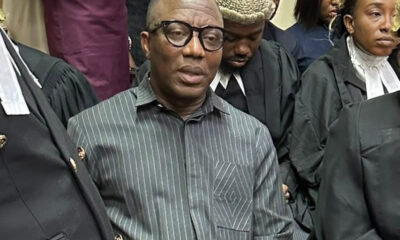


Former Delta State Governor Dr. Emmanuel Eweta Uduaghan is dead. He passed away on the morning of Monday, October 19, 2026, at the age of 71, after a period of illness.
A family statement announced his death, describing it as a devastating loss. Uduaghan, a medical doctor, served as Delta State Commissioner for Health (1999–2003) and Secretary to the State Government (2003–2007) before becoming governor from 2007 to 2015. He was known for contributions to infrastructure and human capital development in the state.
Delta State Governor Sheriff Oborevwori has expressed deep sadness over the passing. In a condolence message, he described Uduaghan as a detribalised leader whose service left a lasting mark on Delta State.
Oborevwori extended heartfelt condolences to Uduaghan’s wife, Roli, his children, the Uduaghan family, the Itsekiri nation, and the people of Delta State, praying for the peaceful repose of his soul.
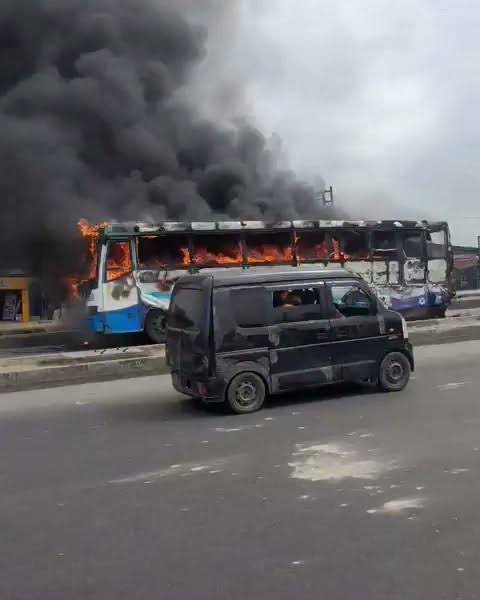
An angry mob has set a Bus Rapid Transit (BRT) bus on fire after it reportedly crushed a commercial motorcyclist to death at Ogolonto Bus Stop along Ikorodu Road in Lagos State.
The incident occurred on Friday, October 16, 2026. Eyewitness accounts and social media reports indicate that the motorcyclist was riding alone along the restricted BRT lane when the collision happened. He died at the scene.
Enraged residents and youths then attacked the bus driver and set the vehicle ablaze. Police officers and officials of the Lagos Neighbourhood Safety Corps (LNSC), who were nearby, intervened promptly and rescued the driver unharmed.
The identity of the deceased motorcyclist and the exact circumstances of the crash had not been officially confirmed at the time of filing this report. It was also unclear whether any arrests had been made in connection with the burning of the bus.
News
ARISE News Wins Seven Honours At Nigerian Broadcasters Merit Awards
The awards recognised the network’s achievements in television journalism and programming, with ARISE News winning the Best TV Channel (Viewer’s Choice) category.


• ARISE News Anchor and host of What’s Trending Ojy Okpe was named Best Newscaster (TV – Female)
ARISE News has emerged as one of the major winners at the just ended Nigerian Broadcasters Merit Awards (NBMA).
ARISE News won seven honours across television broadcasting, news reporting, presentation and production during the ceremony.
The awards recognised the network’s achievements in television journalism and programming, with ARISE News winning the Best TV Channel (Viewer’s Choice) category.
The network’s flagship breakfast programme, The Morning Show, also won the Best TV Talk Show award, further strengthening its recognition in television broadcasting.
ARISE News Anchor and host of What’s Trending Ojy Okpe was named Best Newscaster (TV – Female).
Rufai Oseni was named Nigerian Broadcaster of the Year (Male), while Vimbai Mutinhiri-Ekpeyong received the Nigerian Broadcaster of the Year (Female) award.
The recognition extended to the network’s newsroom, with Ovieteme George winning Best TV News Reporter (Male) for his contributions to television news reporting.
Behind the camera, Sam Adeyemi received the Best Camera Operator/Cinematographer award, recognising his work in television production and visual storytelling.


Mbappé wins Onze d’Or award for 2025/26 season

Ronaldo Gets 30-Day Suspension For Portugal Camp Walkout

JUST IN: Ex-Delta Gov Uduaghan Dies at 71, Oborevwori Mourns

BREAKING: Lagos Govt Declares Today, Thursday Work-Free to Mark 2026 Ìṣẹ̀ṣe Day

Tech Expert, Zuckerberg trains with UFC champions, Adesanya, Alexander