
Health
UPDATED: Health workers begin indefinite strike

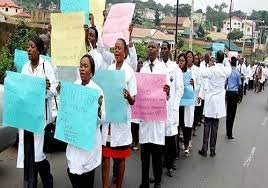
The Joint Health Sector Unions and the Assembly of Health Care Professional Association have directed their members to embark on an indefinite strike.
The National Vice President of JOHESU, Dr Obinna Ogbonna said this at a press briefing held in Abuja on Thursday.
The health workers are demanding the immediate approval and implementation of the Technical Committee report on CONHESS adjustment by FG; immediate payment of the omission and Shortfall in the COVID-19 hazard/inducement allowances of affected health workers in the Federal Health Institutions and recognition of health workers in non-core hospital facilities in the payment of new hazard allowance; payment and inculcation of peculiar allowances to health workers under the aegis of JOHESU/AHPA.
The other demands are the immediate and unconditional implementation of the Pharmacist Consultant cadre, unconditional payment of all withheld salaries of Federal Medical Centre, Owerri, Jos University Teaching Hospital, and the Lagos University Teaching Hospital, and April and May 2018 salaries of members at NOFIC, Azare; and the speedy Implementation of the Increase in Retirement Age from 60 to 65 years and 70 years for Consultants in the health professions.
The leadership of JOHESU had in a letter dated May 9, 2023, issued a 15-day ultimatum to the Federal Government over alleged inconsistencies of the government in the ongoing negotiations to adjust the Consolidated Health Salary Structure for health workers on their platforms.
Dr Obinna said, “Consequent upon the nonchalant, biased and lackadaisical attitude of the Federal Ministry of Health against JOHESU members and the resolution of the expanded National Executive Council meeting of the JOHESU held on Monday, May 8, 2023, our members in Federal Health Institutions nationwide are hereby directed to withdraw their services indefinitely commencing from 00:00 hour on Thursday, May 25, 2023.
“It becomes imperative to inform you that since the Federal Government is yet to meet these demands, our members have been directed by the JOHESU National Executive Council to proceed on an indefinite strike action upon expiration of the ultimatum by midnight of May 25, 2023.”
He, however, said, the union is committed to working with the government and stakeholders to improve the health system with necessary reforms in public interest.
When the Minister of Health, Dr Osagie Ehanire was contacted, he requested a text message to be sent to him on the matter.
He had yet to respond to the text message sent to him as of the time of filing this report.




The National Association of Resident Doctors (NARD) has announced plans to commence a total and indefinite nationwide strike starting at midnight on Tuesday, April 7, 2026, citing the Federal Government’s failure to fully implement key agreements.
In a statement following an Extraordinary National Executive Council (e-NEC) meeting, NARD President Dr. Mohammed Suleiman said the strike, tagged: No Implementation, No Going Back,” is aimed at pressing the government to address several outstanding issues.
These include the reinstatement of five dismissed colleagues, payment of promotion and salary arrears across various health institutions, timely release of funds under the 2026 Medical Residency Training Fund (MRTF), and clearance of long-overdue professional allowances.
The association is also protesting the alleged suspension or scrapping of the agreed Professional Allowance Table (PAT), describing the government’s action as unjustifiable and a threat to doctors’ welfare and the stability of the health sector.
Despite the Federal Government’s recent release of ₦21.3 billion (with additional tranches processed) to clear outstanding allowances of which about 60% of affected doctors have reportedly received alerts NARD maintains that critical demands remain unaddressed.
The group insists the strike will proceed unless there is full implementation of the agreements reached in previous negotiations.
“The responsibility to avert this lies with the Federal Government,” sources close to the association emphasised, warning that partial payments and unfulfilled promises have eroded trust.
Healthcare stakeholders have expressed concern over the potential impact of the strike. Resident doctors form a critical backbone of service delivery in teaching hospitals and federal medical centres across the country.
A shutdown is expected to disrupt emergency care, outpatient services, surgeries, and training programmes, putting additional strain on an already overstretched system and leaving many patients vulnerable.
The development comes amid recurring industrial disputes in Nigeria’s health sector, with NARD previously suspending strikes after signing memoranda of understanding with the government, only for fresh disagreements to arise over implementation.
As of now, neither the Federal Ministry of Health nor the Presidency has issued an official response to the latest announcement, though past statements have highlighted efforts to meet multiple demands and urged dialogue to prevent disruption of essential services.
Patients and the public have been advised to seek updates from their local hospitals and explore alternative care options where possible as the April 7 deadline approaches.
Health
From South Africa to US, ‘Cicada’ COVID-19 variant spreading
According to the latest available data from the health authorities, this variant has been spotted in 23 countries and in wastewater from 25 US states.

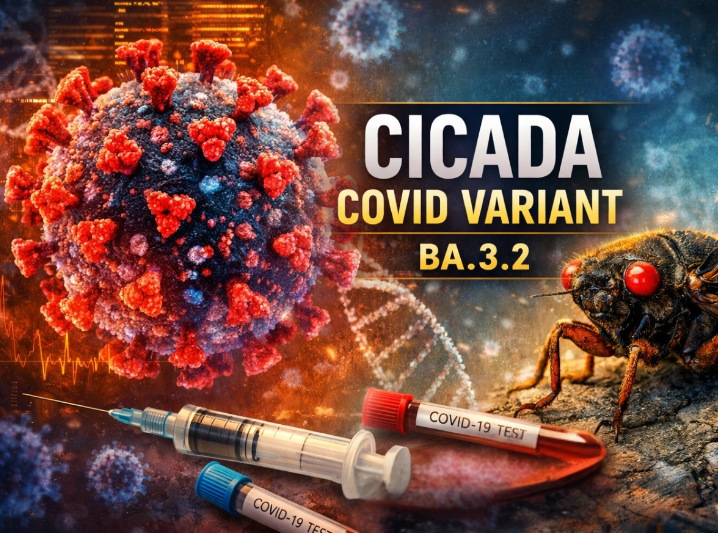
• New Cicada COVID variant detected across US states.
“Cicada” a nickname given to BA.3.2, a COVID-19 variant, is spreading around the world , according to the U.S. Centers for Disease Control and Prevention and the World Health Organization.
Like most other variants, the symptoms of the Cicada variant are the same as those of other COVID-19 variant infections.
According to the CDC, these includes:
Runny or stuffy nose, Fever, Headache, Fatigue, Sneezing, Sore throat,Cough, Muscle pain or body aches Vomiting, Diarrhea, and Changes to the sense of smell or taste.
According to the latest available data from the health authorities, this variant has been spotted in 23 countries and in wastewater from 25 US states.
In November 2024, BA.3.2 popped up in a nose swab of a 5-year-old boy in South Africa, and it looked very different than its parent virus.
It was first picked up in the US last summer, in a traveler from the Netherlands.
In January , the first clinical sample from a sick patient turned out to be BA.3.2.
It appears to be circulating in the US at low levels, although testing has been scaled back since the height of the pandemic, so it may be more widespread than currently known.
Health
Fire Razes Ebonyi Ministry of Health Section
” Different vaccines like BCG, penta, HPV vaccine etc that were all stored in that cold room were burnt”.
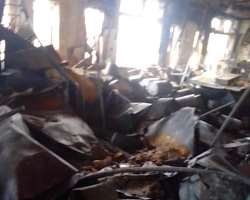
A section of the Ebonyi State Ministry of Health, weekend , was gutted by fire with property worth hundreds of millions of naira destroyed.
The inferno destroyed the cold store housing immunisation and solar units which contained vaccines, vaccine carriers, cold chain boxes, laptops, documents, five refrigerators, two solar refrigerators, 45 solar batteries, inverters, including hospitals beds and foams received from the National Primary Health Care Development Authority (NPHCDA), Abuja, for distribution to local government areas across the state, among others.
The State Commissioner for Health, Dr Moses Ekuma, lamented the disaster and thanked God that no life was lost. He thanked the Commissioner for Power and Energy, the fire service personnel, and the security men who alerted him on time for their prompt response, which made the fire not spread to other parts of the building.
He said, “Different vaccines like BCG, penta, HPV vaccine etc that were all stored in that cold room were burnt”.


Atiku hires US lobbying firm for $1.2m to boost image – Report

Kaduna Mando Garage Explosion Not Bomb- Police

Resident Doctors Set to Begin Nationwide Indefinite Strike on April 7 Over Unmet Demands

Tech Expert, Zuckerberg trains with UFC champions, Adesanya, Alexander

Organ Trafficking: Ekweremadu bags 10 years in UK prison

SAINT OBI: Between his marriage and his death
-

 Politics2 days ago
INEC Dismisses Calls for Chairman’s Removal
-
 Crime1 day ago
Three Killed, One Injured in Fresh Jos Attack (Video)
-
 News30 minutes ago
Kaduna Mando Garage Explosion Not Bomb- Police
-
 Politics2 days ago
Labour Party to hold presidential primary April 28
-

 Politics2 days ago
Onyejeocha resigns as Minister of State for Labour
-
 News18 minutes ago
Atiku hires US lobbying firm for $1.2m to boost image – Report
-
 Politics2 days ago
No force can defeat Tinubu in 2027 –Umahi
-

 News1 day ago
JUST IN: Lagos Fire Service Successfully Contains Two Overnight Fire Incidents iin Lagos