
Business
Top 10 Highest-Paid CEOs in Nigeria
The ranking, published in 2026, is based on estimated annual remuneration and should not be interpreted as basic salary or the amount of cash actually received during the year. Executive remuneration can include salary, bonuses, allowances and other compensation.

By Ochefa
Chief executives of some of Nigeria’s biggest companies are commanding annual remuneration running into billions of naira, with oil and gas, telecommunications, cement, banking and consumer goods executives dominating the latest ranking.
A 2026 ranking puts former Seplat Energy Chief Executive Officer, Roger Thompson Brown, at the top with estimated annual remuneration of ₦3.90 billion, followed by MTN Nigeria CEO Karl Toriola with ₦3.14 billion.
The ranking, published in 2026, is based on estimated annual remuneration and should not be interpreted as basic salary or the amount of cash actually received during the year. Executive remuneration can include salary, bonuses, allowances and other compensation.
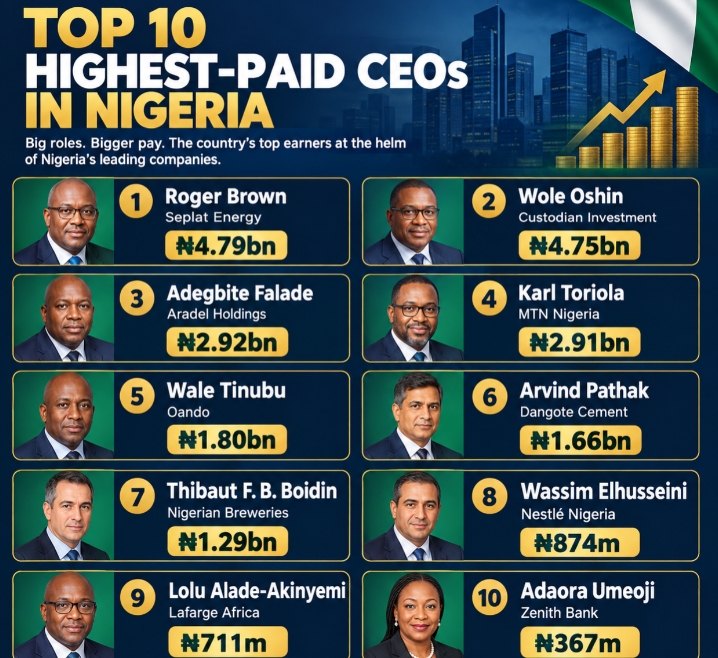
Image generated by AI
1. Roger Thompson Brown — Seplat Energy — ₦3.90bn
Brown topped the ranking with estimated remuneration of ₦3.90 billion.
He joined Seplat in 2013 as Chief Financial Officer and Executive Director before becoming CEO in 2020.
During his tenure, he oversaw Seplat’s $1.28 billion acquisition of ExxonMobil’s Nigerian shallow-water business, a transaction that significantly expanded the company’s domestic oil production portfolio.
However, Brown is no longer Seplat’s CEO. He retired from the company and left its board on July 31, 2026, after six years as CEO.
2. Karl Toriola — MTN Nigeria — ₦3.14bn
MTN Nigeria CEO Karl Toriola ranked second with estimated annual remuneration of ₦3.14 billion.
Toriola joined the MTN Group in 2006 and has held senior positions across its African operations, including CEO of MTN Cameroon and Chief Technology Officer of MTN Nigeria. He became CEO of MTN Nigeria in March 2021.
3. Adegbite Falade — Aradel Holdings — ₦2.44bn
Adegbite Falade, Managing Director and CEO of Aradel Holdings, ranked third with estimated remuneration of ₦2.44 billion.
Falade heads the indigenous integrated energy company with interests spanning oil, gas and power.
He has more than two decades of experience in the energy industry and holds a first-class degree in Electrical and Electronics Engineering from the University of Ibadan and an MBA from Warwick Business School.
4. Wale Tinubu — Oando — ₦1.80bn
Oando Group Chief Executive, Jubril Adewale “Wale” Tinubu, occupied fourth position with estimated remuneration of ₦1.80 billion.
A lawyer by training, Tinubu has spent decades in Nigeria’s oil and gas industry. Under his leadership, Oando expanded through major acquisitions, including Unipetrol and Agip Nigeria.
5. Arvind Pathak — Dangote Cement — ₦1.58bn
Dangote Cement Group Managing Director and CEO, Arvind Pathak, ranked fifth with estimated remuneration of ₦1.58 billion.
Pathak became CEO of Dangote Cement in March 2023 after a long career in the Indian cement industry, including leadership positions at Birla Corporation and other major cement companies.
6. Samba Seye — TotalEnergies Nigeria — ₦1.06bn
Dr Samba Seye, Managing Director of TotalEnergies Marketing Nigeria, ranked sixth with estimated remuneration of ₦1.06 billion.
An engineer with a doctorate from the University of Sciences and Techniques of Lille in France, Seye has worked across the energy industry, including senior positions at Shell and TotalEnergies. He became Managing Director of Total Nigeria in September 2021.
7. Adaora Umeoji — Zenith Bank — ₦874m
Zenith Bank Group Managing Director and CEO, Adaora Umeoji, was the only woman among the 10 executives, ranking seventh with estimated remuneration of ₦874 million.
Umeoji became Zenith Bank’s GMD/CEO in June 2024 after more than two decades with the bank, becoming its first female chief executive.
Separate analysis of audited 2025 accounts shows Zenith’s highest-paid director received ₦367 million in 2025, illustrating why rankings based on different definitions of remuneration can produce substantially different figures.
Proshare, for example, defines total compensation to include basic salary, benefits and dividends from shareholdings.
8. Wassim Elhusseini — Nestlé Nigeria — ₦831m
Nestlé Nigeria Managing Director and CEO, Wassim Elhusseini, ranked eighth with estimated remuneration of ₦831 million.
Elhusseini joined Nestlé in 2002 and held senior sales and business-development positions across the Middle East before becoming Managing Director/CEO of Nestlé Nigeria in September 2020.
9. Adebayo Alli — Guinness Nigeria — ₦756m
Guinness Nigeria Managing Director and CEO, Adebayo Alli, ranked ninth with estimated remuneration of ₦756 million.
Alli became CEO in January 2024, taking responsibility for the Nigerian operations of Guinness Nigeria, part of global drinks company Diageo.
10. Segun Agbaje — GTCO — ₦471m
GTCO Group Chief Executive Officer, Segun Agbaje, completed the top 10 with estimated remuneration of ₦471 million.
Agbaje became Managing Director and CEO of Guaranty Trust Bank in 2011 and later assumed the group CEO role following the creation of GTCO’s holding-company structure.Energy and telecoms dominate.
The ranking highlights the concentration of Nigeria’s highest executive remuneration in capital-intensive sectors.
Oil and gas executives occupy three of the first four positions, while telecommunications, cement, banking and consumer goods also feature prominently.
Proshare’s separate analysis of FY2025 audited accounts found that the 10 highest-paid CEOs had combined total compensation of ₦30.04 billion, up 42 per cent from ₦21.17 billion in 2024. Its methodology included basic salary, benefits and dividends linked to CEOs’ shareholdings.








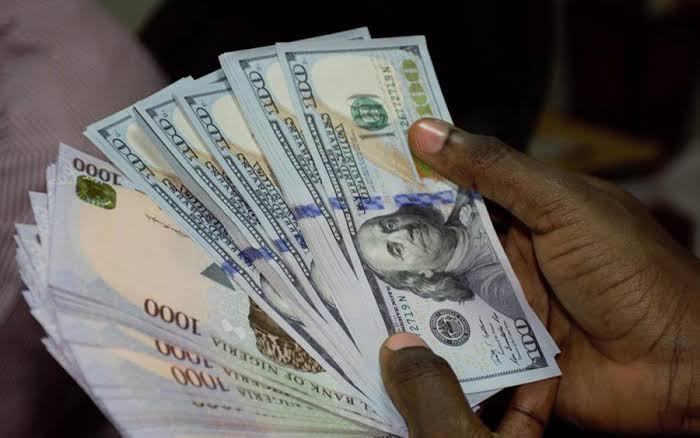
Olayemi Cardoso, Governor of the Central Bank of Nigeria has said that the country’s $54.87 billion foreign exchange reserves is strong enough to withstand pressures on the naira.
Cardoso gave the assurance during the 308th meeting of the Monetary Policy Committee, held yesterday,in Abja.
Responding to concerns about the reserves decline and pressure on the naira, Cardoso said that the movement is a normal and temporary market adjustment.
Cardoso said Nigeria’s reserves, between $54 billion and $55 billion, provide about 10 months of import cover.
That, he said, gives the country a substantial buffer against external shocks.“Buffers remain strong. $54 billion reserves is very substantial,” he said.
He acknowledged that reserves had fallen and the exchange rate had seen volatility.
He argued that the movements were not large enough to undermine Nigeria’s external position.
He assured that the apex bank would keep taking measures to preserve stability.
Cardoso linked part of the pressure to seasonal factors. Portfolio investors are adjusting positions towards the end of the year. Domestic businesses are hedging against possible foreign exchange movements ahead of the new year.
Business
Naira Exchange Rates, Wednesday, 25 Nov 2026
The black market (parallel market) dollar to naira rate is the most searched forex query in Nigeria.
BLACK MARKET RATES
US Dollar =₦1,445
British Pound= ₦1,870
EURO = ₦1,580
Canadian Dollar (CAD) = ₦950
Chinese Yuan (CNY) = ₦190
Ghanaian Cedi =₦100
South African Rand (ZAR)=₦ 70
UAE Dirham =₦ 350
West African CFA franc (XOF) = ₦ 2, 240
Central African CFA franc (XAF)=₦ 2,180
Australian Dollar (AUD)=₦ 820
Business
Naira falls 2.57% despite $1.30bn CBN intervention
The latest decline has raised questions about the effectiveness and sustainability of CBN interventions.
The naira weakened to N1,389.73 per dollar in the official foreign exchange market after a 2.57% weekly depreciation, despite an estimated $1.30 billion intervention by the Central Bank of Nigeria.
The currency had been moving towards N1,400 per dollar, renewing concerns about how long the CBN can defend it.
The decline comes as businesses and households prepare for higher dollar demand during Christmas.
Analysts warn that festive demand and spending ahead of the 2027 general elections could deepen pressure on the naira and push up prices for Nigerians.
CBN data showed the naira depreciated by 2.57% during the week, closing at N1,389.73 per dollar in the official market.
In the parallel market, the currency traded around N1,458 per dollar, with some market reports quoting rates as high as N1,468.
The latest decline has raised questions about the effectiveness and sustainability of CBN interventions.
Despite an estimated $1.30 billion injection into the foreign exchange market, demand from importers, investors and other participants continued to weigh on the currency.


El-Rufai makes u-turn on wiretapping

Katsina Suspends Emir of Daura Over Sexual Allegations By Polish Tourist

Mother, daughter crushed to death by truck in Abuja

BREAKING: Lagos Govt Declares Today, Thursday Work-Free to Mark 2026 Ìṣẹ̀ṣe Day

Tech Expert, Zuckerberg trains with UFC champions, Adesanya, Alexander

Why we Increase the 2025 Budget by ₦700bn – Bichi
-
 News2 days ago
Emir, 92, Under Probe For Alleged Palace Romance
-

 Sports2 days ago
Zenith Bank/Delta Principals’ Cup kicks off November 26
-
 News2 days ago
Tinubu Tasks APC on Winning Lagos in 2027 general elections
-

 Business2 days ago
Naira Exchange Rates, Monday 23 Nov 2026
-

 Sports3 days ago
CAF Chooses Six Venues For Africa Cup of Nations Finals
-
 News2 days ago
Omo-Agege survives assassination attempts at campaign rally in Delta, four dead
-
 Politics2 days ago
Atiku: I’m in 2027 presidential race to win
-

 Health2 days ago
Medical Academy Warms Nigerians New COVID-19 Variant Spreading