
News
Olayemi Cardoso’s dilemma, By Tunde Rahman


Written By: Tunde Rahman, senior presidential aide.
In the wake of the floating of the naira, some of the variables shaping the value of the national currency – including limited production in the country as a result of insecurity, the high taste for imported products, dwindling exports, poor dollar remittances, humongous school fees of Nigerian students abroad and medical tourism, all of which engendered a strong demand for dollar, far outweighing supply – seem to be clearly beyond his control.
Those who know Mr Olayemi Cardoso will agree he got his current job as the governor of Central Bank of Nigeria on the platter of a solid professional background and strong personal attributes. His pedigree is rich as his character is unsullied. Cardoso had a remarkable private sector career, where he shone brilliantly in banking, stockbroking and consulting.
Cardoso also comes from a very solid family pedigree. Nigeria’s late Prime Minister, Sir Abubakar Tafawa Balewa, appointed his late father, Mr Felix Bankole Cardoso, as the first accountant-general of the federation in 1963. The late elder Cardoso served with enviable record till 1971.
Part of the remarkable private sector career of Olayemi Cardoso was his appointment as the chairman of the Board of Citibank in Nigeria.
Cardoso began his public service journey when he became the commissioner for Budget and Economic Planning in the cabinet of Asiwaju Bola Tinubu, governor of Lagos State, as he then was in 1999. In addition to superintending that ministry, Cardoso was charged with several other responsibilities, including heading important cabinet committees that birthed landmark agencies in the state. Cardoso was known for enforcing strict budgetary discipline that contributed significantly to the overall success of the Tinubu administration in Lagos. He refused to authorise the release of funds for projects or programmes that had no budgetary head. For all of that and many more, Cardoso was nicknamed the “Headmaster.”
Armed with a Bachelor of Science degree in Managerial and Administrative Studies and a Masters in Public Administration from the prestigious Harvard Kennedy School of Government, and parading strong personal attributes, Cardoso is obviously a perfect fit for the CBN top job. He is calm but firm, strict but fair, prudent but practical, straightforward and honest, with loads of integrity. These are the unique qualities he carried unto his job at the apex bank and his major selling points when on 23 September, 2023 he officially assumed office with the Senate confirmation of his appointment.
However, it appears Cardoso will need much more than the foregoing to succeed in his present assignment. Under him, the CBN seems to be doing the right thing or doing things right: thinking and working on coming up with appropriate monetary policies, moving to rein in the rising foreign exchange rates and to particularly achieve an appropriate value for the naira, which Cardoso believes has been undervalued.
But in the wake of the floating of the naira, some of the variables shaping the value of the national currency – including limited production in the country as a result of insecurity, the high taste for imported products, dwindling exports, poor dollar remittances, humongous school fees of Nigerian students abroad and medical tourism, all of which engendered a strong demand for dollar, far outweighing supply – seem to be clearly beyond his control.
Until these situations change for the better, no amount of monetary policies by the CBN will work any miracle, hence Cardoso’s predicament. For instance, in his presentation at the sectoral debate organised by the House of Representatives two weeks ago, the CBN governor lamented that the growing number of Nigerian students abroad, increasing medical tourism and food imports, have led to the depreciation of the naira against the dollar. According to him, over the past decade, the foreign exchange demand for education and healthcare totalled nearly $40 billion, surpassing the total current foreign exchange reserves of the CBN, while personal travel allowances accounted for a total of $58.7 billion during the same period.
Another critical, yet intriguing, factor but seemingly odd in Cardoso’s reckoning, is the perception in some quarters of some of the decisions of the CBN, which the apex bank considers purely administrative, but which some others give strange connotations.
One of such is the decision to move some departments of the bank, notably banking supervision, other financial institutions supervision, consumer protection department and payment system management, from Abuja to Lagos.
Indeed, until the Emir of Kano, Alhaji Aminu Ado Bayero, spoke on this issue last week, I had reckoned that the imperative of the planned relocation of some CBN departments and the headquarters of the Federal Airport Authority of Nigeria from Abuja to Lagos was evident enough. I had reasoned that the Northern politicians, including Senator Ali Ndume from Borno State, who had moved to bring down the roof over the development, were merely playing politics.
The Emir of Kano, a highly revered royal father, raised the ante last Monday while receiving the First Lady, Senator Oluremi Tinubu, who was in Kano to inaugurate the School of Law Building named after her by Maryam Abacha American University of Nigeria, and had stopped by to pay a courtesy call on the Emir.
Emir Bayero, whose speech was translated from Hausa to English Language by a senior palace counsellor, had told the First Lady to convey his message to President Tinubu. He said among other things: “We are indeed suspicious on why Mr President single-handedly relocated key departments of CBN, and outright relocation of FAAN to Lagos.
“We are receiving a series of messages from my subjects, and most of them expressed concern over the relocation of CBN and FAAN to Lagos. President Tinubu should come out clean on this matter and talk to Nigerians in the language they would understand. Do more enlightenment on this matter. I, for one, cannot tell the actual intentions of the government. We should be made to actually understand why the relocation of the CBN and FAAN offices back to Lagos.”
Many will wonder why some members of the northern elites are losing their cool, misinterpreting this move and, perhaps inadvertently, heating up the polity on this rather elementary matter. Is their reservation altruistic? Or are they just being sincerely mistaken and reading unnecessary motives into the policy? With the benefit of hindsight, one can say that Cardoso and his team should have understood the political dimensions of the decision better and undertaken a more effective public enlightenment on it, rather than treat it as a purely administrative matter. Knowing the kind of people and country that we are and the fact that ours is a multi-ethnic, multi-religious and multicultural society, where every action or decision is viewed from ethnic and religious lenses, the CBN ought not to have released the news about the movement of the departments concerned in a routine manner as it did.
It should have released the news with the detailed information and explanation behind the move. The CBN Communication Department should have deployed all in its arsenal to explain the movement to its critical stakeholders and the general public. The apex bank should have seen the movement beyond a mere administrative move, which is within its remit to do. The bank should have situated the movement and anticipated the social and political meanings some may give it. That is how things run in Nigeria.
A deeper and detailed explanation was later provided when Cardoso appeared on the floor of the House of Representatives in Abuja. I was there at the session and witnessed it all. Asked by one of the members of the House from the North the rationale behind the movement, the CBN governor said: “There is nothing political in the movement. We didn’t change any plan. It has always been like that to ease banking supervision. Most of the banks are based in Lagos. So it works well for supervision if our officials are there with them and close to them and close to those the banks interact with. It’s for administrative convenience. It’s also cheaper for the CBN.” He also disclosed that the movement of the departments concerned to Lagos is also important because, according to him, the country is at the point where there is a need for more banking surveillance.
It is important that the CBN governor draws the appropriate lesson from this. He should learn from this experience that though his job of superintending the country’s monetary system is a professional and economic one, yet it has its political aspects. His decisions have consequences not only on the economy but also on the political front. As such, the CBN governor must always pay attention to the political ramifications of his decisions.
He must be political without being partisan.
Indeed, his situation is also not helped by the fact that he has had very political predecessors-in-office, including the high-sounding Professor Chukwuma Soludo, the soft-spoken but loud former Emir of Kano, Khalifa Sanusi Lamido Sanusi, and the immediate-past governor, Godwin Emefiele (this one even attempted to contest for president while holding the office as CBN governor).
There are a couple of things to say on the hoopla about the staff transfer though.
One, President Tinubu is receiving attacks over the movement. Emir of Kano says he must reverse it, urging the First Lady to deploy the feminine soft power to actualise this. Yet, to all intent and purposes, the President that is being asked to reverse the transfer may not have been apprised of the decision because he does not micromanage those he gives responsibilities to where their unique expertise and experience are called to service. The CBN, on its part, may not have briefed the President because Cardoso had seen the planned movement as purely administrative.
Secondly and more importantly, those who are responding negatively to the policy are treating Abuja as if it belongs to the North, rather than being the symbol of the entire country as the Federal Capital Territory. In that capacity, as the FCT, Abuja belongs to all and belongs to no one. In the same vein, as the economic capital and nerve centre of the country, Lagos is a melting pot where representatives of virtually all ethnic and cultural groups in the country reside and earn a living.
There is absolutely nothing that says that the headquarters of all federal agencies must be located in the Federal Capital, even when economic considerations and efficiency dictate otherwise. Some federal agencies reside neither in Abuja nor Lagos at present and their work go on unimpeded.
In any case, President Tinubu’s pan-Nigerian outlook and credentials are too well known. His ability to build political and personal networks and relationships across the length and breath of the country were partly responsible for his victory in the keenly contested 2023 presidential election. He will be the last person to approve or support any policy designed to be detrimental to any part of the country.
But for CBN Governor Cardoso, all of that represents his baptism of fire and a wake-up call for him to be a little more flexible, particularly in matters that have wider political connotations.
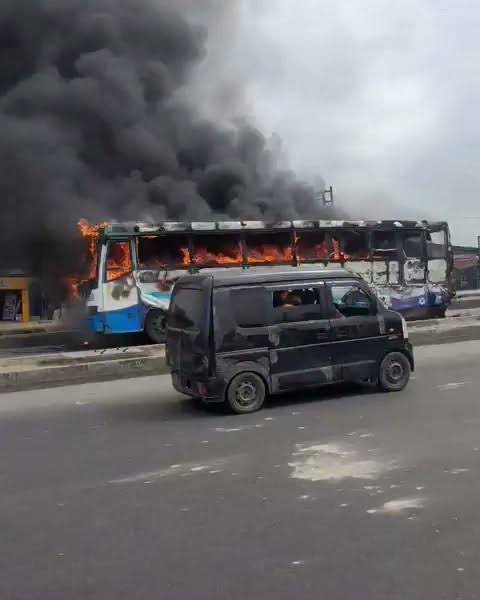
An angry mob has set a Bus Rapid Transit (BRT) bus on fire after it reportedly crushed a commercial motorcyclist to death at Ogolonto Bus Stop along Ikorodu Road in Lagos State.
The incident occurred on Friday, October 16, 2026. Eyewitness accounts and social media reports indicate that the motorcyclist was riding alone along the restricted BRT lane when the collision happened. He died at the scene.
Enraged residents and youths then attacked the bus driver and set the vehicle ablaze. Police officers and officials of the Lagos Neighbourhood Safety Corps (LNSC), who were nearby, intervened promptly and rescued the driver unharmed.
The identity of the deceased motorcyclist and the exact circumstances of the crash had not been officially confirmed at the time of filing this report. It was also unclear whether any arrests had been made in connection with the burning of the bus.
News
ARISE News Wins Seven Honours At Nigerian Broadcasters Merit Awards
The awards recognised the network’s achievements in television journalism and programming, with ARISE News winning the Best TV Channel (Viewer’s Choice) category.


• ARISE News Anchor and host of What’s Trending Ojy Okpe was named Best Newscaster (TV – Female)
ARISE News has emerged as one of the major winners at the just ended Nigerian Broadcasters Merit Awards (NBMA).
ARISE News won seven honours across television broadcasting, news reporting, presentation and production during the ceremony.
The awards recognised the network’s achievements in television journalism and programming, with ARISE News winning the Best TV Channel (Viewer’s Choice) category.
The network’s flagship breakfast programme, The Morning Show, also won the Best TV Talk Show award, further strengthening its recognition in television broadcasting.
ARISE News Anchor and host of What’s Trending Ojy Okpe was named Best Newscaster (TV – Female).
Rufai Oseni was named Nigerian Broadcaster of the Year (Male), while Vimbai Mutinhiri-Ekpeyong received the Nigerian Broadcaster of the Year (Female) award.
The recognition extended to the network’s newsroom, with Ovieteme George winning Best TV News Reporter (Male) for his contributions to television news reporting.
Behind the camera, Sam Adeyemi received the Best Camera Operator/Cinematographer award, recognising his work in television production and visual storytelling.
News
Meta removes 3.7 million accounts in West Africa scam crackdown
The joint operation led to 28 arrests, identified more than 30 suspected scam centres and rescued 117 people allegedly trafficked and forced to work in scam compounds in Ghana.

Meta, the parent company of Facebook and Instagram, has removed more than 3.7 million Facebook and Instagram accounts, pages and groups linked to suspected scam networks operating in West Africa.
The joint operation led to 28 arrests, identified more than 30 suspected scam centres and rescued 117 people allegedly trafficked and forced to work in scam compounds in Ghana.
The company announced the crackdown in a statement on Tuesday, October 13, 2026. It involved 14 technology companies and law enforcement agencies from 10 countries.
The United Kingdom’s National Crime Agency coordinated the operation with the US Department of Justice, the Federal Bureau of Investigation and other agencies. Nigerian authorities were involved.
Other countries included Ghana, Australia, Canada, New Zealand and India.Tech companies that took part included Google, Microsoft, OpenAI, Coinbase, Starlink and Adobe.
Meta said the partnership let participants share intelligence across digital platforms, countries and financial systems to identify criminal networks.


JUST IN: Mob Sets BRT Bus Ablaze After Motorcyclist’s Death in Lagos

BREAKING: DSS Arrests Fugitive Maina Son, Hands Him to EFCC

BREAKING: 5 Arrested Over Imo NYSC Abduction

BREAKING: Lagos Govt Declares Today, Thursday Work-Free to Mark 2026 Ìṣẹ̀ṣe Day

Tech Expert, Zuckerberg trains with UFC champions, Adesanya, Alexander

Organ Trafficking: Ekweremadu bags 10 years in UK prison
-
 Business2 days ago
Naira Exchange Rates For Thursday, October 15
-
 Sports2 days ago
CAF Increases Annual Funding for Member Federations to $700,000
-
 News2 days ago
ASCON To Be Rebranded “National School Of Government”
-

 Business2 days ago
Germany plans tax on sugary drinks
-
 Business2 days ago
WEF could appoint Lagarde as its next chair, sources say
-

 International2 days ago
“Mother of all bombs,” Trump Plans To Hit Iran
-

 News3 days ago
Sanwo-Olu Appoints Olatunbosun Ogunbanwo, 5 Others as Perm Secs
-
 Business1 day ago
Naira Exchange Rates Friday, October 16