
News
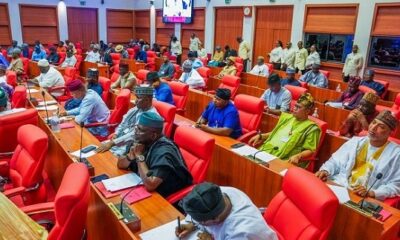
JUST IN: Senate Refutes Alleged Padding Of Supplementary Budget


The Senate has said that it is not ready to join issues with some misguided and mischief makers on the recently appropriated N70bn for the National Assembly which they have mischeavously decribed as a “gift” from the Executive arm of government.
The Senate also said that the passage of the Supplementary Appropriation Act was part of the constitutional duties of the Senate to accommodate funding for the Federal Government’s Palliative for the Nigerian public among other National demands.
The reaction of the Senate to the alleged padding of the Supplementary Budget as reported in some sections of the media was contained a statement issued by the Chairman,, Senate Committee on Media and Public Affairs, Senator Yemi Adaramodu and made available to newsmen in Abuja.
According to the statement, “after the passage of the Supplementary Budget to accommodate funding for Federal Government’ Palliative for the Nigerian public, among other urgent national demands, the socio-political space has been inundated with spurious, inaccurate and irreverent misinterpretations.
“Suffice to say that the passage is part of the absolute constitutional duty of the Senate. We would therefore, not wish to join issues with the mischief and misrepresentation that a portion of the just passed Amendment Act that appropriated 70b Naira was a ‘gift’ to the Legislators,” the statement noted.
Senator Adaramodu stressed that “a visit to the Suites, offices and the general structures of the National Assembly complex would reveal a yawning and the need for exigent attention. Many Senators had to bring their chairs, tables and electronics and in many cases, do sundry repairs.
“The so much debated allocation will not be paid to any Legislator. This will be managed by the National Assembly Bureaucracy. It’s pertinent to also note that the National Assembly complex does not house only the Legislators. There are thousands of workers and service providers, whose working environment need a face-lift, and/with necessary tools.
” Since the Assembly Complex is not owned by Legislators who are merely political birds of passage, such allocation cannot be termed by anyone as a palliative to the Legislators.
“The alleged padding of the palliatve Budget by the National Assembly only exists in the minds of those who are all out to discredit the 10th Assembly. There is nothing like padding as being alleged in some misinformed media outfits.
“We wish to urge fellow compatriots to see the National Assembly as partners in the progress of Nigeria.The National Assembly is the soul of democracy and the 10th Senate shall join hands with other arms of government and our forward looking Nigerians to sing new songs of progress, development, safety and all round economic recovery and growth.










News
NAF Helicopter Makes Precautionary Landing In Makurdi
The Air Force says the operation disrupted the activities of suspected kidnappers and supported the advance of surface forces. The helicopter has since returned to base.


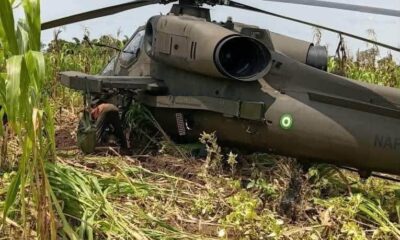
A Nigerian Air Force helicopter has made a precautionary landing in Makurdi, the Benue State capital, after completing a close air support operation targeting suspected kidnappers in Ogbadigbo Local Government Area of the state.
The incident occurred on Wednesday, October 7, 2026, with the helicopter landing on farmland in the Utur, Tse-Igboji area of Makurdi.
According to the Nigerian Air Force, the pilot, while returning to base after the operation, exercised professional discretion to make a precautionary landing approximately ten nautical miles from the airfield, in line with established operational and safety procedures following combat missions.
The Air Force says the operation disrupted the activities of suspected kidnappers and supported the advance of surface forces. The helicopter has since returned to base.
The NAF says it remains committed to sustaining pressure on criminal elements and supporting surface forces through coordinated air and ground operations.
END.
News
Breaking: Military rescue 20 corps members, civilian in Imo
The victims were reportedly abducted while travelling through the state, prompting security agencies to launch an operation to locate and rescue them.

The military, Department of State Services, DSS, police and other security agencies have rescued twenty prospective National Youth Service Corps, NYSC, members and one civilian abducted in Imo State.
The victims were reportedly abducted while travelling through the state, prompting security agencies to launch an operation to locate and rescue them.
The rescued victims are currently receiving medical attention at a DSS facility, according to security sources, while efforts are ongoing to establish the circumstances surrounding the abduction and apprehend any remaining suspects.
News
Military Chiefs Visit Ondo Crash Site As Underwater Search Intensifies
The Nigerian Navy has also brought in specialized hydrographic divers to map the murky waters while plans are underway to use swamp buggies for excavation.

Top military chiefs have visited the crash site of the Nigerian Air Force ATR-42 aircraft in Igbokoda, Ondo State.
The Western Naval Command FOC, Rear Admiral Abubakar Mustapha and Logistics Command AOC, Air Vice Marshal Abubakar Abdul Suleh led the visit to inspect ongoing recovery efforts.
To locate the submerged aircraft, teams have deployed advanced underwater sonar equipment and drones across the difficult mangrove terrain.
The Nigerian Navy has also brought in specialized hydrographic divers to map the murky waters while plans are underway to use swamp buggies for excavation.
Rear Admiral Mustapha thanked the Ondo State Government, local communities and emergency agencies for their support while appealing to the public to remain calm as the operation continues.


Obi advocates policy support for manufacturers

Japan beer giants raided over alleged price-fixing cartel

Belgian Students Protest Over Rising Education Costs

Tech Expert, Zuckerberg trains with UFC champions, Adesanya, Alexander

Organ Trafficking: Ekweremadu bags 10 years in UK prison

SAINT OBI: Between his marriage and his death
-

 Politics2 days ago
BREAKING: APC Chairmen Accused of Leading Armed Attacks on ADC Members in Igueben
-

 News1 day ago
Military Chiefs Visit Ondo Crash Site As Underwater Search Intensifies
-
 News11 hours ago
NAF Helicopter Makes Precautionary Landing In Makurdi
-

 News3 days ago
Military Aircraft Crashes Near Ondo Naval Base; 32 On Board
-
 News2 days ago
UPDATE: NAF Release Identities of Ondo Crash Victims
-

 Politics2 days ago
I sleep And Eat Thinking About Tinubu’s Re-Election – Wike
-

 Business11 hours ago
Naira Today Exchange Rates, Thursday October 8
-
 International10 hours ago
Belgian Students Protest Over Rising Education Costs