News
IPOB to SouthEast Govs: Rename second Niger bridge after Igbo son, not Buhari

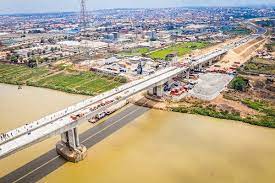
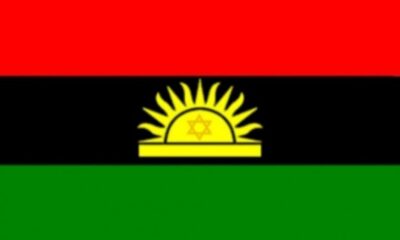
The Indigenous People of Biafra, IPOB, has described the naming of the Second Niger Bridge after President Muhammadu Buhari as unacceptable, saying that the second Niger bridge should be named after an illustrious Igbo person and not Buhari
Recall that Southeast governors had agreed to name the bridge after Buhari following the commissioning of the project.
However, IPOB’s spokesman, Emma Powerful, said it is shameful that the bridge was named after Buhari because he has no regard for Igbos.
A statement by Powerful reads: “The attention of the global Family and movement of the Indigenous People of Biafra (IPOB) under the leadership of Mazi Nnamdi Okwuchukwu KANU has been drawn to the shameful naming of the second Niger Bridge after General Muhammadu Buhari by the shameless Igbo politicians.
“The man that the second Niger bridge is named after did not even show up for the opening ceremony because he had no respect or regard for Ndigbo and knows that he does not deserve any accolades in Biafra land.
“The sellout among the South Eastern Governors, particularly APC Governors who are the useless idiots of the caliphate, want the genocidist and a hater of Ndigbo, Muhammadu Buhari to become the face of the Eastern Region as they display the face and name of a terrorist sponsorer at the entry and exit point of South East through the bridge.
“Muhammadu Buhari was among the Nigeria genocidist soldiers who massacred Ndigbo at Asaba, Anambra, Enugu, and in the rest of the Eastern region.
“His government coordinated the influx of Fulani terrorists masquerading as herdsmen who have massacred our people and raped our women.
“Naming the Second Niger Bridge after the murderer Buhari must not be allowed. The bridge must be renamed to a meritorious Igbo name. The Eastern politicians should tell us any project in the North named after an Igbo person. Our leaders should stop being cowards and Fulani Arewa’s political stooges. They are disgracing the culture of Ndigbo, who never bows down to any man but only worship Chukwu Okike Abiama (God Almighty).
“IPOB maintains that the second Niger Bridge must be renamed. If no Biafran is found worthy by the Eastern politicians to name the second Niger bridge, the existing name of Onitsha Head Bridge should be maintained. “


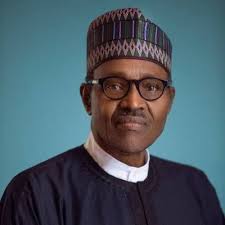



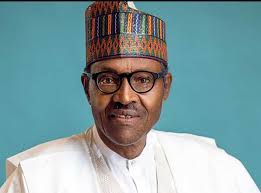


Former Delta State Governor Dr. Emmanuel Eweta Uduaghan is dead. He passed away on the morning of Monday, October 19, 2026, at the age of 71, after a period of illness.
A family statement announced his death, describing it as a devastating loss. Uduaghan, a medical doctor, served as Delta State Commissioner for Health (1999–2003) and Secretary to the State Government (2003–2007) before becoming governor from 2007 to 2015. He was known for contributions to infrastructure and human capital development in the state.
Delta State Governor Sheriff Oborevwori has expressed deep sadness over the passing. In a condolence message, he described Uduaghan as a detribalised leader whose service left a lasting mark on Delta State.
Oborevwori extended heartfelt condolences to Uduaghan’s wife, Roli, his children, the Uduaghan family, the Itsekiri nation, and the people of Delta State, praying for the peaceful repose of his soul.
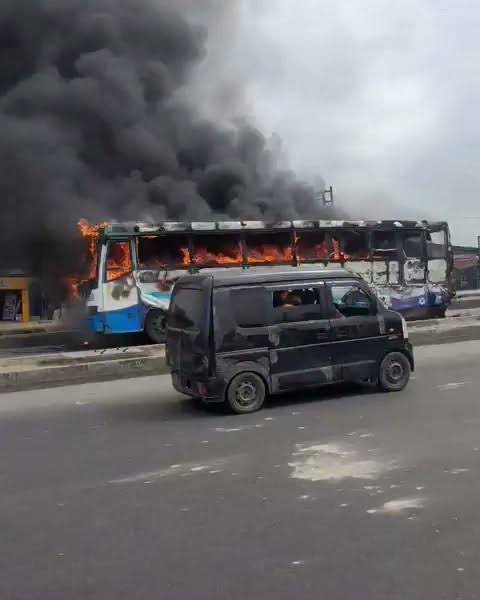
An angry mob has set a Bus Rapid Transit (BRT) bus on fire after it reportedly crushed a commercial motorcyclist to death at Ogolonto Bus Stop along Ikorodu Road in Lagos State.
The incident occurred on Friday, October 16, 2026. Eyewitness accounts and social media reports indicate that the motorcyclist was riding alone along the restricted BRT lane when the collision happened. He died at the scene.
Enraged residents and youths then attacked the bus driver and set the vehicle ablaze. Police officers and officials of the Lagos Neighbourhood Safety Corps (LNSC), who were nearby, intervened promptly and rescued the driver unharmed.
The identity of the deceased motorcyclist and the exact circumstances of the crash had not been officially confirmed at the time of filing this report. It was also unclear whether any arrests had been made in connection with the burning of the bus.
News
ARISE News Wins Seven Honours At Nigerian Broadcasters Merit Awards
The awards recognised the network’s achievements in television journalism and programming, with ARISE News winning the Best TV Channel (Viewer’s Choice) category.

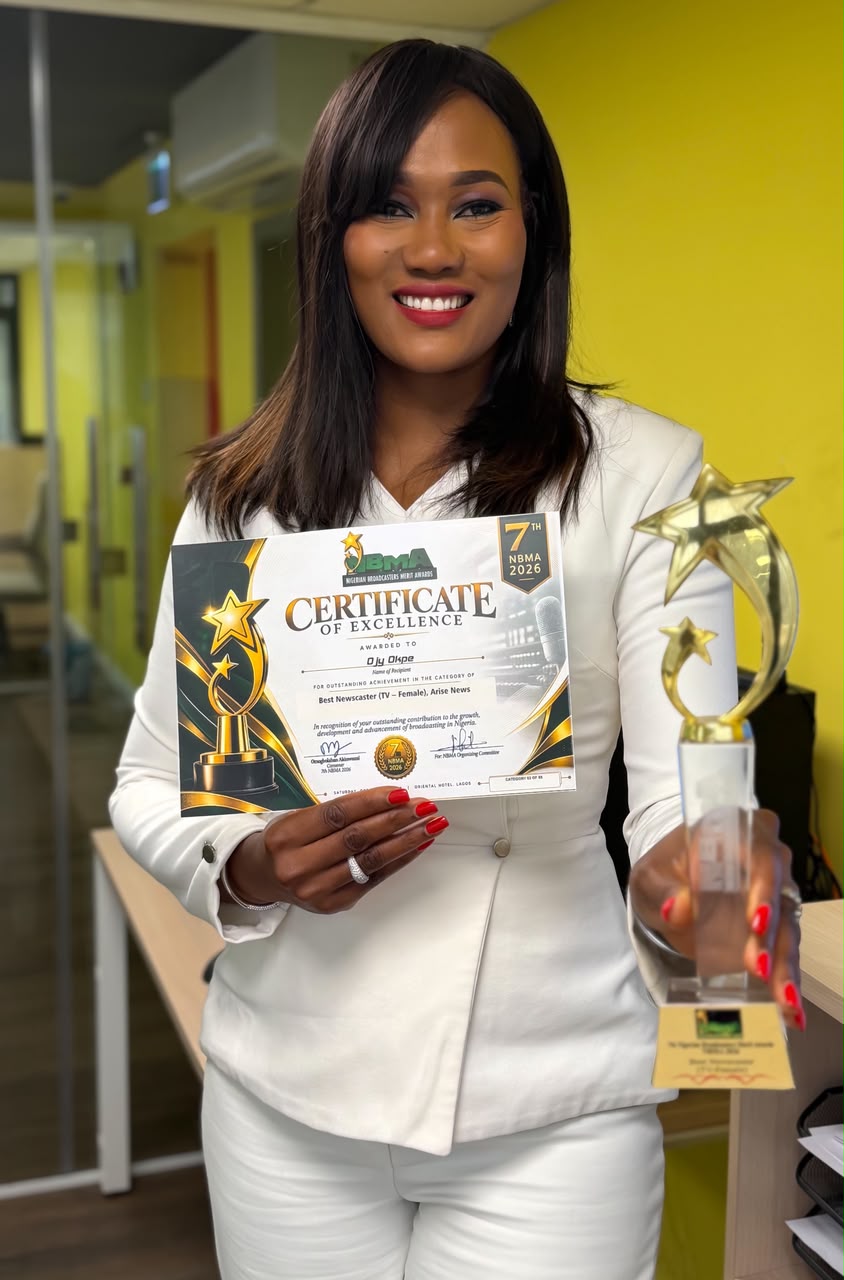
• ARISE News Anchor and host of What’s Trending Ojy Okpe was named Best Newscaster (TV – Female)
ARISE News has emerged as one of the major winners at the just ended Nigerian Broadcasters Merit Awards (NBMA).
ARISE News won seven honours across television broadcasting, news reporting, presentation and production during the ceremony.
The awards recognised the network’s achievements in television journalism and programming, with ARISE News winning the Best TV Channel (Viewer’s Choice) category.
The network’s flagship breakfast programme, The Morning Show, also won the Best TV Talk Show award, further strengthening its recognition in television broadcasting.
ARISE News Anchor and host of What’s Trending Ojy Okpe was named Best Newscaster (TV – Female).
Rufai Oseni was named Nigerian Broadcaster of the Year (Male), while Vimbai Mutinhiri-Ekpeyong received the Nigerian Broadcaster of the Year (Female) award.
The recognition extended to the network’s newsroom, with Ovieteme George winning Best TV News Reporter (Male) for his contributions to television news reporting.
Behind the camera, Sam Adeyemi received the Best Camera Operator/Cinematographer award, recognising his work in television production and visual storytelling.


Mbappé wins Onze d’Or award for 2025/26 season

Ronaldo Gets 30-Day Suspension For Portugal Camp Walkout

JUST IN: Ex-Delta Gov Uduaghan Dies at 71, Oborevwori Mourns

BREAKING: Lagos Govt Declares Today, Thursday Work-Free to Mark 2026 Ìṣẹ̀ṣe Day

Tech Expert, Zuckerberg trains with UFC champions, Adesanya, Alexander