
International
Gaza: Trump, Jordan’s king set for tense meeting

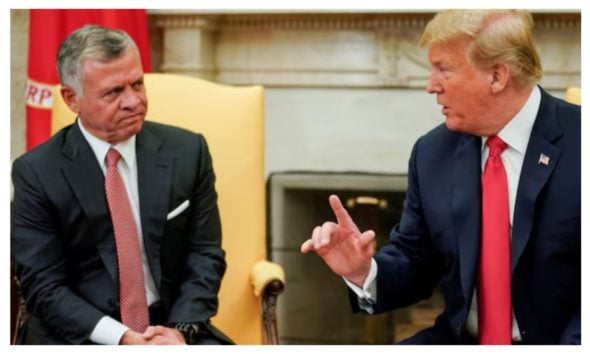
President Donald Trump of the United States will on Tuesday meet Jordan’s King Abdullah for a tense encounter following the US president’s Gaza redevelopment idea and threat to cut aid to the US-allied Arab country if it refuses to resettle Palestinians.
Trump’s proposal, floated one week ago, for the US to take over Gaza, move its shell-shocked residents, and transform the war-ravaged territory into the Riviera of the Middle East prompted a negative response from the Arab world.
The concept has introduced new complexity into a sensitive regional dynamic, including a fragile ceasefire between Israel and the Palestinian militant group Hamas.
Meanwhile, Hamas on Monday said it would stop releasing Israeli hostages from Gaza until further notice, alleging that Israel was violating the agreement to end strikes that have pummeled Gaza.
Trump later proposed canceling the ceasefire if Hamas doesn’t release all remaining hostages it took on October 7, 2023, by the weekend.
King Abdullah has said he rejects any moves to annex land and displace Palestinians. On Tuesday, he is expected to tell Trump such a move could spur radicalism, spread chaos in the region, jeopardize peace with Israel, and threaten his country’s very survival.
For his part, Trump has modified aspects of his initial proposal and doubled down on others. He has expressed increasing impatience with Arab leaders who see the idea as unworkable.
AFP













Vietnamese authorities have busted what officials describe as one of the country’s largest cryptocurrency scams, arresting key suspects in a multi-billion dollar Ponzi-style scheme that allegedly defrauded thousands of investors both domestically and overseas.
The operation, centered around a fraudulent digital token known as Paynet Coin (PAYN), was dismantled by police in Phu Tho province in August 2025. Authorities charged at least 20 individuals, including the alleged ringleader, Nguyen Van Ha, a 45-year-old entrepreneur and founder linked to the Hahalolo platform.
According to reports from local state media, including Công an Nhân dân, the suspects operated an illegal multi-level marketing (MLM) network disguised as a legitimate cryptocurrency investment platform.
Victims were lured with promises of high returns through the Paynet Coin scheme, which authorities labeled as the biggest crypto fraud uncovered in Vietnam to date. The operation reportedly spanned multiple provinces and attracted investors from abroad.
Police seized evidence related to the scheme and charged the suspects with fraud and organizing illegal MLM activities. Estimates of the total scale have varied in reports, with some describing losses in the billions of dollars, though exact figures for victim losses and assets recovered have not been fully disclosed publicly.
This bust is part of a broader crackdown on cryptocurrency-related crimes in Vietnam, where digital asset trading has grown rapidly in recent years but has also attracted scammers exploiting regulatory gaps.
Other recent cases include arrests tied to platforms like ONUS and HanaGold for alleged price manipulation, as well as smaller scams involving fake exchanges and investment schemes totaling millions of dollars.
Vietnamese law enforcement has intensified efforts against online fraud, Ponzi schemes, and unlicensed crypto operations amid a surge in investor complaints. Officials have warned the public to exercise caution with high-yield crypto investments promising unrealistic returns.
The investigation remains ongoing, with authorities urging additional victims to come forward. This case highlights the risks in Vietnam’s booming but largely unregulated crypto market, where millions of citizens hold digital assets.
No further details on trial dates or additional arrests have been released as of the latest reports.
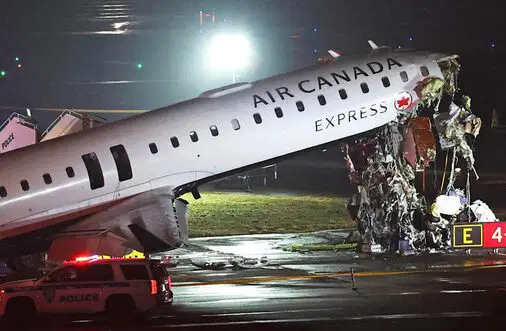
Two pilots were killed and at least 41 people were hospitalized after an Air Canada regional jet struck a Port Authority fire truck on a runway at LaGuardia Airport late Sunday night, officials said.
The incident occurred around 11:40 p.m. on March 22, 2026, when Air Canada Flight 8646 — operated by Jazz Aviation as an Air Canada Express service — was landing after departing from Montreal.
The Bombardier CRJ-900 aircraft, carrying 72 passengers and four crew members, collided with the airport’s Aircraft Rescue and Firefighting vehicle, which was crossing the runway in response to a separate incident.
Both the captain, identified as 30-year-old Antoine Forest, and the first officer, Mackenzie Gunther, died in the crash. The impact heavily damaged the cockpit area of the jet.
At least 41 passengers and crew were transported to area hospitals with injuries ranging from minor to serious, while additional people were treated at the scene. Two Port Authority workers in the fire truck were also reported injured.
Passengers described the collision as sudden and violent, with some crediting the pilots’ actions for helping mitigate a worse outcome.
CCTV and other video footage captured the moments leading up to and during the collision, showing the aircraft striking the emergency vehicle. Air traffic control audio reportedly included urgent calls of “Stop, truck 1. Stop” just before impact.
LaGuardia Airport was temporarily closed following the crash, causing widespread flight delays and cancellations across the New York area. It reopened on Monday at reduced capacity as investigators continued their work on the scene.
The U.S. National Transportation Safety Board (NTSB), along with Canadian aviation authorities and the Port Authority of New York and New Jersey, have launched a full investigation into the runway incursion and collision.
Preliminary reports suggest the fire truck had been cleared to cross the active runway.
Air Canada expressed condolences to the families of the deceased pilots and said it is cooperating fully with investigators.
“Our thoughts are with everyone affected by this tragic event,” the airline stated. This marks a rare fatal ground collision at a major U.S. airport in recent years, raising fresh questions about runway safety protocols and vehicle movements during active landings.
International
Middle East War: IEA recommends options to ease oil price pressures on consumers, Motorists
Work from home where possible. Displaces oil use from commuting, particularly where jobs are suitable for remote work.

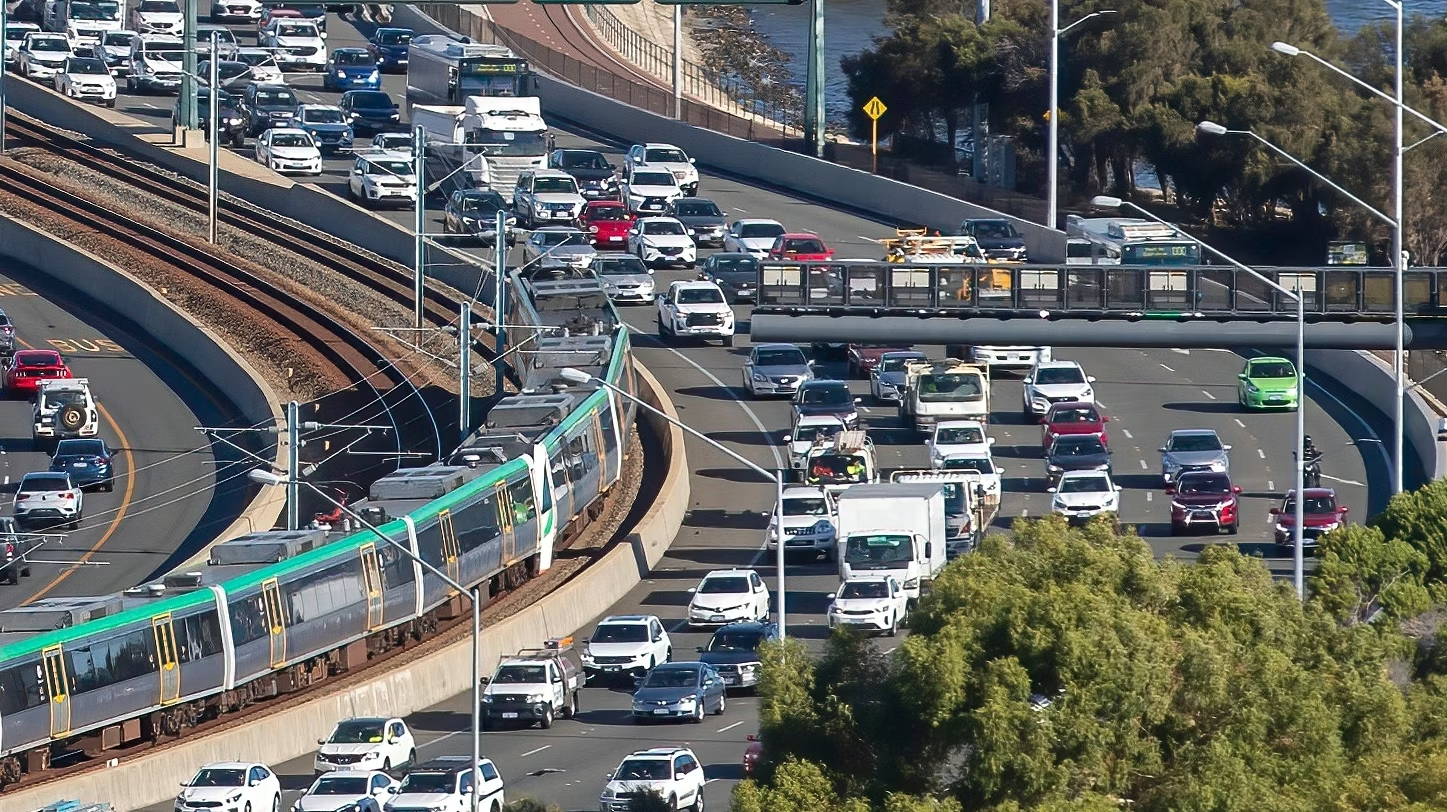
Image credit : Shutterstock
Immediate actions to reduce demand:
1. Work from home where possible. Displaces oil use from commuting, particularly where jobs are suitable for remote work.
2. Reduce highway speed limits by at least 10 km/h. Lower speeds reduce fuel use for passenger cars, vans and trucks.
3. Encourage public transport. A shift from private cars to buses and trains can quickly reduce oil demand.
4. Alternate private car access to roads in large cities on different days.
Number-plate rotation schemes can reduce congestion and fuel-intensive driving.
5. Increase car sharing and adopt efficient driving practices. Higher car occupancy and eco-driving can lower fuel consumption quickly.
6. Efficient driving for road commercial vehicles and delivery of goods
Better driving practices, vehicle maintenance and load optimisation can cut diesel use.
7. Divert LPG use from transport
Shifting bi-fuel and converted vehicles from LPG to gasoline can preserve LPG for cooking and other essential needs.
8. Avoid air travel where alternative options exist
Reducing business flights can quickly ease pressure on jet fuel markets.
9. Where possible, switch to other modern cooking solutions
Encouraging electric cooking and other modern options can reduce reliance on LPG.
10. Leverage flexibility with petrochemical feedstocks and implement short-term efficiency and maintenance measures
Industry can help free up LPG for essential uses while reducing oil consumption through quick operational improvements


INEC Dismisses Calls for Chairman’s Removal

Ebonyi: Gunmen Assasinate Another Traditional Ruler

From South Africa to US, ‘Cicada’ COVID-19 variant spreading

Tech Expert, Zuckerberg trains with UFC champions, Adesanya, Alexander

Organ Trafficking: Ekweremadu bags 10 years in UK prison

SAINT OBI: Between his marriage and his death
-
 Business2 days ago
33 Nigerian Banks Beat CBN’s Recapialisation with ₦4.65trn Combined Capital Base
-
 Politics2 days ago
BREAKING: INEC Withdraws Recognition of David Mark’s ADC
-

 Sports2 days ago
FirstBank Sponsors Samuel Okwaraji U-16 Football Championship 2026
-

 News2 days ago
JUST IN: Tinubu Heads to Jos Tomorrow, Postpones Ogun Trip for 5-State Visits
-

 News2 days ago
Easter: FG declares Friday, Monday public holidays
-

 Entertainment2 days ago
Super Eagles Iwobi to launch music album ‘More To Life’
-

 News2 days ago
Gas Leak in Ogun School: 30 Students, Teacher Hospitalised
-

 Politics2 days ago
Arise News Anchor Ikokwu in Political Race for Reps Seat