Health
FG launches Ultramodeen fashion Hub in Borno, Targets 48,000 jobs

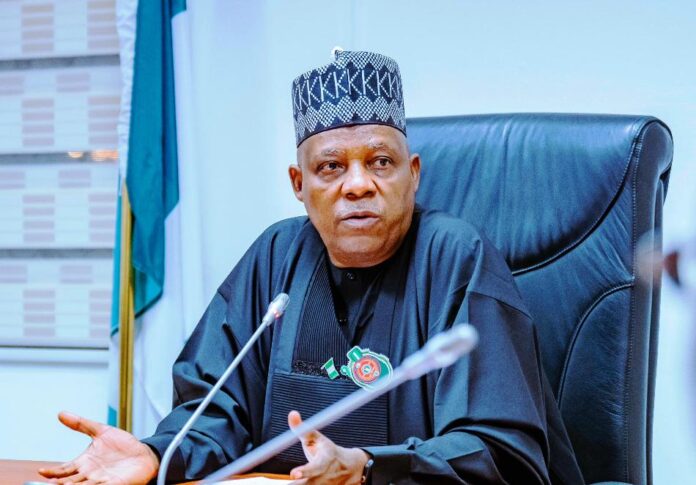
The federal government has launched one of Nigeria’s largest ultramodern fashion manufacturing hubs in Maiduguri, the Borno State capital with a target of generating over 48,000 jobs through the facility in the state.
In continuation of the disbursement of its N75 billion support package for Micro, Small and Medium Enterprises (MSMEs), the government also announced unconditional grants of N300,000 for outstanding MSMEs participating in the 6th Expanded National MSME Clinics programme.
Speaking on Tuesday when he launched the fashion hub and the Expanded MSMEs Clinic in Maiduguri, Vice President Kashim Shettima restated the commitment of the administration of President Bola Ahmed Tinubu to fostering innovation, upskilling the workforce, and ensuring equitable wealth distribution across the nation.
“The strength of any nation lies not in its natural resources but in the hands of its skilled and enterprising citizens. You are the surest means of distributing wealth equitably across the land. You are the crucial link to securing a prosperous future,” he declared.
The N75 billion MSME Intervention Fund is being administered through the Bank of Industry, offering loans up to N1 million at 9% interest to 75,000 businesses nationwide.
Announcing the N300,000 grant for each business owners, VP Shettima said, “I am pleased to announce on behalf of His Excellency, President Bola Ahmed Tinubu, that an unconditional grant of N300,000 will be awarded to each outstanding MSME exhibiting at today’s clinic”.
According to him, the intervention represents yet another fulfillment of the promise made by President Bola to provide access to capital and expand opportunities for all Nigerians.
“Every business empowered is a step closer to eradicating poverty, and we do not take for granted the critical role you play as the buffer of our economy, particularly at the informal level,” he added.
On the MSME Clinic, Senator Shettima explained that it provides “a unique platform for business owners, aspiring entrepreneurs, and innovators in Borno State to interact directly with regulatory agencies, financial institutions, and business support organisations.
“It is an avenue to receive practical, on-the-spot solutions to the challenges you face in running your businesses,” he pointed out.
The Vice President also announced the successful completion of the second cohort of the FGN-ALAT Digital Skill inovation Programme in Borno State, a partnership with Wema Bank that has trained over three million Nigerians in digital skills.
“The FGN-ALAT programme has trained over two million Nigerian youths and one million MSMEs in digital skills and resources critical for thriving in today’s technology-driven economy,” the VP noted.
He further stated that the fashion hub is among the largest ever established by the federal government, furnished with state-of-the-art equipment to support the fashion manufacturing cluster in Borno State.
He continued: “It has the capacity to boost production, achieve economies of scale, and align with global standards.
We anticipate that this facility will be managed by a competent private sector entity, with federal and state governments providing vigilant oversight.
“Our vision is for this hub to become a reference point for excellence, enterprise, and training—not only for Borno State but for the entire nation.”
Commending the state government for its support, the Vice President expressed gratitude to the government of Borno State, under the stewardship of Governor Babagana Umara Zulum, for partnering with the federal government to bring the Expanded MSME Clinic and the fashion hub to the people of the state.
He reiterated the administration’s commitment to grassroots economic development, noting that “without skills, innovation stalls. Without accessible capital, dreams wither.
“This is why we are committed to standing with you, supporting you, and ensuring that your most ambitious ideas are transformed into flourishing enterprises instead of being forgotten in the cupboards of dreams not realised,” he added.
In his remarks, Governor Zulum regretted that MSMEs had suffered “untold hardship in the state due to decade-long insurgency and the prevailing economic situation in the country.
”He expressed optimism that the launch of the MSME Clinic will revive business activities, small and medium enterprises, provide employment opportunities and sources of income for individuals in Borno State.
Assuring that the government is committed to creating more opportunities for the population, Governor Zulum said in recognition of the importance of MSMEs, his administration has made several policies to encourage the citizens to build expanded sources of income.
Also, the Minister of Agriculture and Food Security, Senator Abubakar Kyari, stated that the launch of the MSME Clinic and the Fashion and Innovation Hub marks another milestone of success in the administration of President Bola Ahmed Tinubu.
He said that going around the exhibition with the Vice President, he observed that “everything speaks to the 8-point agenda of Mr. President.”
He highlighted the agenda to include food security, poverty reduction, job creation, inclusion of women and youths, provision of security, access to capital and rule of law.
On his part, the Minister of State for Industry, Trade and Investment, Sen John Owen Eno, said the MSME Clinic is a transformational programme being led by the Vice President and is responsible for unlocking a lot of economic opportunities, empowering small businesses and encouraging innovation.
He said that coming to commission MSME in Maiduguri underscores the legacy of diversifying the economy, contributing to job growth as well as trying to be competitive.
Giving a recap of the MSME Clinics across the country, especially in Borno State, the Senior Special Assistant to the President on MSMEs and Job Creation, Mr. Tola Johnson, expressed appreciation for the commissioning of the Clinic in the state.
While thanking the Governor and his team for a cordial working relationship, he said that the MSME Clinic organizes an award ceremony every June 27, and any state that the Vice President attends for the MSME Clinic prior to the award ceremony is qualified to win either the male or female MSME award.











Health
Millions of bedbugs crawl out of mattresses and walls in huge outbreak
Bedbugs can enter homes on clothes, luggage, or second hand furniture – and “hide” in mattresses or walls, according to the NHS.


Millions of bedbugs were crawling out of mattresses in what a pest controller said was the worst outbreak he had seen in 38 years.
They were even in the walls and under the wallpaper, with the mattresses and bed frames needing to be incinerated.
Cardiff pest controller Gareth Davies had to wear full protection as his team tackled the problem in the Canton area of the city, using a specialist vacuum cleaner to collect millions of the bugs.
It came after they had tackled a large cockroach outbreak last month in a scene he likened to a horror movie.
“This house was just horrific,” he told BBC Radio Wales Breakfast.
“Hundreds of thousands of them when you lifted the mattresses up.
“They were coming out of the wallpaper, it was horrendous.”
Bedbugs can enter homes on clothes, luggage, or second hand furniture – and “hide” in mattresses or walls, according to the NHS.
Credit: BBC
The Nigeria Centre for Disease Control and Prevention (NCDC) has confirmed that Lassa fever has claimed 259 lives and infected 1,086 people across 24 states and 118 local government areas so far in 2026.
In its latest Lassa Fever Situation Report for epidemiological week 36 (August 31 to September 6), the agency said the figures represent a case fatality rate of 23.9 percent — significantly higher than the 18.6 percent recorded during the same period in 2025.
Twelve new confirmed cases were recorded in week 36, a decline from the 18 cases reported the previous week. The fresh infections were detected in Ondo, Edo and Kogi states.
Five states continue to bear the heaviest burden, accounting for 87 percent of all confirmed cases this year: Bauchi, Ondo, Taraba, Benue and Edo. People aged 21 to 30 remain the most affected age group.
The NCDC noted that no new infections among healthcare workers were recorded during the latest reporting week. The agency continues to urge the public to maintain hygiene, avoid contact with rodents and their droppings, and seek early medical care if symptoms appear.
Health
Nigerian hospital successfully performs kidney cancer surgery via tele-robotic
The development could reduce the need for Nigerians to travel abroad for specialised medical treatment, thereby reducing expenditure on international travel, accommodation and medical services.
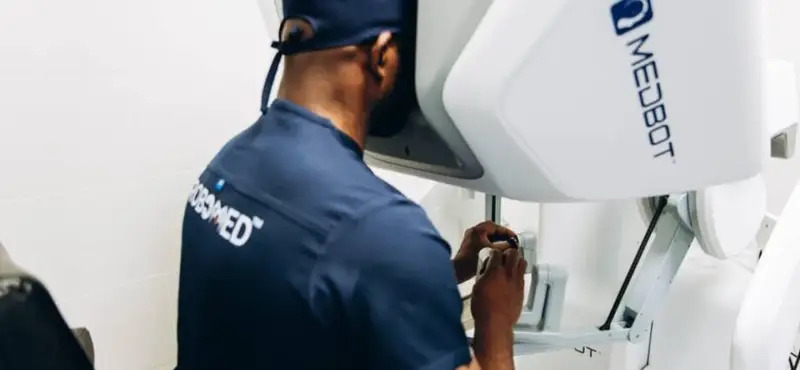
• A surgeon performing tele-robotic surgery.
Nisa Premier Hospital, Abuja, has partnered with RoboMed Global and The Redeemer’s Health Village (RHV) to successfully perform what the hospital described as the first tele-robotic surgery in Nigeria and West Africa.
The landmark kidney cancer surgery was performed on a patient at Nisa Premier Hospital, Abuja, while the surgeon, Professor Obi Ekwenna-Davis, remotely controlled the robotic surgical platform from Redeemer’s Health Village in Lagos.
The procedure, which lasted approximately three hours, was performed to remove a kidney affected by a cancerous tumour.
The hospital said the patient had been discharged following the successful procedure, although details about the patient’s identity and condition were withheld for privacy reasons.
Speaking during an event to mark the milestone, the Chief Executive Officer of Nisa Premier Hospital, Dr Ibrahim Wada, said the development demonstrated the potential of tele-robotic surgery to connect specialist surgical expertise with patients across Nigeria.
Wada said the procedure was carried out using the MicroPort robotic surgical platform installed at Nisa Premier Hospital, with the remote surgeon controlling the system from Lagos.
He said the development could reduce the need for Nigerians to travel abroad for specialised medical treatment, thereby reducing expenditure on international travel, accommodation and medical services.
According to him, the technology also creates an opportunity for Nigerians to access specialised expertise from doctors located in other parts of the world without requiring the doctors to travel physically to Nigeria.
Source: Daily Trust


JUST IN: Mob Sets BRT Bus Ablaze After Motorcyclist’s Death in Lagos

BREAKING: DSS Arrests Fugitive Maina Son, Hands Him to EFCC

BREAKING: 5 Arrested Over Imo NYSC Abduction

BREAKING: Lagos Govt Declares Today, Thursday Work-Free to Mark 2026 Ìṣẹ̀ṣe Day

Tech Expert, Zuckerberg trains with UFC champions, Adesanya, Alexander