
News
UK begins Alison-Madueke’s trial on bribery charges
Alison-Madueke sat in the dock alongside oil industry executive Olatimbo Ayinde, 54, who is charged with one count of bribery relating to Alison-Madueke and a separate count of bribery of a foreign public official.


The alleged corruption trial of the former Minister of Petroleum Resources, Diezani Alison-Madueke commenced on Tuesday at the London’s Southwark Crown Court.
Alison-Madueke sat in the dock alongside oil industry executive Olatimbo Ayinde, 54, who is charged with one count of bribery relating to Alison-Madueke and a separate count of bribery of a foreign public official.
British prosecutors told the court that Alison-Madueke took bribes including luxury goods and the use of high-end properties from industry figures interested in lucrative oil and gas contracts, when she was minister for petroleum resources between 2010 and 2015 under then-president Goodluck Jonathan and was also briefly president of the Organization of the Petroleum Exporting Countries (OPEC), the first woman to hold either role.
According to Reuters, the 65-year-old is now one of the most high-profile former energy officials to stand trial for alleged corruption, having been charged in 2023 with five counts of accepting bribes and a charge of conspiracy to commit bribery, which she denies.
Prosecutor Alexandra Healy told jurors at London’s Southwark Crown Court that Alison-Madueke “enjoyed a life of luxury in London”, where she often stayed, provided by those interested in being awarded or retaining contracts with Nigerian state-owned companies.
Healy said Alison-Madueke was given the use of high-end properties and vast quantities of luxury goods by people who “clearly believed she would use her influence to favour them”.
There was no evidence that Alison-Madueke awarded contracts to someone who should not have had one, Healy said.
But given Alison-Madueke’s role “she should not have accepted benefits from those who were no doubt doing extremely lucrative business in oil and gas with government-owned entities”, Healy added.

Apartments available for Rent
2-bedroom flat
Room and Parlour Self-Contained
A room self contain
Contact: +2347067784741
News
ESUT to be renamed after Jim Nwobodo – Mbah
… there is a legal process to follow. ESUT was established by law, and changing its name would require the appropriate legislative steps and engagement with relevant stakeholders.

Governor of Enugu State, Dr. Peter Mbah, has unveiled plans to rename the Enugu State University of Science and Technology (ESUT) after a Second Republic Governor of old Anambra State, Senator Jim Nwobodo.
Mbah made this known during the 3rd Distinguished Personality Lecture of the university delivered by Nwobodo at the Barr. Peter Ndubuisi Mbah Multipurpose Auditorium, ESUT, Enugu, on Thursday.
He said the idea, which was first suggested by the ESUT Alumni Association, was in tandem with his thoughts, describing it as a fitting tribute to the elder statesman, who founded the institution in 1980.
The Governor emphasised that the brainchild of the ex-governor had played a critical role in the human capital development of not just Enugu State, but also the old Anambra State and Nigeria as a whole.
He, however, said that there is a legal process to follow. ESUT was established by law, and changing its name would require the appropriate legislative steps and engagement with relevant stakeholders.
“I intend to begin those engagements and work with the institutions concerned to advance the proposal through the proper process,” he said.
News
South Africans Begin Another ‘Operations Flush Out Nigerians’ Protest
Fani-Kayode described those behind xenophobic attacks as a tiny minority who should not be allowed to define the character of the country’s population.
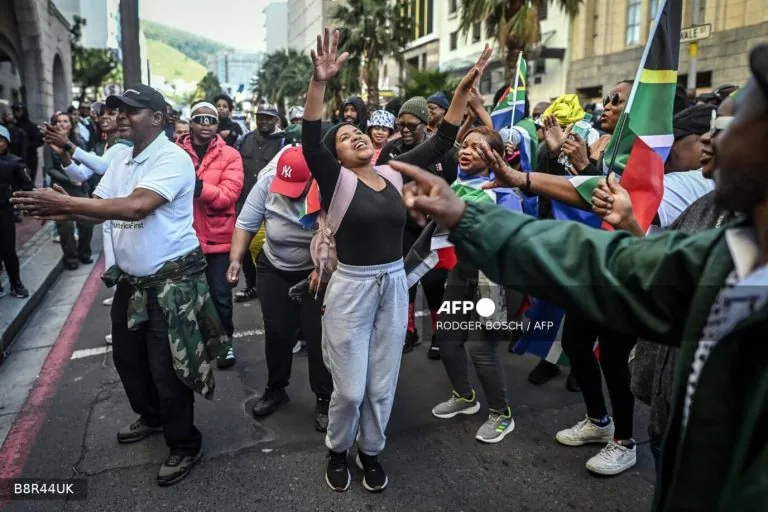
Nigeria’s High Commissioner to South Africa, Femi Fani-Kayode, is sweating to protect Nigerians and Nigeria’s image as protesters, operating under the March and March movement launched a fresh anti-Nigerian campaign, ” The state must ban Nigerians from South Africa. They must ban Nigerians until they stop selling drugs to our people. The rest of Africa, we are fine, but we do not want Nigerians in South Africa anymore. That is what we are saying.”
The protesters on Wednesday led by the group’s leader, Jacinta Ngobese-Zuma, took a particularly confrontational turn in Sunnyside, a Pretoria suburb popularly associated with a sizeable Nigerian community and sometimes described as ‘Little Lagos.
They specifically accused Nigerians of engaging in drug trafficking and contributing to social problems in South African communities.
The demonstration, .Challenging Nigerian residents to explain their presence and influence in the neighbourhood, Ngobese-Zuma questioned how the area acquired the nickname.
“I am being told here that we’ve entered Sunnyside, the home of Nigerians. I am inviting Nigerians to come out, let’s talk to each other. We want to know who gave you this place and called it Nigeria. Who gave you permission to call this place Lagos or whatever you call it?” she asked.She further questioned who had authorised Nigerians to identify parts of South African territory with their home country.
The remarks point to the increasingly hostile rhetoric directed at the immigrant community.
Ngobese-Zuma described the convention as “not sustainable and not feasible”.
She alleged that the presence of migrants was placing additional pressure on public resources and aggravating the frustrations of South African citizens.
The movement said it was taking its grievances to the Department of Home Affairs, where it intended to formally present its demands for tougher immigration controls, restrictions on refugee admissions and accelerated deportation of undocumented foreign nationals.
For his part, the group’s legal representative, Xolani Zuma, went further by demanding an outright prohibition on Nigerians entering South Africa.
The latest demonstration comes amid growing strain in relations between Nigeria and South Africa over recurring xenophobic hostility, the safety of Nigerian nationals and disagreements surrounding the diplomatic representation of both countries.
Only last week, Fani-Kayode, and the South African Presidency were involved in a diplomatic exchange following the exclusion of his prepared speech during the presentation of his credentials.
Fani-Kayode had described the omission as disrespectful to Nigeria.
Although he subsequently said the disagreement had been resolved following the intervention of South African President Cyril Ramaphosa and an invitation from the country’s Department of International Relations and Cooperation.
The envoy also disclosed that he had begun addressing concerns affecting Nigerians in South Africa since assuming office.
Fani-Kayode described those behind xenophobic attacks as a tiny minority who should not be allowed to define the character of the country’s population.
He maintained that the majority of South Africans were decent and accommodating.
He expressed confidence that the two countries could overcome their differences without severing longstanding diplomatic relations.
However, Fani-Kayode had warned that patience was running thin within Nigeria’s corridors of power over repeated attacks on its citizens.He insisted that the country would not abandon its nationals to xenophobic violence.

House For Rent

Armed Men Attack Fmr. Super Eagles Captain, Segun Odegbami in Abeokuta Residence (Images)

Dr. Victor Okhai Named Dean of the Osiri University School of Business

BREAKING: Lagos Govt Declares Today, Thursday Work-Free to Mark 2026 Ìṣẹ̀ṣe Day

Tech Expert, Zuckerberg trains with UFC champions, Adesanya, Alexander

Organ Trafficking: Ekweremadu bags 10 years in UK prison
-

 Crime3 days ago
UPDATE: 17 Kidnap Victims Rescued After Forest Gun Battles in Kogi – Police (Images)
-
 Politics3 days ago
Soludo Bets on Tinubu – Shettima Winning Second Term
-

 Business2 days ago
Kuda to layoff 40% workforce in Nigeria , six other countries
-

 News3 days ago
South Africans Begin Another ‘Operations Flush Out Nigerians’ Protest
-
 Sports2 days ago
Armed Men Attack Fmr. Super Eagles Captain, Segun Odegbami in Abeokuta Residence (Images)
-
 News2 days ago
ESUT to be renamed after Jim Nwobodo – Mbah
-
 Business2 days ago
Fidelity Bank Designates Amuchie Next MD/ CEO
-
 Opinions2 days ago
Dr. Victor Okhai Named Dean of the Osiri University School of Business