
Business
Dangote refinery: Crude supply crisis threatens oil investments, operators warn FG


The recent developments in Nigeria’s oil sector, particularly surrounding the Dangote Petroleum Refinery and the broader issues of domestic crude oil supply, have raised significant concerns among industry stakeholders and observers.
- Accusations and Denials: The Vice President of Oil and Gas at Dangote Industries Limited, Devakumar Edwin, accused International Oil Companies (IOCs) of deliberately frustrating the Dangote refinery’s efforts to source local crude oil. He alleged that IOCs were inflating prices or claiming unavailability, forcing the refinery to import crude at higher costs from distant countries like the United States. These actions, according to Edwin, hinder the refinery’s viability and perpetuate Nigeria’s dependence on imported refined products.
- Response from Government and Regulators: The Nigerian Midstream and Downstream Petroleum Regulatory Authority (NMDPRA) refuted claims of issuing licenses for importing substandard fuel into Nigeria, countering allegations made by Dangote refinery officials. The government emphasized that steps were being taken to ensure compliance with regulations and quality standards in the importation of refined products.
- Industry Impact: The Lagos Chamber of Commerce and Industry (LCCI) highlighted the potential damage to investor confidence due to these disputes. They stressed the importance of resolving issues around crude oil pricing, supply contracts, and logistics costs promptly to maintain a favorable investment climate in the oil and gas sector. The chamber called for transparency and fair dealings among all parties involved, urging the government to play a regulatory role effectively.
- Investment Concerns: Stakeholders, including modular refinery operators and industrialists, expressed concerns over the implications of ongoing supply disputes on Nigeria’s oil sector investment attractiveness. They emphasized the need for regulatory clarity and fair practices to sustain investor trust and support local refining capacity.
- Path Forward: The LCCI advocated for continued dialogue and negotiation among stakeholders to resolve these critical issues. They emphasized the role of effective regulation and adherence to international best practices in fostering a competitive and sustainable oil and gas sector in Nigeria.
In summary, the domestic crude oil supply crisis and related accusations underscore significant challenges facing Nigeria’s oil industry. Resolving these issues requires collaborative efforts among government regulators, IOCs, refineries, and other stakeholders to ensure fair practices, regulatory compliance, and sustainable investment in the sector.









BLACK MARKET RATES
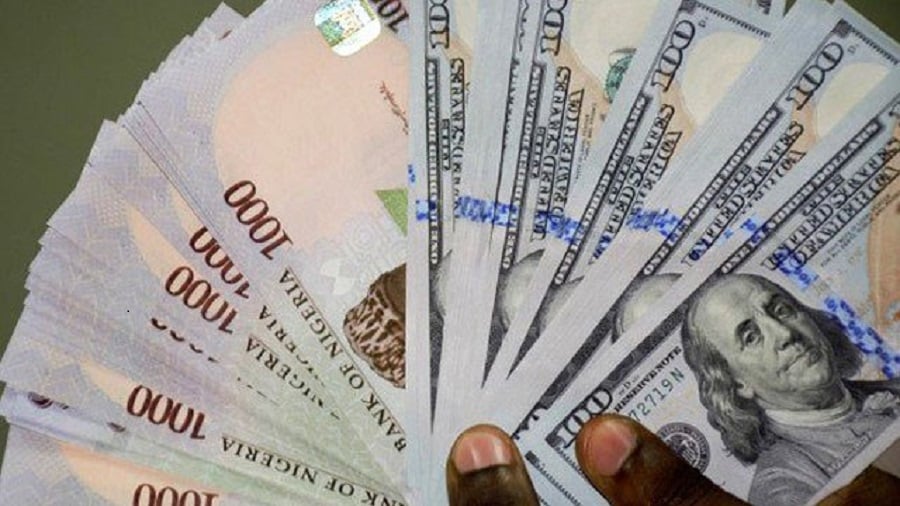
US DOLLAR (USD) Buy ₦1,416 Sell ₦1,423
GREAT BRITISH POUND (GBP) Buy ₦1,890 Sell: ₦1,910
EURO (EUR) Buy ₦1,590 Sell ₦1,610
CANADIAN DOLLAR (CAD) Buy ₦1,020 Sell ₦1,080
SOUTH AFRICAN RAND (ZAR) Buy ₦75 Sell ₦90
UAE DIRHAM Buy ₦350 Sell ₦370 CHINESE YUAN Buy ₦190 Sell ₦205
GHANA CEDI (GHS) Buy ₦95 Sell ₦110
WEST AFRICAN CFA Buy ₦2, 300 Sell ₦2, 400
CENTRAL AFRICAN CFA Buy ₦2,150 Sell 2,250
AUSTRALIAN DOLLAR Buy ₦800 Sell ₦900
CBN Exchange Rates
US DOLLAR (USD) ₦1,357. 65
GREAT BRITISH POUND (GBP) ₦1,834.04
EURO (EUR) ₦1,567.00
SWISS FRANC (CHF) ₦1,671. 98
JAPANESE YEN (JPN) ₦8.53
CHINESE YUAN (CNY) ₦201. 34
WEST AFRICAN CFA (XOF) ₦2. 39
WEST AFRICAN UNIT ACCOUNT (WAUA) ₦1,858.02
SAUDI RIYAL (SAR) ₦361.62
SOUTH AFRICAN RAND (ZAR) ₦84.23
Business
Traders shut down Enugu ‘s Obollo-Afor market over N25,000 haulage levy
However, Chairman of ESIRS, Emmanuel Nnamani, in a letter to the traders, said the haulage levy was not paid by traders buying or selling goods in the markets, but was applicable strictly to truck drivers plying interstate routes.

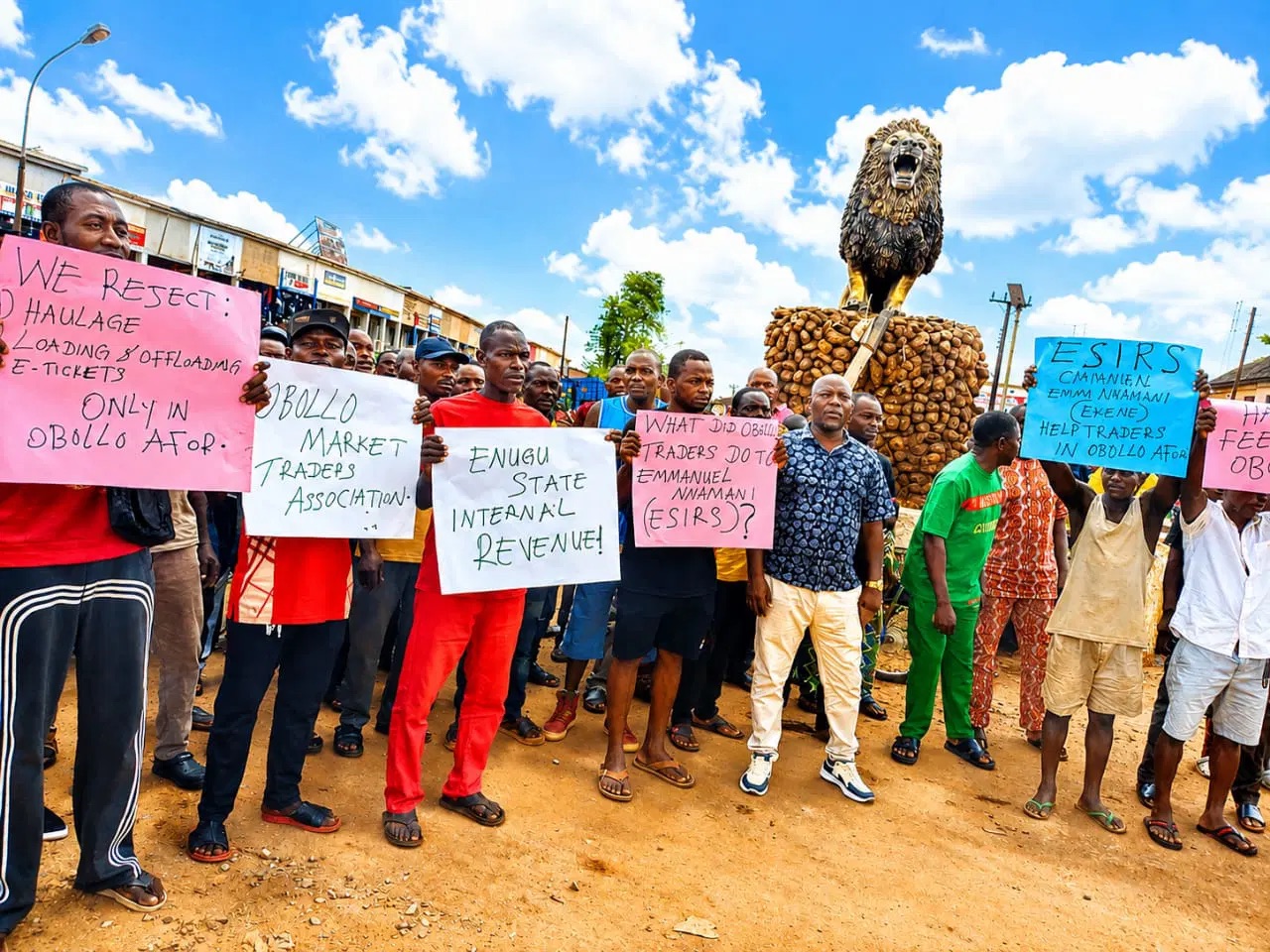
All shops and markets at Obollo-Afor, Udenu Local Government Area of Enugu State were shut yesterday, as traders staged a peaceful protest against alleged selective collection of a N25,000 haulage levy in the market.
The traders, who locked their shops and took to the streets in large numbers, carried placards with various inscriptions, alleging that the Enugu State Internal Revenue Service (ESIRS) had singled out Obollo-Afor Market for the collection of N25,000 haulage fee on every truckload of goods loaded or offloaded in the market.
However, Chairman of ESIRS, Emmanuel Nnamani, in a letter to the traders, said the haulage levy was not paid by traders buying or selling goods in the markets, but was applicable strictly to truck drivers plying interstate routes.
Addressing officials of the Udenu Local Government Council at the council secretariat, where the protesters marched to present their grievances, Chairman, Obollo-Afor Market Traders Association, Charles Eze, lamented that truck operators bringing foodstuffs, building materials, and other commodities to the market had stopped coming because of the levy.
Business
Nigeria’s oil production dropped by 4% in July – NUPRC
“In the month under review, the daily peak production of crude oil and condensate was 1.78mbpd, while the lowest daily production was 1.57mbpd.”

The Nigerian Upstream Regulatory Commission (NUPRC) data has shown Nigeria’s average daily oil production fell by four percent in July, 2026.
According to the NUPRC, Nigeria produced 1.505 million barrels per day (bpd) of crude oil and 0.17 million bpd of condensate, bringing the combined daily production to 1.67 million bpd.
The commission said the country met and exceeded its Organisation of the Petroleum Exporting Countries (OPEC) quota of 1.5 million bpd for the third consecutive month.
“In the month under review, the daily peak production of crude oil and condensate was 1.78mbpd, while the lowest daily production was 1.57mbpd.”


HAPPENING NOW: Security Beefed up at INEC Office in Osun Ahead of Saturday’s Governorship Election

Gov Mbah Invest in world-class Enugu International Hospital

Committees hit the ground running for 8th Kwara State Sports Festival

Tech Expert, Zuckerberg trains with UFC champions, Adesanya, Alexander

Organ Trafficking: Ekweremadu bags 10 years in UK prison

SAINT OBI: Between his marriage and his death
-

 Business2 days ago
FG approves tax waivers for 4,000 electric vehicles
-

 Business2 days ago
Azikel Refinery in Bayelsa Set To Add 25,000 bpd To National Capacity
-

 Business2 days ago
Guaranty Trust Bank doubles naira card international spending limit to $40,000
-

 Business2 days ago
Nigeria’s oil production dropped by 4% in July – NUPRC
-

 Business2 days ago
Naira Exchange Rates Thursday, August 13
-

 Sports2 days ago
Katsina United player declared dead found alive in mortuary
-

 Sports2 days ago
NBA’s Los Angeles Lakers to be sold for $12.5bn – Report
-

 International2 days ago
Millions Rushing To Watch Solar Eclipse in Europe