
News
House softens stance on Tax Reform Bills

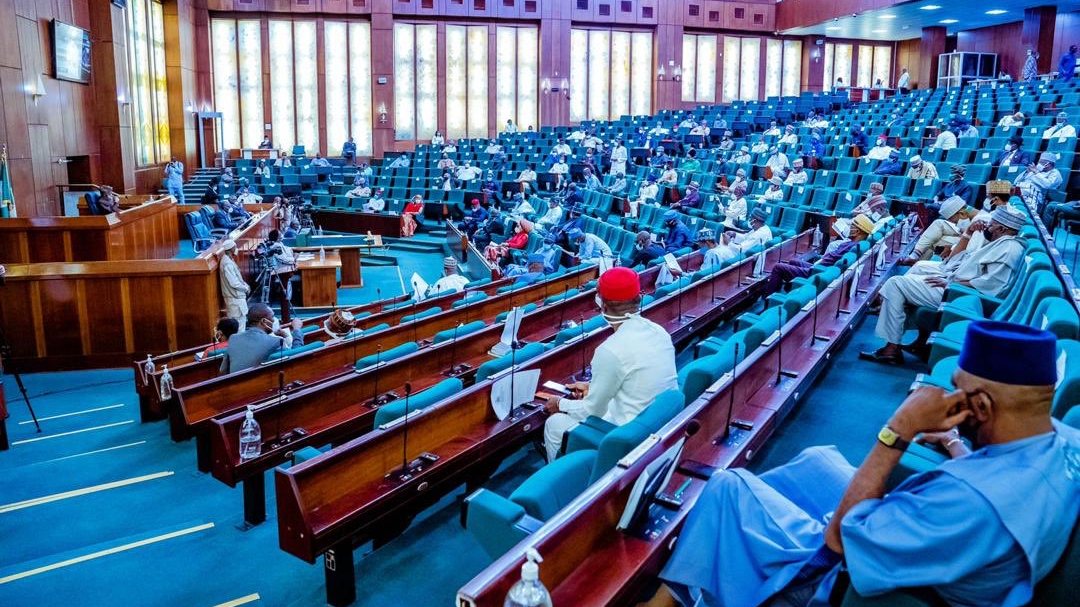
The House of Representatives has softened its stance on the Tax Reform Bills.
Yesterday, after a three-hour generally positive debate by members, the Bills scaled second reading and passed for public hearing.
This is unlike the situation when the Bills were sent by President Bola Ahmed Tinubu to the Green Chamber in October.
Following opposition from a section of the ruling class, the House exploded in uproar over the Bills, forcing Speaker Abbas Tajudeen to dissolve the House into and Executive session after which all issues on the Bills were kept in ambiance to allow for consultations.
But at the Senate, the Bills were quickly debated and moved to the public hearing stage.
The Bills are the Nigeria Revenue Service (Establishment) Bill, the Nigeria Tax Bill, the Nigeria Tax Administration Bill, and the Joint Revenue Board (Establishment) Bill.
The bills were consolidated into one at the House for a seamless debate.
The proposed laws were read for the first time on October 8 but debate by the House was put on hold due to disagreement on the content of the bill, especially by Northern leaders and the Nigerian Governors’ Forum (NGF).
Although the House engaged government officials on the benefits of the bills, Speaker Tajudeen asked members to engage in wide consultations with their constituents to pave the way for a robust debate.
Apart from some observations on certain areas of the bills that appeared not in tandem with some sections of the 1999 Constitution and a few other clauses, members unanimously okayed the bills for a second reading.
Minority Leader Kingsley Chinda said while opposition members supported the spirit behind the bills, some had issues with certain aspects.
Chinda noted that the bills seek to rejig the nation’s tax system for effective revenue generation. He pointed out that for every law, there must be the spirit of the letters.
He said: “We have all agreed that the spirit behind the four bills is good.‘’
But we have issues with some of the letters of the bills. Why we oppose some letters of the bills, we support the spirit and want to assure Nigerians that we will watch those letters and at the appropriate time, we will ensure that the letters are corrected in the interest of Nigerians.
“He advocated a reduction in the Value Added Tax(VAT), saying ‘’It is possible to reduce tax, while efforts should be made to tidy up all areas of conflicts..’’
House Leader Julius Ihonvbere thereafter set the tone for the debate by explaining that the bills were intended to overhaul the country’s outdated tax laws.
Ihonvbere reassured the public that the reforms would benefit ordinary Nigerians without imposing tax burdens on the poor.
While appreciating those who hold opposing views to the bills, he said their views helped strengthen the bills.
The House leader charged members to “be part of history in reforming the tax system to promote revenue growth, increase employment and better the life of ordinary Nigerians.
Minority Whip, Ali Isa commended Speaker Abass for creating an opportunity for members to engage and consult widely on the contentious parts of the bills.
Isa however expressed concern about clause 146 which encourages a gradual increase in VAT from 7.5 percent to 10 percent and later 15 percent.




By Christian ABURIME
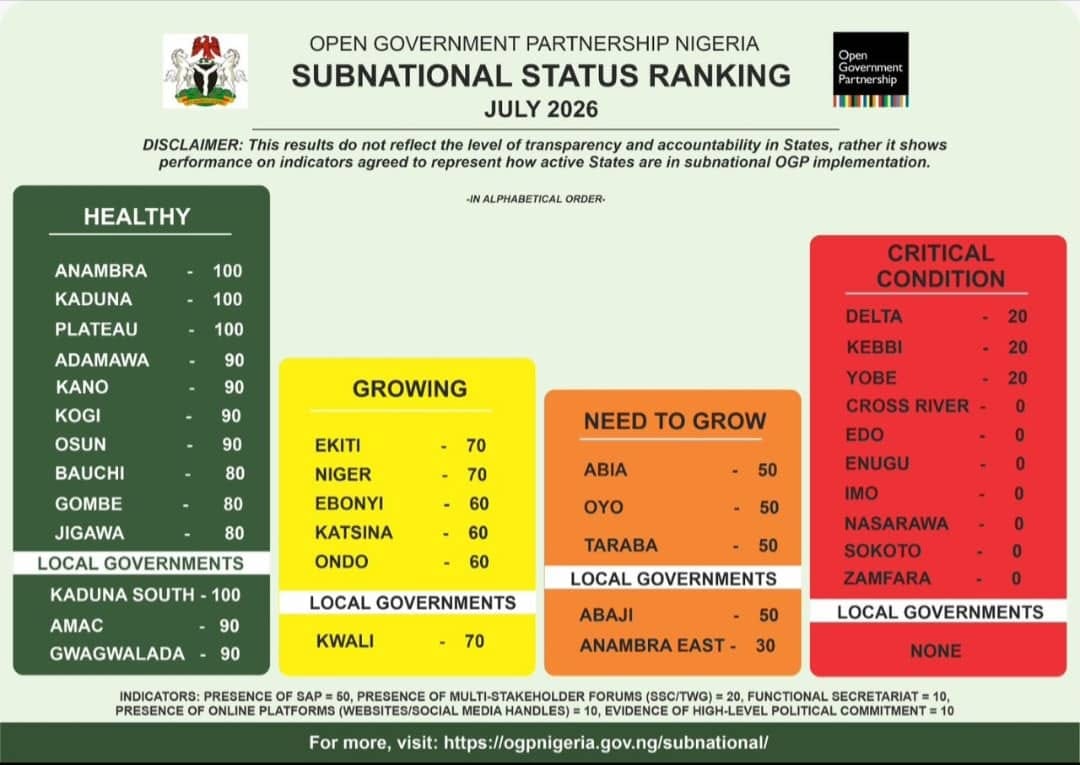
In a strong validation of institutional transparency and accountability, Anambra State has attained the highest possible “100% Healthy” rating in the latest Open Government Partnership (OGP) Nigeria Subnational Status Ranking released in July 2026.
The ranking evaluates participating states across a rigorous nine-point framework that measures genuine openness, accountability, and citizen engagement in governance. Anambra’s perfect score reflects full compliance and strong performance across all assessed criteria, based on verifiable actions rather than declarations.
Under the leadership of Governor Chukwuma Charles Soludo, CFR, the state has embedded a culture of structured governance that prioritises systems, predictability, and measurable results. The OGP assessment highlights Anambra’s political will, resource commitment, and consistent implementation of open government reforms.
“This rating is not an isolated achievement but the natural outcome of a deliberate approach to public administration,” sources familiar with the state’s reforms noted. Governor Soludo’s background as an economist and institution-builder has shaped policies that favour enduring structures over short-term visibility.
The state’s performance aligns with broader gains in service delivery, including notable improvements in primary healthcare that have earned recognition from international partners such as the World Health Organisation (WHO), UNICEF, and Médecins Sans Frontières.
A “100% Healthy” status signals to investors, development partners, and citizens that Anambra’s regulatory, fiscal, and accountability mechanisms are robust and operational. It positions the state as one of the few in Nigeria with independently verified governance architecture that emphasises transparency as a core operating principle.
The OGP framework operates in continuous cycles of commitment, co-creation, and implementation. Officials say Anambra’s leadership is focused on sustaining and deepening these reforms rather than resting on the current achievement.
In a political landscape often dominated by rhetoric, Anambra’s verified success underscores the compounding value of credibility built on measurable processes. The state continues its upward trajectory, reinforcing its reputation for commercial dynamism and sound governance.
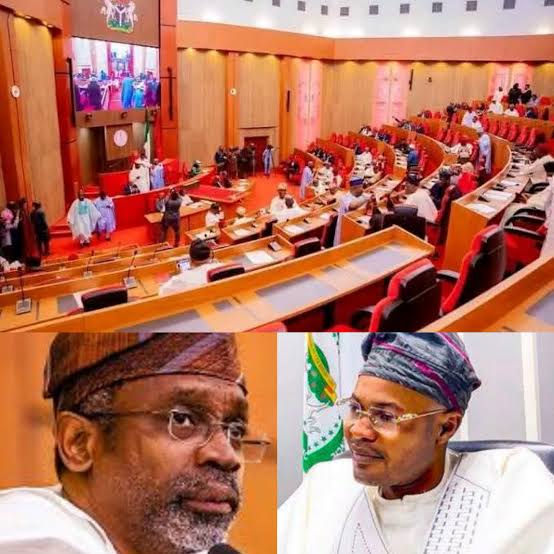
The Nigerian Senate has rejected a motion seeking a full-scale investigation into the controversial allocation of N1.3 billion to the Petroleum Fuel Import Pricing Committee (PFIPC), a decision that has intensified accusations of a cover-up in what is now being called the PFIPC scandal.
The motion, which was brought before the upper chamber on Wednesday, aimed to compel relevant committees to investigate the disbursement and utilisation of the funds. Proponents argued that the allocation raised serious questions of transparency, accountability, and possible mismanagement of public resources at a time when Nigerians are grappling with high fuel prices and economic hardship.
However, the Senate voted against the motion after a heated debate, with a majority of senators opposing the probe. Critics within and outside the chamber have described the rejection as a blatant attempt to shield powerful interests from scrutiny.
Details of the N1.3 billion allocation first emerged in recent weeks, triggering public outrage. Opposition lawmakers and civil society groups claim the funds were released under questionable circumstances with little documentation on how they were spent or what specific objectives were achieved. Some reports suggest the money was meant for subsidy-related activities or price modulation mechanisms, but lack of clarity has only fuelled suspicions of impropriety.
Reacting to the Senate’s decision, Senator [Name], who sponsored the motion, expressed disappointment: “This is a sad day for transparency in governance. Nigerians deserve to know what happened to this money.”
The development comes as the National Assembly faces growing pressure to demonstrate commitment to fighting corruption. Public commentators and activists have taken to social media to condemn the rejection, with many calling for external intervention by anti-graft agencies such as the EFCC and ICPC.
As of now, the executive arm has remained silent on the matter. The Senate leadership has defended its decision, stating that existing oversight mechanisms are sufficient and that not every allegation warrants a full parliamentary investigation.
The PFIPC scandal continues to generate heated debate, with calls mounting for more openness in the management of petroleum sector funds that directly affect the cost of living for millions of Nigerians.
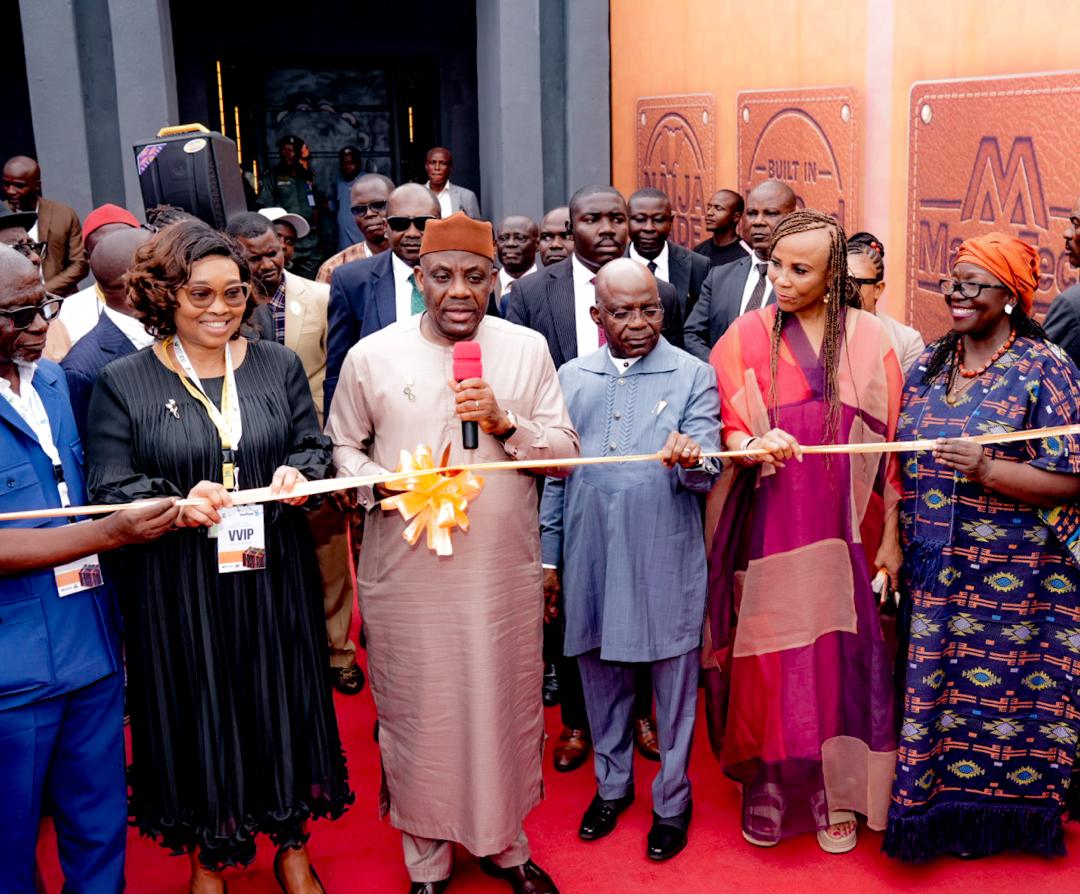
The Federal Government has launched Nigeria’s first Manu-Tech University Innovation Pod at the Michael Okpara University of Agriculture, Umudike, as part of a broader strategy to transform universities into hubs of innovation, manufacturing, entrepreneurship and enterprise development.
The initiative is designed to connect academic research with industry and accelerate economic growth.
Speaking at the launch in Umudike, Abia State, the Minister of Education, Tunji Alausa, said universities must move beyond producing graduates and academic publications to becoming centres that create industries, generate jobs and provide practical solutions to national challenges.
He stressed that education must serve as a catalyst for production, innovation and national prosperity, and
explained that the Innovation Pod aligns with the Renewed Hope Agenda of President Bola Ahmed Tinubu and is the product of collaboration between the Federal Government, the United Nations Development Programme, Tertiary Education Trust Fund, MOUAU and other stakeholders.
“The facility is expected to bring together researchers, students, innovators, manufacturers and investors within a single innovation ecosystem”. the centre integrates emerging technologies including artificial intelligence, advanced manufacturing systems, agro-processing, industrial automation and entrepreneurship”.
“The facility will support the development of ideas from research and design stages through prototyping, production and eventual commercialisation”.
The Minister noted that the location of the Innovation Pod in Abia State is strategic because of its proximity to the renowned Aba manufacturing cluster, creating opportunities to link local enterprise with university research and investment.
He said the initiative would strengthen local manufacturing, promote value addition, create jobs and improve the competitiveness of Made-in-Nigeria products within the African Continental Free Trade Area.
Alausa also disclosed that the Innovation Pod model will be replicated across Nigeria’s geopolitical zones based on regional economic strengths, reaffirming the Federal Government’s commitment to building an education system that equips young Nigerians with future-ready skills, supports research commercialisation and contributes to the nation’s goal of becoming a one-trillion-dollar economy.


Atiku warns Presidency: Nothing must happen to Obi, El-Rufai

ADC Releases Lawyers Engagement Advisory To State Chapters

CBN Urges Public, Businesses Not To Reject N100 Bank Note

Tech Expert, Zuckerberg trains with UFC champions, Adesanya, Alexander

Organ Trafficking: Ekweremadu bags 10 years in UK prison

SAINT OBI: Between his marriage and his death
-
 Politics3 days ago
Jonathan denies ₦500bn offer to challenge Peter Obi
-

 Sports3 days ago
UEFA tackles FIFA over Balogun’s suspension reversal
-
 Business3 days ago
Emmanuel Nnorom takes over as UBA Chairman
-
 News3 days ago
NGE to host Lateef Jakande 2026 Memorial Lecture: “The Media, INEC, Voters and Path to Credible Elections.”
-

 Business2 days ago
BACITI graduates pioneer set of 40 Senior Customs Officers
-
 News3 days ago
Senate hails Nigerian Army at 163
-

 Sports2 days ago
Paris FC confirm Liam Rosenior as new coach
-

 News2 days ago
FG Launches First University Innovation POD, Targets Research-Led Industrial Growth