
News
Tinubu: Data Now Nigeria’s “New Oil,” Key to Progress


President Bola Tinubu has declared data as “the new oil,” emphasising its critical role in governance and Nigeria’s global standing.
He announced a directive for all ministries, departments, and agencies to capture, safeguard, and responsibly release data to drive public value and facilitate international benchmarking.
This strategic emphasis on data comes as Galaxy Backbone launches its 1Government Cloud Academy, an initiative designed to equip civil servants with the essential digital skills for Nigeria’s transition to a paperless public sector.
According to a statement from Galaxy Backbone on Wednesday, the set up of the academy is a strategic move to advance Nigeria’s transition to a paperless civil service and enhance communication across Ministries, Departments, and Agencies.
The announcement was a key highlight of the 2025 International Civil Service Conference in Abuja, attended by President Tinubu, members of the Federal Executive Council, the diplomatic community, industry leaders, and civil servants.
In his opening remarks, President Tinubu reinforced the strategic significance of data, describing it as “the new oil.”
He clarified that unlike traditional oil, data’s value appreciates with refinement and responsible utilisation.
The President mandated all MDAs to diligently capture and safeguard data under the Nigerian Data Protection Act (2023), and to release it in ways that generate public value, ensuring strict adherence to international data privacy standards.
“We must let our data speak for us. We must publish verified data assets locally and share them globally. This will enable international benchmarking and strengthen Nigeria’s standing on the world stage,” he stated.
He further emphasised the need for data sovereignty and privacy to be rigorously protected within local and allied data centers.
Galaxy Backbone’s new 1Government Cloud Academy aims to train selected civil servants and public sector stakeholders in technical tools crucial for successful digital transformation.
This move is a strategic step towards advancing Nigeria’s digital public service and improving communication across MDAs.
The Programme Director of the 1Government Cloud initiative, Mr. Wumi Oghoetuoma, while speaking on a panel at the event, underscored the paramount importance of trust and understanding in the successful adoption of digital tools.
“Many digital solutions have failed not because they were ineffective, but because users didn’t trust or fully understand them,” Oghoetuoma noted.
He lauded the Head of the Civil Service of the Federation for her decisive reform efforts in public sector digitalization, highlighting that the academy’s training encompasses both technical competencies and vital soft skills for transformation.
The 1Government Cloud Academy will serve as a central hub for training and certifying government personnel, particularly ECM Project Managers.
These civil servants are selected as “transformation champions” within their departments, acting as in-house digital guides to help colleagues overcome initial challenges and build confidence in new tools.
“This approach builds trust, improves usability, and encourages widespread adoption across MDAs,” Oghoetuoma explained, adding, “Many tools are abandoned not because they don’t work, but due to lack of communication and internal support.”
Oghoetuoma pointed out that even basic issues, like poor WiFi connectivity, often remain unresolved because ministry staff fail to engage with their IT departments, and those departments, in turn, don’t escalate the issues to Galaxy Backbone.
“This silent communication breakdown creates a false perception that the system is broken, when in reality, it’s an unreported or unresolved issue,” he said.
To tackle this, the academy is also offering specialized certification courses for IT departments to boost responsiveness and cross-functional collaboration.
He stressed that the challenge isn’t a lack of digital literacy, as most civil servants are proficient with smartphones and social media. Instead, it’s a matter of “mindset, motivation, and ongoing support.”
Oghoetuoma emphasized, “Digital transformation hinges on people, processes, and technology.”
He concluded, “With strong personnel and well-documented processes already in place, the missing link is often technology adoption, and the glue that holds it all together is communication. Sustainable digitalisation in the public sector requires making people feel like active participants, not passive users.”
Head of the Civil Service of the Federation, Mrs. Didi Esther Walson-Jack, highlighted that Nigeria’s digital reforms as a model for other nations.
She cited the automation of processes through the Enterprise Content Management system, the introduction of a Performance Management System, and the deployment of ServiceWise GPT, which aligns individual roles with national priorities.
The British High Commissioner to Nigeria, Richard Montgomery, commended Nigeria’s reform agenda under President Tinubu, stating,“
These are bold and necessary steps for long-term development.”
He underscored that the success of these reforms hinges on efficient service delivery and integrity within the civil service.
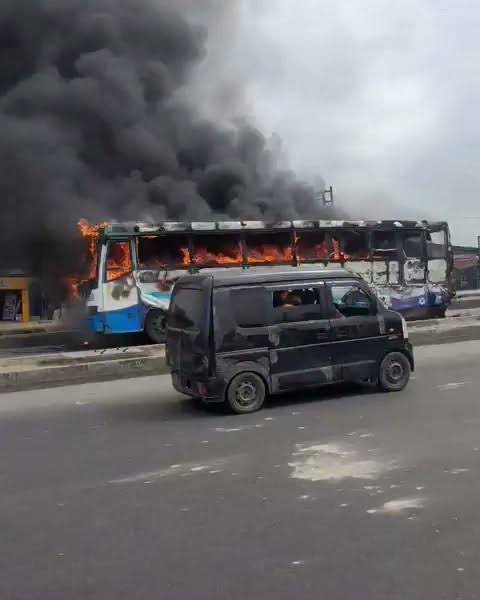
An angry mob has set a Bus Rapid Transit (BRT) bus on fire after it reportedly crushed a commercial motorcyclist to death at Ogolonto Bus Stop along Ikorodu Road in Lagos State.
The incident occurred on Friday, October 16, 2026. Eyewitness accounts and social media reports indicate that the motorcyclist was riding alone along the restricted BRT lane when the collision happened. He died at the scene.
Enraged residents and youths then attacked the bus driver and set the vehicle ablaze. Police officers and officials of the Lagos Neighbourhood Safety Corps (LNSC), who were nearby, intervened promptly and rescued the driver unharmed.
The identity of the deceased motorcyclist and the exact circumstances of the crash had not been officially confirmed at the time of filing this report. It was also unclear whether any arrests had been made in connection with the burning of the bus.
News
ARISE News Wins Seven Honours At Nigerian Broadcasters Merit Awards
The awards recognised the network’s achievements in television journalism and programming, with ARISE News winning the Best TV Channel (Viewer’s Choice) category.


• ARISE News Anchor and host of What’s Trending Ojy Okpe was named Best Newscaster (TV – Female)
ARISE News has emerged as one of the major winners at the just ended Nigerian Broadcasters Merit Awards (NBMA).
ARISE News won seven honours across television broadcasting, news reporting, presentation and production during the ceremony.
The awards recognised the network’s achievements in television journalism and programming, with ARISE News winning the Best TV Channel (Viewer’s Choice) category.
The network’s flagship breakfast programme, The Morning Show, also won the Best TV Talk Show award, further strengthening its recognition in television broadcasting.
ARISE News Anchor and host of What’s Trending Ojy Okpe was named Best Newscaster (TV – Female).
Rufai Oseni was named Nigerian Broadcaster of the Year (Male), while Vimbai Mutinhiri-Ekpeyong received the Nigerian Broadcaster of the Year (Female) award.
The recognition extended to the network’s newsroom, with Ovieteme George winning Best TV News Reporter (Male) for his contributions to television news reporting.
Behind the camera, Sam Adeyemi received the Best Camera Operator/Cinematographer award, recognising his work in television production and visual storytelling.
News
Meta removes 3.7 million accounts in West Africa scam crackdown
The joint operation led to 28 arrests, identified more than 30 suspected scam centres and rescued 117 people allegedly trafficked and forced to work in scam compounds in Ghana.
Meta, the parent company of Facebook and Instagram, has removed more than 3.7 million Facebook and Instagram accounts, pages and groups linked to suspected scam networks operating in West Africa.
The joint operation led to 28 arrests, identified more than 30 suspected scam centres and rescued 117 people allegedly trafficked and forced to work in scam compounds in Ghana.
The company announced the crackdown in a statement on Tuesday, October 13, 2026. It involved 14 technology companies and law enforcement agencies from 10 countries.
The United Kingdom’s National Crime Agency coordinated the operation with the US Department of Justice, the Federal Bureau of Investigation and other agencies. Nigerian authorities were involved.
Other countries included Ghana, Australia, Canada, New Zealand and India.Tech companies that took part included Google, Microsoft, OpenAI, Coinbase, Starlink and Adobe.
Meta said the partnership let participants share intelligence across digital platforms, countries and financial systems to identify criminal networks.


JUST IN: Mob Sets BRT Bus Ablaze After Motorcyclist’s Death in Lagos

BREAKING: DSS Arrests Fugitive Maina Son, Hands Him to EFCC

BREAKING: 5 Arrested Over Imo NYSC Abduction

BREAKING: Lagos Govt Declares Today, Thursday Work-Free to Mark 2026 Ìṣẹ̀ṣe Day

Tech Expert, Zuckerberg trains with UFC champions, Adesanya, Alexander

Organ Trafficking: Ekweremadu bags 10 years in UK prison
-
 Business3 days ago
Naira Exchange Rates For Thursday, October 15
-
 Sports3 days ago
CAF Increases Annual Funding for Member Federations to $700,000
-
 News3 days ago
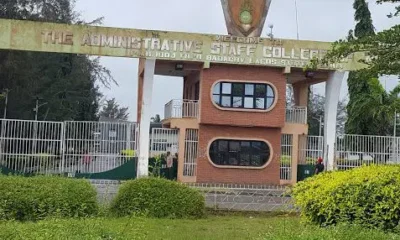
ASCON To Be Rebranded “National School Of Government”
-

 Business2 days ago
Germany plans tax on sugary drinks
-

 Business2 days ago
WEF could appoint Lagarde as its next chair, sources say
-

 International2 days ago
“Mother of all bombs,” Trump Plans To Hit Iran
-

 Business2 days ago
Naira Exchange Rates Friday, October 16
-
 Crime1 day ago
BREAKING: 5 Arrested Over Imo NYSC Abduction