
News
President Tinubu’s Moment with Pope Leo XIV
The US pontiff shook hands with several world leaders in St Peter’s Square after the inauguration mass on Sunday.

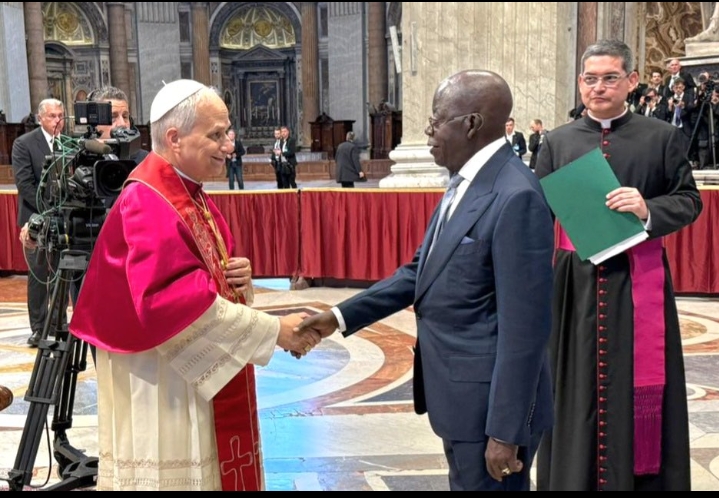
• President Bola Tinubu exchanging pleasantries with Pope Leo XIV at the installation mass for the new Pope in Rome on Sunday. Photo: State House.
President Bola Tinubu exchanging pleasantries with Pope Leo XIV at the installation mass for the new Pope in Rome on Sunday. Photo: State House.
President Bola Tinubu shook hands with the newly installed Bishop of Rome and the new leader of the Roman Catholic Church, His Holiness Pope Leo XIV, on Sunday.
The US pontiff shook hands with several world leaders in St Peter’s Square after the inauguration mass on Sunday.
While shaking hands with the Pope, Tinubu had a brief conversation with him before moving away.
Other world leaders who shook hands with the Pope include US Vice President J.D Vance and Ukrainian President Volodymyr Zelensky, among others.

News
Atiku hires US lobbying firm for $1.2m to boost image – Report
One of the objectives of the engagement is to “counterbalance” the Nigerian government’s “lobbying narratives” in the United States, while also working to “advance understanding” of Atiku’s “leadership posture and policy vision” among policymakers.

Ex-Vice-President Atiku Abubakar has hired a Washington-based lobbying firm, Von Batten-Montague-York, L.C., to strengthen his reputational standing in the United States.
The PUNCH reported that the details of the deal are contained in documents filed with the U.S. Department of Justice, which show that the agreement was signed on March 9 and 10, 2026, by the firm’s managing partner, Karl Von Batten, and Nigerian politician Fabiyi Oladimeji on behalf of the former vice president.
According to the filing sighted on the Department of Justice ’s website on Sunday, the contract is aimed at shaping perceptions of Atiku within U.S. policy circles and countering narratives linked to the Nigerian government.
One of the objectives of the engagement is to “counterbalance” the Nigerian government’s “lobbying narratives” in the United States, while also working to “advance understanding” of Atiku’s “leadership posture and policy vision” among policymakers.
Under the arrangement, the firm is expected to facilitate meetings between the former vice-president and U.S. government officials, including members of Congress, as well as provide advisory services on policy positioning and engagement strategy.
“These activities include lobbying and government affairs engagement with Members of Congress, congressional staff, and executive branch officials concerning issues related to democratic governance, regional stability, economic development, and U.S. engagement with Nigeria and the broader West African region,” part of the contract reads.
The firm will also undertake “promotion, perception management, and public relations activities designed to enhance understanding among U.S. policymakers and relevant stakeholders” of Atiku’s positions.
News
Kaduna Mando Garage Explosion Not Bomb- Police
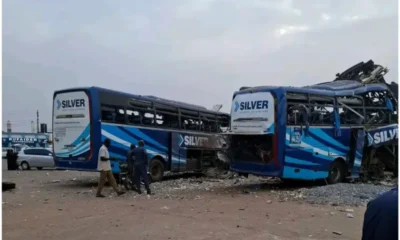
The command’s Public Relations Officer, DSP Mansir Hassan, said in a statement that the incident occurred at about 3:00a.m. on Sunday at the premises of Silver Luxury Travel, a bus company operating at Mando Garage, Kaduna.
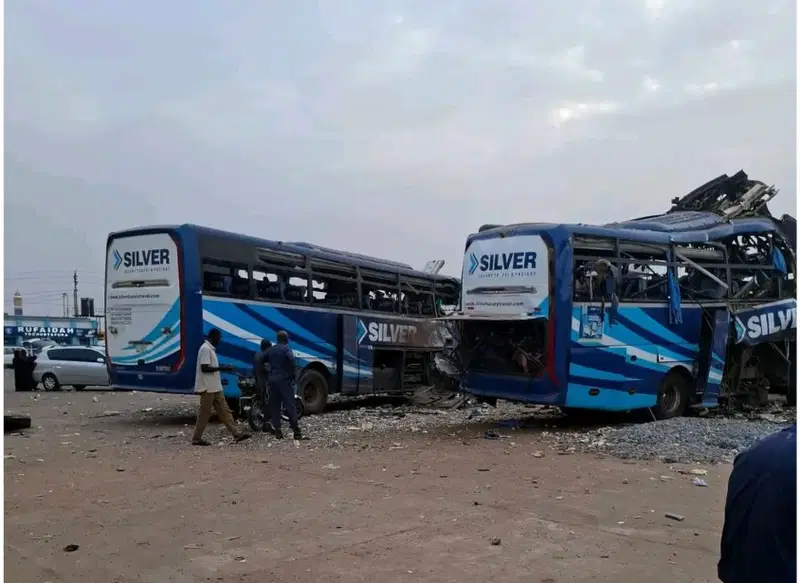
The Kaduna State Police Command has confirmed that an explosion at the Lagos Garage Terminus in Mando area of Kaduna State today wasn’t a bomb explosion, but a CNG-powered luxury bus that ruptured after its gas tank was overfilled.
The incident occurred during the early hours of Sunday with the loud blast drawing attention from commuters, traders, and nearby residents, prompting a swift response from emergency services.
The command’s Public Relations Officer, DSP Mansir Hassan, said in a statement that the incident occurred at about 3:00a.m. on Sunday at the premises of Silver Luxury Travel, a bus company operating at Mando Garage, Kaduna.
He said detectives were immediately deployed to the scene after a loud sound was reported, and that the vehicle has been safely evacuated, while normal business activities have since resumed at the motor park.
He noted that no casualties or loss of property were recorded, and normal activities had since resumed in the area.
News
Nigerian Army Debunks Claims of Attack on Bishop Matthew Kukah’s Residence and Sokoto Catholic Cathedral

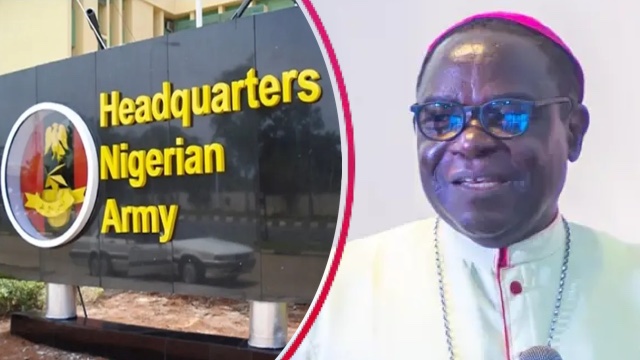
The Nigerian Army has categorically dismissed as false and misleading a viral social media post alleging an armed attack on the residence of Bishop Matthew Kukah, the Catholic Bishop of the Sokoto Diocese, and the Sokoto Catholic Cathedral.
In an official statement issued on Saturday by the 8 Division Nigerian Army and Sector 2 of Operation FANSAN YAMMA, the military said no such incident occurred in Sokoto State. The claim, which circulated on Facebook, was described as unfounded and fabricated.
“The safety and security of Bishop Matthew Kukah and the Sokoto Catholic Cathedral remain intact,” the statement read. It added that the Bishop is currently carrying out his Easter duties without any disruption.
The Army noted that it had taken note of the misleading report and, in collaboration with other security agencies, confirmed there was no attack anywhere in the state.
The Division reaffirmed its commitment to the safety of all residents in Sokoto State and its area of responsibility. “Robust security measures are in place to guarantee a peaceful and secure Easter celebration,” it said.
The statement was signed by Lieutenant Colonel Olaniyi Osoba, Acting Deputy Director, Army Public Relations, 8 Division Nigerian Army / Sector 2 Operation FANSAN YAMMA.
Similar clarifications have also been issued by the Catholic Diocese of Sokoto, which described circulating videos and reports as attempts to cause panic and destabilise peace in the area. Both the Bishop’s residence, the Cathedral, and related facilities remain safe and operational.
Authorities urged the public to disregard the false information and rely on verified sources during the Easter period.


Lagos Fanti carnival holds tomorrow at TBS and environs

Atiku hires US lobbying firm for $1.2m to boost image – Report

Kaduna Mando Garage Explosion Not Bomb- Police

Tech Expert, Zuckerberg trains with UFC champions, Adesanya, Alexander

Organ Trafficking: Ekweremadu bags 10 years in UK prison

SAINT OBI: Between his marriage and his death
-
 Politics3 days ago
INEC Dismisses Calls for Chairman’s Removal
-
 Crime1 day ago
Three Killed, One Injured in Fresh Jos Attack (Video)
-
 News4 hours ago
Kaduna Mando Garage Explosion Not Bomb- Police
-
News4 hours ago
Atiku hires US lobbying firm for $1.2m to boost image – Report
-
 Politics2 days ago
Labour Party to hold presidential primary April 28
-
 Politics2 days ago
Onyejeocha resigns as Minister of State for Labour
-
 News1 day ago
Nigerian Army Debunks Claims of Attack on Bishop Matthew Kukah’s Residence and Sokoto Catholic Cathedral
-
 Politics2 days ago
No force can defeat Tinubu in 2027 –Umahi