Connect with us

News

PDP, Atiku Present 26th Witness As Tribunal Hears Petition Against Tinubu

Published

on

549 Views

The Peoples Democratic Party (PDP) and its candidate in the last presidential election, Alhaji Atiku Abubakar, have called their 26th witness before the Election Petition Tribunal, in its case against the victory of President Bola Tinubu.

The witness, Mr Hitler Nwanna, is a digital forensic analyst who is appearing with a forensic report and a certificate of compliance, all arising from the conduct of the February 25 Presidential Election.

Nwanna told the court that he did not inspect all the BVAS machines, and worked on only 110.

In response, lawyer to the Independent National Electoral Commission (INEC), Abubakar Mahmood stated that going by the 110 BVAS devices inspected by the witness, only 0.069% of the machines deployed nationwide were inspected.

Mahmood further stated that INEC deployed 3,163 polling devices to 2,822 polling units in the FCT. According to him, the witness inspected just 3.5% of the number of devices deployed.

Abubakar Mahmoud therefore stated that the result of Mr Nwala’s forensic inspection isn’t an accurate representation of the outcome of the election.

To verify the witness’ claims on deleting of results, INEC’s lawyer brought four BVAS devices for the witness to inspect. The witness however declined to this gesture, insisting it’s a move that amounts to tampering with evidence in a matter already before the Court.

The witness had referenced in his report that the forensic inspection of the BVAS machine and IReV report was pursuant to a court order urging INEC to allow inspection.

However, during cross examination, the witness noted that the said Court order wasn’t attached to his witness statement.

Following arguments and listening to all sides in the matter, the court decided that the PDP’s case be adjourned to tomorrow Friday for conclusion.

Expected to come up later today is the hearing of the case put forward by the Labour Party.

News

FG Engages CCECC To Build N545bn New Carter Bridge in Lagos

The decision to reconstruct the bridge became necessary after years of alarming structural investigations revealed worsening defects beneath both the Carter Bridge and the 3rd Mainland Bridge.

Published

on

By

24 Views

The federal government has officially handed over the construction of a brand-new Carter Bridge in Lagos to China Civil Engineering Construction Corporation (CCECC).

Speaking during the handover ceremony in Lagos, the Minister of Works, Dave Umahi, said that the decision to reconstruct the bridge became necessary after years of alarming structural investigations revealed worsening defects beneath both the Carter Bridge and the 3rd Mainland Bridge.

According to the minister, investigations into the underwater structural elements of the bridges began as far back as 2013, with another assessment carried out in 2019.

The reports, he said, showed that the defects were increasing at what experts described as “geometrical progression.”

Experts, according to him, advised that repairing the Carter Bridge would cost almost twice the amount required to build a completely new structure. Following detailed technical analysis, the federal government, he said, approved the construction of a new modern bridge.

Continue Reading

News

Federal High Court posts new Judges across divisions

All the affected Judges are expected to resume at their respective duty stations on May 13, following the recent appointment of 14 new Judges, and the transfer of three serving Judges to different divisions of the court.

Published

on

By

18 Views

The Federal High Court has unveiled a new nationwide posting schedule affecting recently appointed Judges and some serving judicial officers, as part of efforts to strengthen the administration of justice across its divisions.

The redeployment, approved by the Chief Judge of the Court, Hon. Justice John Tsoho, followed recommendations made by the National Judicial Council, and was formally announced in a statement issued in Abuja by the Court’s Director of Information, Catherine-Oby Christopher.

All the affected Judges are expected to resume at their respective duty stations on May 13, following the recent appointment of 14 new Judges, and the transfer of three serving Judges to different divisions of the court.

Under the new arrangement, Justices Salim Olasupo Ibrahim and Onah Chigozie Sergius were assigned to the Abuja Division, while Justice Hassan Dikko was posted to the Gusau Division in Zamfara State, and Justice Sulaiman Amida Hassan to the Osogbo Division in Osun State.

Other appointments include Justice Muhammad Saidu to Minna, Justice Igboko Conchita to Akure, Justice Onuegbu Angela to Yenagoa and Justice Galumje Edingah to Abakaliki, alongside Justice Ibrahim Eneabo who will serve in the Gombe Division.

The posting schedule also deployed Justice Abubakar Usman to Ado-Ekiti, Justice Salihu Yunusa to Damaturu, Justice Ikpeme Bassey to Uyo, Justice Shehu Adamu to Maiduguri, and Justice Mohammed Buba to the Dutse Division in Jigawa State.

Also affected by the reshuffle are Justice Binjin-Eigegbe Nendelmum Judith, posted to Lokoja, while Justices Usoro Uduak and Nwoye Osinachi Donatus were assigned to the Lagos Division, with the Court confirming that the new postings take immediate effect.

Continue Reading

News

‎”I Warned Them The Coup Would Fail” — Islamic Cleric’s Video Confession Played in Court

‎‎In a ruling, Justice Joyce Abdulmalik ordered a joint trial-within-trial to determine the voluntariness and admissibility of both the written and video statements of all six defendants.

Published

on

By

30 Views

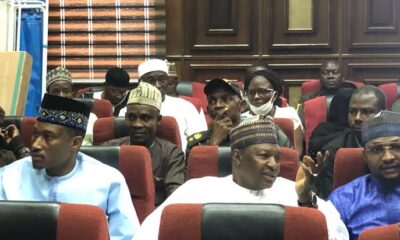
‎A Federal High Court in Abuja on Monday viewed a video recording containing the alleged confession of the sixth defendant in the ongoing trial of persons accused of conspiring to plot a coup.

In the video, defendant Sheikh Sani Abdulkadir told investigators that he had warned the alleged plotters the plan would fail and that they would eventually be exposed.‎‎

The video was played during the continuation of trial proceedings, with the fourth prosecution witness, identified as PW4, still in the witness box.‎‎In the recording previewed before the court, Abdulkadir, who described himself as an Islamic cleric, said he knew the alleged ringleader, Colonel Maaji, for less than a year.

He testified that he was approached through a man identified as Sanda for prayers concerning the alleged coup plot.‎‎

According to Abdulkadir, Sanda informed him that his “oga” intended to stage a coup and needed spiritual prayers and divination regarding its success.‎‎

Abdulkadir told investigators that after conducting prayers, he informed them the operation would fail and that two persons would eventually betray those involved.‎‎

He said a message was later relayed back to him through Sanda, requesting further prayers so that the two individuals would not betray the group.‎‎

The defendant further stated that money was subsequently sent to him for prayers and charity, while names of individuals allegedly involved in the plot were also forwarded to him for inclusion in the prayers.‎‎

He said shortly after the prayers commenced, Sanda informed him that Colonel Maaji had not been seen for four days, adding that he later learned through media reports that arrests had been made over an alleged coup plot.‎‎In the video, Abdulkadir maintained that the funds transferred to him were not payments for supporting a coup but were meant for prayers.‎‎

He also told investigators that he never reported the alleged plot because he did not know who to report to, despite admitting that he understood a coup to mean a military overthrow of government.‎‎

The defendant narrated that he was eventually arrested after visiting the Economic and Financial Crimes Commission (EFCC) over restrictions placed on his bank account.‎‎

According to him, he had gone to withdraw the money transferred to him when he discovered that his account had been flagged.‎‎

He said after contacting an EFCC deputy director, he was invited to the commission’s office, where he explained that the money was meant for prayers.‎

Abdulkadir insisted in the recording that he did not make any statement relating to a coup while in EFCC custody.‎‎

Before the video ended, the defendant also stated that nobody assaulted or tortured him and that his statements were made voluntarily.‎‎

Following the playback, the prosecution sought to tender the extra-judicial statements allegedly made by the first to fifth defendants before a Special Investigation Panel and military police authorities, as well as the sixth defendant’s statement made before military police investigators.‎‎

However, counsel to all six defendants separately objected to the admissibility of the statements and accompanying video recordings.‎‎

The lawyers to the defendants argued that the statements were either not voluntarily made or were obtained in violation of provisions of the Administration of Criminal Justice Act (ACJA).‎‎

Counsel to the first defendant argued that the written statement sought to be tendered did not correspond with what was shown in the video evidence regarding voluntariness.‎‎

The second defendant’s lawyer contended that his client was neither informed of his right to legal representation nor provided access to counsel before the statement was recorded, adding that the video shown in court was not a recording of the making of the written statement sought to be tendered.‎‎

The third defendant equally challenged the admissibility of the statement, arguing that the contents of the video differed from the written extra-judicial statement.‎‎

Counsel to the fourth defendant argued that the video and statement contravened Sections 15 and 17 of the ACJA, which provide for the presence of legal representation during statement-taking.‎‎

He further alleged that his client was coerced into making the statement and argued that the recording failed to show whether the defendant’s legs were free at the time the video was made.‎‎

The fifth defendant’s lawyer also opposed the admissibility of the statements on grounds of alleged inducement, torture, and non-compliance with provisions of the ACJA and the Evidence Act.‎‎

He further argued that since there were multiple defendants in the matter, the court ought to conduct separate trial-within-trial proceedings for each disputed statement rather than a joint exercise.‎‎

Counsel to the sixth defendant similarly objected to the admissibility of both the written and video statements credited to Abdulkadir, insisting they were obtained through inducement and were not voluntarily made.

‎‎The matter was subsequently adjourned until May 12 at 12 noon for the continuation of proceedings.

‎‎Responding, the prosecution urged the court to reject the defence arguments and order a single trial-within-trial proceeding for all the disputed statements.‎‎

The prosecution argued that the law did not require separate proceedings for each defendant and maintained that the trial judge retained discretion over how evidence is received.

‎‎In a ruling, Justice Joyce Abdulmalik ordered a joint trial-within-trial to determine the voluntariness and admissibility of both the written and video statements of all six defendants.

‎‎The matter was subsequently adjourned until May 12 at 12 noon for the continuation of proceedings.

Continue Reading

Trending