
Business
PAMA Lauds Banks Crucial Roles Towards Achieving Continental Integration


By Ocheneyi Alli
Pan African Manufacturers Association – PAMA, has lauded Afreximbank, AFDB, AFC, and others stakeholders for the energy they are putting towards achieving continental integration and creating the world’s largest Free Trade Area- AfCFTA.
Engr Mansur Ahmed, the Interim Chairman of PAMA, gave the kudos during the relaunch of the Association on the sideline of the ongoing Intra-African Trade Fair (IATF 2023) in Cairo, Egypt.
” Despite facing numerous challenges, significant strides have been made to advance the African Union’s Agenda 2063 since 2013, thanks to the dedication of African leaders, the AUC, and institutions like Afreximbank and the African Development Bank,” said Engr Mansur.
He, however, noted that the road to “The Africa We Want” remains lengthy and arduous, with intra-African trade still below 18 percent, and Africa’s global trade contribution at a mere 4 percent.
He said that to change this narrative, transformation is required across every sector, but one sector stands out as critical for economic growth: manufacturing.
In the modern global economy, manufacturing accounts for around 70 percent of global trade and more than 30 percent of service jobs.
To achieve the goals of Agenda 2063, African manufacturing must undergo a transformation and expansion, which is no easy feat and cannot be left to chance. Both the public and private sectors must make sustained efforts to successfully implement AFCFTA and attain Agenda 2063’s objectives.
The road to “The Africa We Want” remains lengthy and arduous, with intra-African trade still below 18 percent, and Africa’s global trade contribution at a mere 4 percent.
Institutions like Afreximbank, AFDB, AFC, and others are already playing crucial roles in this effort, but it’s essential for the private sector, particularly African manufacturers, to engage actively in fostering the necessary collaborations and partnerships for sector integration, expansion, and diversification.
This is where the Pan-African Manufacturers Association (PAMA) must play a more prominent role in promoting the growth of the African manufacturing sector.
Business
Global energy costs take its toll on Nigerian Manufacturers
The recent surge in global fuel prices, driven by geopolitical tensions, is compounding the challenge. While some manufacturers have temporarily absorbed the increases, Onafowakan warned that the full impact could materialise within the next three to four months.

The Managing Director/CEO of Coleman Technical Industries Ltd, Mr George Onafowakan, said that the global higher energy costs occasioned by Iran -US Israeli war has started impacting on manufacturers in Nigeria.
Onafowokan said that findings across major industrial zones reveal a sector heavily dependent on diesel-powered generators, with factories running at high energy costs to sustain operations. Engineers and technical teams now work around the clock to monitor fuel consumption and prevent disruptions that could halt production lines.
Onafowakan stressed that power outages routinely stall factory operations, placing manufacturers under intense pressure to meet delivery timelines.
“When the lights go off, everything stops. We rely on generators, but the costs are rising, and there is constant uncertainty about meeting production targets,” he added.
The recent surge in global fuel prices, driven by geopolitical tensions, is compounding the challenge. While some manufacturers have temporarily absorbed the increases, Onafowakan warned that the full impact could materialise within the next three to four months.
“By the second quarter, businesses may be forced to make difficult decisions around production planning and pricing,” he said.
Beyond individual firms, the impact is already rippling across supply chains. Production delays are affecting dependent businesses and, ultimately, consumers, who are likely to face higher prices for goods.
Despite the growing pressure, Onafowakan said widespread layoffs or major operational restructuring may not occur immediately but cautioned that the situation could deteriorate without timely intervention.
Business
CBN orders banks to reverse failed ATM transactions immediately
The requirement will be implemented gradually over three years, with banks expected to meet 30 percent of the threshold in 2026, 60 percent in 2027 and full compliance by 2028.

The Central Bank of Nigeria (CBN) has directed banks to immediately reverse failed automated teller machine (ATM) transactions.
The apex bank said that the revised framework is designed to strengthen ATM service reliability, improve fraud monitoring, enhance security and ensure stronger consumer protection across Nigeria’s fast-growing digital payments ecosystem., tightening rules aimed at improving consumer protection and reliability across the country’s payment infrastructure.
Beyond refund timelines, the regulator introduced new requirements for ATM deployment nationwide.
All card issuers are required to deploy at least one ATM for every 7,500 payment cards issued.
The requirement will be implemented gradually over three years, with banks expected to meet 30 percent of the threshold in 2026, 60 percent in 2027 and full compliance by 2028.
Under new Guidelines on the Operations of Automated Teller Machines in Nigeria, the apex bank said failed “on-us” ATM transactions, where a customer uses the ATM of their own bank, must be reversed instantly. Where an instant reversal fails due to technical issues or system glitches, banks are required to complete a manual reversal within 24 hours.
For failed “not-on-us” transactions, where a customer uses another bank’s ATM, the refund timeline must not exceed 48 hours.
The guidelines also state that automated reversals for on-us transactions should occur in less than five minutes, while not-on-us transactions should be resolved in less than 15 minutes where automated systems function properly.
The CBN added that in cases where transaction failures arise from biometric mismatch or device errors, ATM operators must provide an immediate fallback to non-biometric verification where it is considered safe.
Such events must also be logged for diagnostics while the stipulated refund timelines are maintained.
The Central Bank also directed that ATMs must be located within reasonable proximity to one another across both urban and rural areas, while deployment, relocation or decommissioning of machines must receive prior written approval from the regulator.
The guidelines also set operational and service benchmarks for ATM operators.
Business
Nigeria Ranks 14th out of 50 Most Agricultural Land globally
The ranking highlights where the world’s largest agricultural footprints are located, spanning major producers across Asia, Africa, and the Americas.
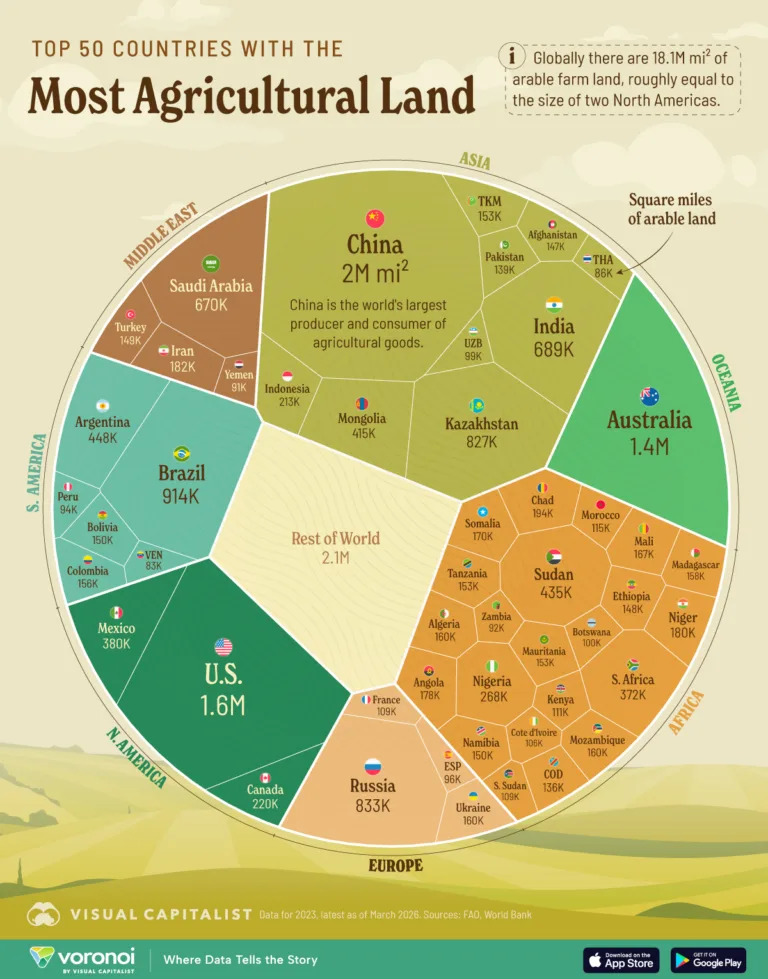
Nigeria has been ranked the fourteenth country among the top 50 Most Agricultural Land in the world.
Agricultural land spans more than 18 million square miles worldwide, forming the foundation of global food production.
In a data analysed by Visual Capitalist using the most recent FAO data compiled by the World Bank, China has the most agricultural land in the world, with roughly 2.0 million square miles.
The United States (1.6 million), Australia (1.4 million), Brazil (914,000) and Russia (832,826) round out the top five countries worldwide.
Each of these countries specialises in different crops.
For example, the U.S. is the world’s largest producer of corn, while Brazil is the top grower of both soybeans and sugarcane.
Meanwhile, Australia has overcome its mostly arid geography to become a major wheat and cereals grower, rivaling major producers like India (689,000) and Ukraine (160,000).
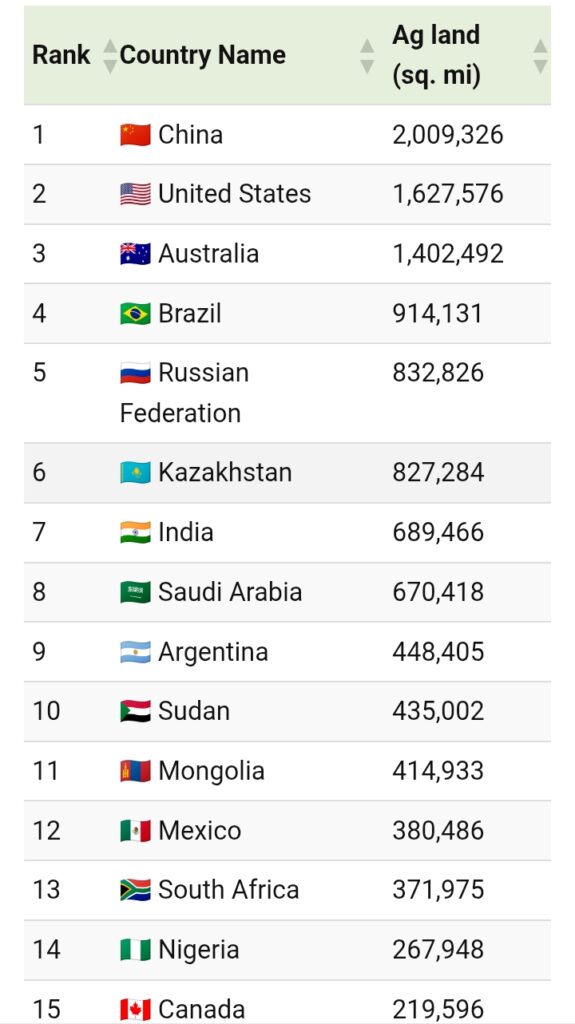
In the data, Asia and Africa account for a large share of the top 50 countries by agricultural land area.
African countries make up nearly half of the top 50 countries worldwide by square mileage of agricultural land area. They’re led by larger countries like Sudan (435,000), South Africa (372,000), and Nigeria (268,000).
The ranking highlights where the world’s largest agricultural footprints are located, spanning major producers across Asia, Africa, and the Americas.
Each of these countries specializes in different crops.
For example, the U.S. is the world’s largest producer of corn, while Brazil is the top grower of both soybeans and sugarcane.
Meanwhile, Australia has overcome its mostly arid geography to become a major wheat and cereals grower, rivaling major producers like India (689,000) and Ukraine (160,000).
Africa’s Growing Desert ProblemAfrican countries make up nearly half of the top 50 countries worldwide by square mileage of agricultural land area.
They’re led by larger countries like Sudan (435,000), South Africa (372,000), and Nigeria (268,000).
As with peers in Eurasia and the Americas, African agriculture is increasingly facing challenges from climate change.In particular, the growing desertification problem is reducing countries’ agricultural land, especially in the Sahel region, as temperatures rise and soil becomes less fertile for growing crops.
Over-farming and over-grazing are exacerbating regional soil erosion and deepening desertification.


2027 polls: 50% Nigerians lack confidence in INEC — GoNigeria

2027: Labour Party sets May 23 for presidential primaries

Wale Adenuga says ‘Papa Ajasco’ Lied About Financial Hardships

Tech Expert, Zuckerberg trains with UFC champions, Adesanya, Alexander

Organ Trafficking: Ekweremadu bags 10 years in UK prison

SAINT OBI: Between his marriage and his death
-

 Entertainment3 days ago
Oscars 2026:‘One Battle After Another’ Biggest Winner as Michael Jordan Wins Best Actor
-
 Business3 days ago
Nigeria Ranks 14th out of 50 Most Agricultural Land globally
-

 News3 days ago
Military Troops Battle ISWAP Attack in Maiduguri
-
 Entertainment3 days ago
Papa Ajasco : Despite Fame, “I don’t have a car or a house of my own”
-

 News3 days ago
NRC Confirms Minor Train Incident Near Asham, Reports No Fatalities (Images)
-

 Entertainment3 days ago
Michael B. Jordan Claims First Oscar Win for Best Actor in ‘Sinners’
-

 Sports3 days ago
W’Cup play-off infractions : FIFA Fines NFF 1,000, DR Congo 5,000 Swiss Francs
-

 News3 days ago
President Tinubu Embarks on Historic State Visit to United Kingdom