
International
JUST IN: Prominent Televangelist and Founder of Christian Broadcasting Network, Pat Robertson is Dead


A prominent televangelist who founded the Christian Broadcasting Network, Pat Robertson, is reportedly dead at the age of 93 made the Christian right a powerful political force and unsuccessfully ran for president in 1988, died on Thursday.
According to a release by the network, “Pat Robertson, longtime TV host, religious broadcaster, educator, humanitarian, and one-time presidential candidate died at his home in Virginia Beach early Thursday morning. He was 93”.
Regent University in Virginia also released a statement saying it was mourning the loss of Robertson.
“We are deeply saddened by the loss of our beloved founder,” Regent University Executive Vice President for Academic Affairs William L. Hathaway said.
“Dr. Robertson was a globally-renowned leader, broadcaster, philanthropist, educator, author, accomplished businessman, and – most importantly – a faithful servant of God who dedicated his life to glorifying the Lord and sharing the gospel of Jesus Christ.”
Born in 1930, Robertson founded the Christian Broadcasting Network in 1960 and was ordained as a Southern Baptist minister a year later. He used that TV perch to push his message of conservative Christian values to people at home, taking aim at gay rights, feminism, abortion and other social issues.
Robertson helped transform the conservative evangelical movement into a political force on the American right that helped elect Ronald Reagan. He then ran for the Republican nomination for president in 1988, coming in behind both George H.W. Bush and Bob Dole.
Afterwards, he founded the Christian Coalition of America, which promoted conservative Christian political candidates, and returned to his TV show “The 700 Club.”
Robertson made a series of inflammatory and controversial opinions and repeatedly said that acts of terrorism or weather disasters were a form of divine retribution for perceived immorality.
“We have killed over 40 million unborn babies in America,” Robertson said on his September 12, 2005, broadcast of “700 Club,” about two weeks after Hurricane Katrina struck New Orleans.
“I was reading, yesterday, a book that was very interesting about what God has to say in the Old Testament about those who shed innocent blood. And he [the author] used the term that those who do this, ‘the land will vomit you out.’ … But have we found we are unable somehow to defend ourselves against some of the attacks that are coming against us, either by terrorists or now by natural disasters? Could they be connected in some way?”
In more recent years, he became a supporter of former President Donald Trump, and in 2017 he linked the Las Vegas mass shooting to “disrespect” for Trump.
International
Brazil’s Lula Wins Fourth Term In Presidential Runoff
Flávio Bolsonaro rejected the runoff result, describing it as “inexplicable” and calling for the election to be annulled.


Brazil’s left-wing President Luiz Inácio Lula da Silva has won a fourth term in office after defeating right-wing challenger Flávio Bolsonaro in a closely fought presidential runoff.
The 80-year-old secured just under 52 per cent of the vote, overturning Bolsonaro’s first-round lead in a surprise victory that runs against a wider shift towards right-wing leadership across Latin America.
Addressing cheering supporters in São Paulo, Lula thanked voters for what he described as their defence of Brazilian democracy.
The victory follows a bitter election campaign between the veteran left-wing leader and Bolsonaro, whose father, former President Jair Bolsonaro, is serving a prison sentence under house arrest for plotting a coup after losing the previous presidential election.
Flávio Bolsonaro rejected the runoff result, describing it as “inexplicable” and calling for the election to be annulled.

Four Philippine Air Force pilots died Friday after two SF-260 trainer aircraft collided mid-air during a training flight and crashed at Fernando Air Base in Lipa City, Batangas, south of Manila, the air force confirmed Saturday.
The accident occurred at about 3:51 p.m. local time on October 23, 2026. Both single-propeller planes went down within the base perimeter. No other casualties were reported on the ground.
Philippine Air Force spokesman Colonel Alvin Capinguian (also referred to as Alvin Jay Capinguian) said the aircraft were involved in a training flight. Officials with knowledge of the incident, speaking anonymously, and local reports confirmed the planes collided while flying at low altitude. Some accounts noted they were part of a larger formation or flyby rehearsal, with other aircraft landing safely.
The air force described it as an “aviation accident” and said an investigation is underway to determine the cause. As a precaution, the entire fleet of SF-260 aircraft has been temporarily grounded. The air force is coordinating assistance with the families of the deceased and asked the public to respect their privacy. One of the pilots was later identified in some reports as 1st Lt. Angeleo Adrian Peñaflor.
The SF-260 is a light Italian-designed trainer used by the Philippine Air Force. The incident is the latest fatal crash involving the type; two pilots were killed in a similar SF-260 training accident in Benguet province in May.
International
“Mother of all bombs,” Trump Plans To Hit Iran
The 21,600-pound airburst weapon is designed to affect surface targets over a wide area and has so far not been deployed by the U.S. in previous strikes on targets inside Iran. It was used in Afghanistan in 2017 during the previous Trump administration.
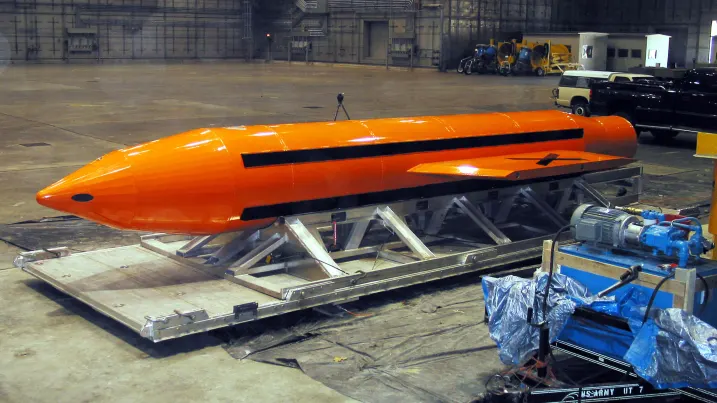
The U.S. military is considering use of the GBU-43/B Massive Ordnance Air Blast (MOAB) bomb if it resumes strikes inside Iran, CNN reported Thursday, citing U.S. officials.
The 21,600-pound airburst weapon is designed to affect surface targets over a wide area and has so far not been deployed by the U.S. in previous strikes on targets inside Iran. It was used in Afghanistan in 2017 during the previous Trump administration.
Trump said Oct. 8 that he would not resume U.S. strikes on Iran before the Nov. 3 midterm elections, while attacks on shipping near the Strait of Hormuz and deadly Houthi strikes in Saudi Arabia have raised regional tensions.
Iranian Parliament Speaker Mohammad Bagher Ghalibaf said Tehran will combine military capabilities and negotiations to press its demands.


FG Approves ₦70k Transport Allowance for Civil Servants

Suffocation, Overcrowding Kill 37 Niger Miners – Panel

Nigeria’s First Imported Ebola Patient Moved to Switzerland

BREAKING: Lagos Govt Declares Today, Thursday Work-Free to Mark 2026 Ìṣẹ̀ṣe Day

Tech Expert, Zuckerberg trains with UFC champions, Adesanya, Alexander

Organ Trafficking: Ekweremadu bags 10 years in UK prison
-

 News2 days ago
BREAKING: Former Arise News Anchor, Constance Ikokwu Appointed NDC National Campaign Council Spokesperson
-

 Business2 days ago
Dangote Visit London Stock Exchange Ahead of November Cement Listing
-

 Health2 days ago
EBOLA: Lagos Heightens Watch at Airports After Abuja Case
-

 Business2 days ago
Naira To Dollar, Pound, Euro…Rate Monday, October 26
-

 International2 days ago
Brazil’s Lula Wins Fourth Term In Presidential Runoff
-

 Business2 days ago
History of Naira Revaluation and Devaluation (1973–2026) (Part 2)
-
News2 days ago
Sanwo-Olu: Opebi-Ojota Link Bridge Will Open Before Christmas
-

 Health2 days ago
Ebola: Nigeria Sends Back Swiss Woman Via Medivac Plane