
Business
Israel-Iran conflict sharply drives Nigerian petrol prices up as crude oil hits $74pb
According to Petroleumprice.ng, the depot prices of petroleum products would continue to rise in the coming weeks, due to instability of the global oil market.

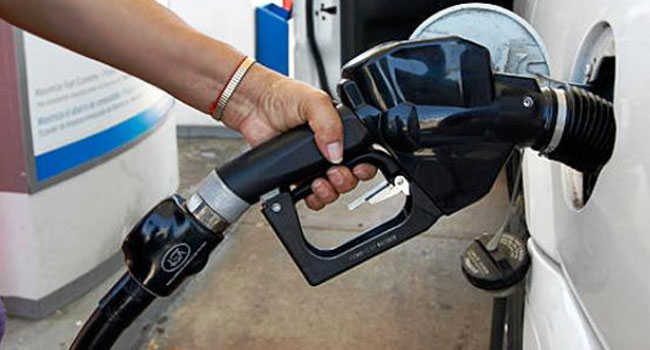
The ongoing Israeli-Iran conflict has triggered an upward adjustment in petrol prices by 10 marketers as crude oil rose 8.8 per cent to $74 per barrel from $68 per barrel.
The 10 oil marketers that adjusted depot prices included Aiteo, Pinnacle, Dangote, MENJ, Swift, Rainoil, First Royal, Emadeb, First Fortune and Ever.
EMADEB made the highest adjustment to N845 from N827 per litre, indicating an increase of 2.18 percent while Ever implemented the least adjustment to N870 from N866 per litre, showing a marginal increase of 0.46 percent.
Also, Aiteo adjusted its depot price to N840 per litre from N835 per litre; Pinnacle adjusted to N845 per litre from N829 per litre while Dangote Petroleum Refinery adjusted to N840 per litre from N830 per litre.
MENJ, Swift and Rainoil (Lagos) adjusted prices to N850 from N810 per litre, N845 from N830 per litre and to N850 from N840 per litre, respectively.
First Royal and First Fortune also adjusted their depot prices to N838 from N826 per litre and N860 from N850 per litre, respectively.
According to Petroleumprice.ng, the depot prices of petroleum products would continue to rise in the coming weeks, due to instability of the global oil market.
Crude prices are expected to rise further should Iran carry out its threat to block the Straight of Hormuz, which is responsible for the shipment of more than 20 per cent of global oil and gas.


Business
Manufacturers sitting on N40trn untapped opportunities, says report
The Nigerian Manufacturing Opportunity Report 2026 provides decision-makers with the insights on opportunities that are most immediate, where Nigeria is already making progress and what needs to be done better to unlock greater value.

SEID, a marketing communications and market intelligence firm in Lagos, has estimated that the Manufacturing industries in Nigeria is sitting on more than N40 trillion in untapped manufacturing opportunities.
The Managing Partner at SEID, Tubosun Akeju, disclosed this in a report -The Nigerian Manufacturing Opportunity Report 2026 launched by the during the 54th Annual General Meeting of the Manufacturers Association of Nigeria, held at the Oriental Hotel.
Akeju emphasised that the report provides decision-makers with the insights on opportunities that are most immediate, where Nigeria is already making progress and what needs to be done better to unlock greater value.
“The opportunity is to understand where those strengths exist, deepen them, and build the competitiveness required to capture more value locally and compete beyond our borders,” he said .
The report examines manufacturing opportunities across Nigeria’s subsectors, states, value chains and industrial clusters, while identifying areas where existing strengths can be deepened and competitiveness improved.
It said that Nigeria’s manufacturing landscape was shaped by distinct areas of industrial strength, with different states, regions and value chains demonstrating varying levels of scale, specialisation and competitiveness.
The report noted that this created an opportunity to build on existing capabilities rather than adopt a one-size-fits-all approach to industrial development.
Manufacturing activity is spread across states with different levels of scale, specialisation and growth.
The South-West remains the country’s largest manufacturing zone, while other regions are developing strengths in areas ranging from food and agro-processing to textiles, chemicals, pharmaceuticals, cement, steel and light manufacturing.
The report maps these differences to show where investment and industrial development can build on existing capabilities.
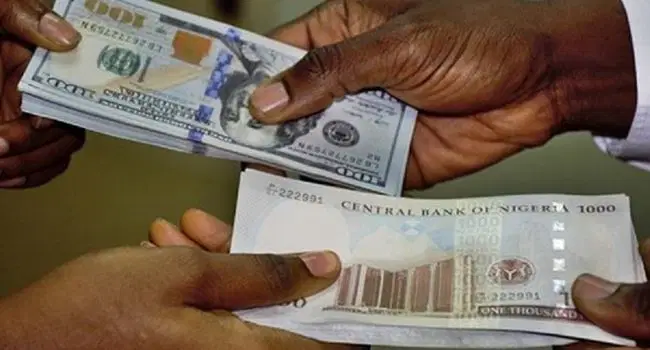
BLACK MARKET RATES
₦1375 DOLLAR (USD)
₦1830 POUND (GBP)
₦1530 EURO (EUR)
₦970 DOLLAR (CAD)
₦65 SOUTH AFRICAN RAND (ZAR)
₦350 UAE DIRHAM (AED)
₦190 CHINESE YUAN (CNY)
₦100 GHANAIAN CEDI (GHS)
₦2300 CFA F.(XOF)
₦2200 CFA F.(XAF)
₦850 AUSSIE (AUD)
OFFICIAL CBN RATES
DOLLAR (USD)₦1332.10
POUND (GBP)₦1759.17
EURO (EUR)₦1490.22
SWISS FRANC (CHF)₦1597.44
JAPANESE YEN (JPN)₦8.42
SWISS FRANC (CHF) ₦159
JAPANESE YEN (JPN) ₦8.42
CFA FRANC (XOF) ₦2.27
WEST AFRICAN UNIT OF ACCOUNT (WAUA) ₦1800.13
CHINESE YUAN (CNY)₦198.75
SAUDI RIYAL (SAR) ₦354.80
SOUTH AFRICAN RAND (ZAR)₦80.00


Business
Obi advocates policy support for manufacturers
Obi made the call following his attendance at the inauguration ceremony of the newly installed President of the Manufacturers Association of Nigeria (MAN), Dr. Eric Okoye, in Lagos, where he interacted with current and former leadership of the association.

Nigeria Democratic Congress (NDC) presidential candidate Peter Obi has called for stronger collaboration between government and private sector stakeholders to unlock the potential of Nigeria’s manufacturing industry.
He stressed that the country must transition from a consumption-oriented economy to a productive powerhouse.
Obi made the call following his attendance at the inauguration ceremony of the newly installed President of the Manufacturers Association of Nigeria (MAN), Dr. Eric Okoye, in Lagos, where he interacted with current and former leadership of the association.
According to him, targeted policies and a more favourable business environment are vital to increasing the manufacturing sector’s contribution to the nation’s gross domestic product (GDP).
“With the right government policies, an enabling business environment, and stronger collaboration between the public and private sectors, Nigeria can significantly increase the contribution of manufacturing to our GDP,” Obi stated.
Highlighting current economic figures, Obi noted that manufacturing accounts for approximately 7.5 per cent of Nigeria’s GDP, a figure he argued lags behind several other developing and emerging economies.
“Manufacturing currently contributes about 7.5 per cent of Nigeria’s GDP, compared with about 14 per cent in Egypt, 15 per cent in Morocco, 25 per cent in Vietnam, 19 per cent in Indonesia, and 20 per cent in Bangladesh,” he observed.


‘Stop Giving Testimony In Church, And Why’ – Police IRT Commander

Man,55, survives train collision with Honda Car in Lagos

Millions of bedbugs crawl out of mattresses and walls in huge outbreak

Tech Expert, Zuckerberg trains with UFC champions, Adesanya, Alexander

Organ Trafficking: Ekweremadu bags 10 years in UK prison

SAINT OBI: Between his marriage and his death
-

 News1 day ago
NAF Helicopter Makes Precautionary Landing In Makurdi
-
 Politics3 days ago
BREAKING: APC Chairmen Accused of Leading Armed Attacks on ADC Members in Igueben
-

 News2 days ago
Military Chiefs Visit Ondo Crash Site As Underwater Search Intensifies
-

 News3 days ago
UPDATE: NAF Release Identities of Ondo Crash Victims
-
 Business1 day ago
Naira Today Exchange Rates, Thursday October 8
-
 Business2 days ago
African Union launch continent’s first credit rating agency
-
 News2 hours ago
Tears, Embraces as Rescued NYSC Members Reunite with Families in Ibadan
-

 International1 day ago
Belgian Students Protest Over Rising Education Costs