
Business
Global oil reserves: Nigeria down to 11th position in latest rankings
According to report, Nigerian oil reserves haven’t grown significantly for years, failing to replace daily extraction.

Stagnation in Nigeria’s crude oil reserve for decades has placed the country to 11th position on the global rankings of oil producing countries.
The United States occupy the 10th position with 45 billion barrels of proven oil reserve.
Crude oil reserve data computed from OPEC’s Annual Statistical Bulletin 2025, reveals that Nigeria sits as the 11th country with 37.28 billion barrels proven oil reserve in the world.
Likewise, official figures from the Nigerian Upstream Petroleum Regulatory Commission (NUPRC) places it at 37.28 billion barrels as of January 2025.
In a report published recently by Visual Capitalist.com, Venezuela holds the world’s largest proven oil reserves, accounting for an estimated 303 billion barrels of proven oil reserves, the largest of any country.
These reserves account for roughly 17% of the global total, well ahead of Saudi Arabia 267 billion barrels ; Iran 209 billion barrels, Canada 163 billion barrels , and Iraq 113 billion barrels.
Chart credit: Visual capitalist.com
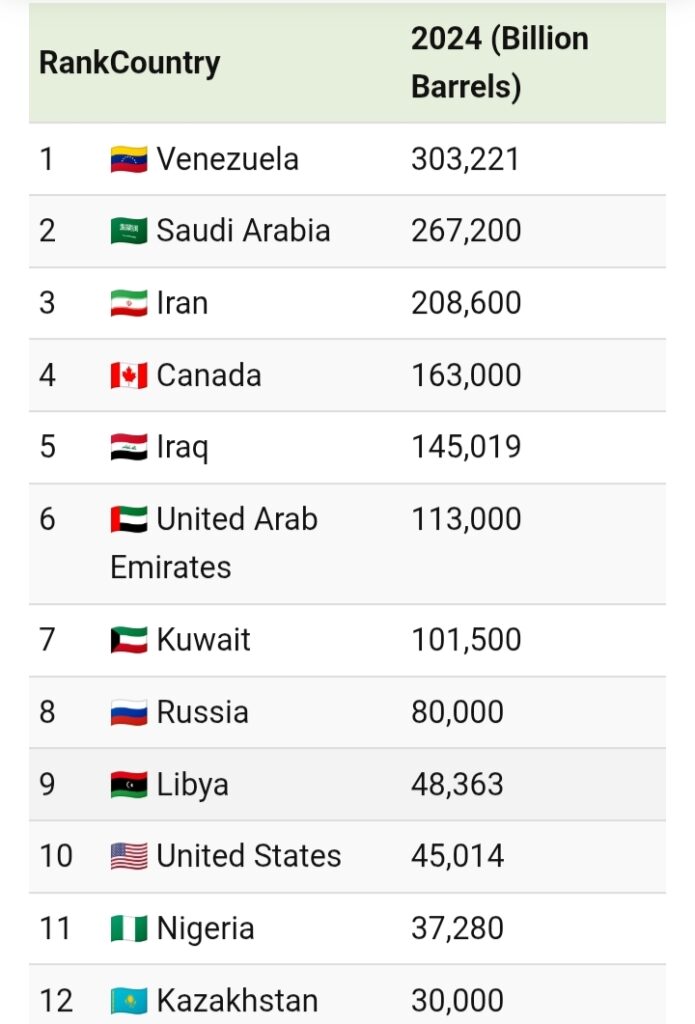
According to report, Nigerian oil reserves haven’t grown significantly for years, failing to replace daily extraction.
Oil theft, vandalism, and insecurity hinder efforts to reach full production potential.
Nevertheless, the NUPRC aims to boost reserves and production, with plans to attract investment for new exploration and development.
Business
CBN Pledges Policy Consistency Into 2027
The single-digit inflation target remains the anchor.

The Central Bank of Nigeria says that it will keep a consistent monetary policy direction in 2027, as it pursues the single-digit inflation target.
The stance puts policy continuity at the centre of the CBN’s inflation fight.
The bank is tying its inflation goal to consistency in monetary policy rather than a change in direction.
The single-digit inflation target remains the anchor.
The CBN’s message is that the target still stands and that policy will stay consistent in 2027.
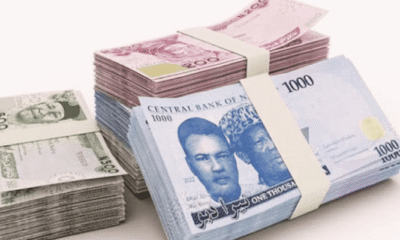
₦1450 DOLLAR (USD)
₦1875POUND (GBP)
₦1575EURO (EUR)
₦950 CANADIAN DOLLAR (CAD)
₦70 SOUTH AFRICAN RAND (ZAR)
₦350 UAE DIRHAM (AED)
₦190 CHINESE YUAN (CNY)
₦100 GHANAIAN CEDI (GHS)
₦2240 WEST AFRICAN CFA F.(XOF)
₦2180 CENTRAL AFRICAN CFA F.(XAF)
₦820 AUSTRALIAN DOLLAR (AUD)
Business
MAN Seeks Tobacco Exclusion From NAFDAC Bills Over Regulatory Overlap
The association further maintained that the existing regulatory framework, administered through the Federal Ministry of Health and Social Welfare and the Federal Ministry of Industry, Trade and Investment, already provides for the regulation of the legal tobacco sector.
The Manufacturers Association of Nigeria (MAN) has called on the National Assembly for explicit tobacco products exclusion from two proposed bills seeking to repeal and reenact the laws establishing the National Agency for Food and Drug Administration and Control (NAFDAC), warning that their passage could create overlapping regulatory responsibilities and increase compliance costs for manufacturers.
The bills are the National Agency for Food and Drug Administration and Control (Repeal and Enactment) Bill, 2026 (SB. 940) and the Food, Medical Products and Related Products (Registration, Etc.) Bill, 2026 (SB. 952).
The Director-General of MAN, Segun Ajayi-Kadir, therefore urged the lawmakers to remove all references to tobacco from both bills, including relevant definitions, schedules and consequential provisions.
It also called for an explicit exclusion clause to prevent tobacco products from subsequently being brought under the proposed legislation through administrative instruments.
According to the association, such a provision would preserve clarity in institutional mandates and regulatory responsibilities while preventing unnecessary regulatory overlaps.
MAN maintained that regulatory reforms should strengthen public-health protection, address demonstrable regulatory gaps and improve compliance without creating additional administrative burdens for legitimate businesses.
It argued that clear institutional mandates, proportionate enforcement and effective inter-agency coordination were essential to achieving these objectives while supporting manufacturing, employment and investment.
The association further maintained that the existing regulatory framework, administered through the Federal Ministry of Health and Social Welfare and the Federal Ministry of Industry, Trade and Investment, already provides for the regulation of the legal tobacco sector.
MAN reaffirmed its readiness to engage constructively with the National Assembly and relevant government institutions, particularly the two federal ministries, to ensure that the proposed legislation delivers effective regulation without unnecessary duplication, conflicting institutional mandates or regulatory uncertainty.


CBN Pledges Policy Consistency Into 2027

Naira Exchange Rates, Thursday,26 Nov

MAN Seeks Tobacco Exclusion From NAFDAC Bills Over Regulatory Overlap

BREAKING: Lagos Govt Declares Today, Thursday Work-Free to Mark 2026 Ìṣẹ̀ṣe Day

Tech Expert, Zuckerberg trains with UFC champions, Adesanya, Alexander

Why we Increase the 2025 Budget by ₦700bn – Bichi
-

 News3 days ago
Katsina Suspends Emir of Daura Over Sexual Allegations By Polish Tourist
-
 Business2 days ago
Naira Exchange Rates, Thursday,26 Nov
-
 News3 days ago
El-Rufai makes u-turn on wiretapping
-

 News3 days ago
Mother, daughter crushed to death by truck in Abuja
-

 Business3 days ago
Cardoso : Pressure on The Naira Is Seasonal Factors- It won’t last
-
 Business2 days ago
MAN Seeks Tobacco Exclusion From NAFDAC Bills Over Regulatory Overlap
-
Business2 days ago
CBN Pledges Policy Consistency Into 2027