Business
Forest Sector Employs 42m People Globally – FAO
According to the report, the 42 million jobs are distributed across Africa, the Americas, Asia, Europe and Oceania, highlighting the forest sector’s significant contribution to global employment and livelihoods.

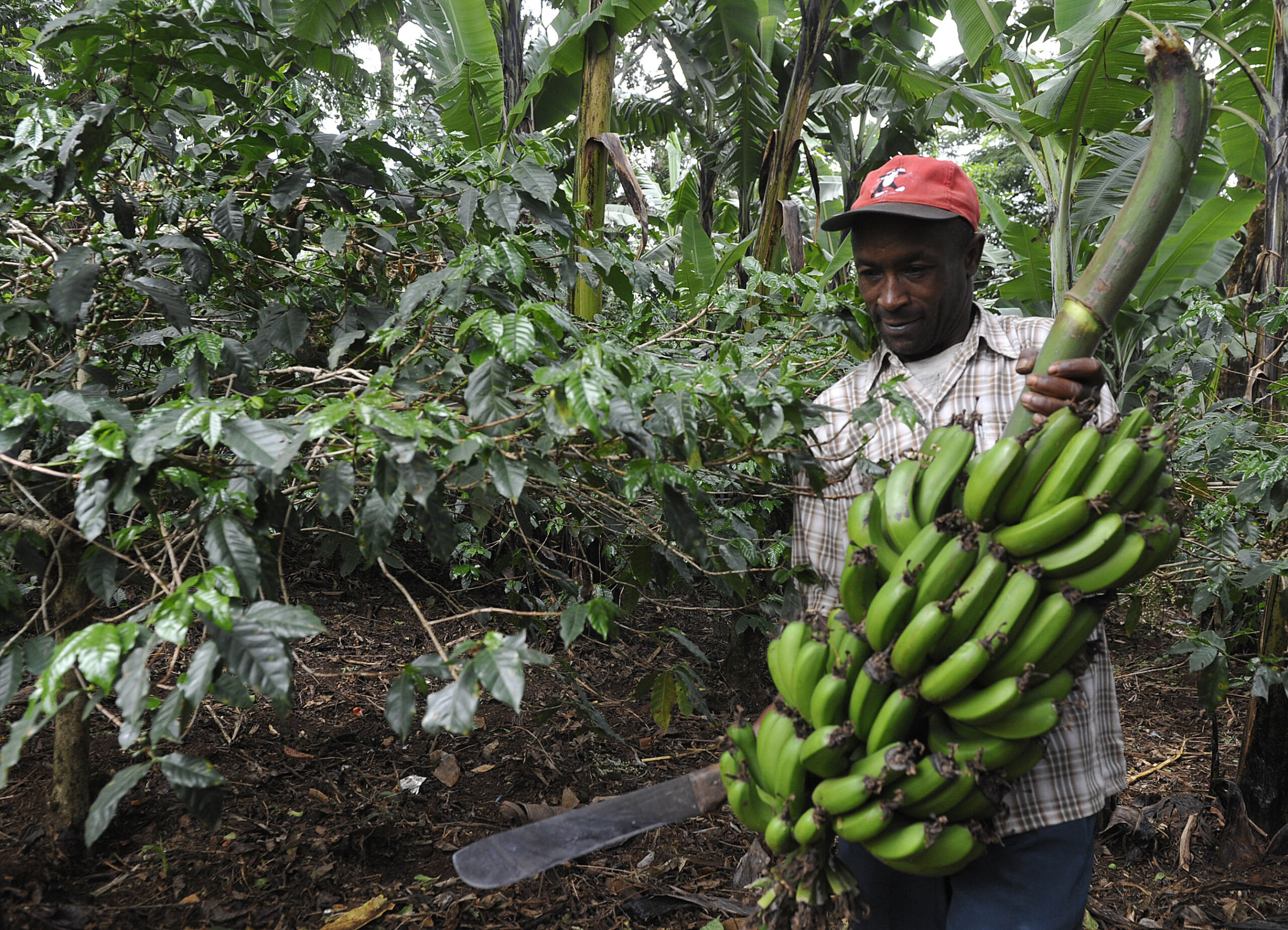
• A farmer carrying harvested banana / FAO
The global forest sector provides employment for approximately 42 million people, spanning activities within forests as well as industries, services and supply chains dependent on forest resources, a new international study has revealed.
The study was jointly conducted by the Food and Agriculture Organization of the United Nations (FAO), the International Labour Organization (ILO) and the Thünen Institute of Forestry of Germany.
According to the report, the 42 million jobs are distributed across Africa, the Americas, Asia, Europe and Oceania, highlighting the forest sector’s significant contribution to global employment and livelihoods.
FAO said the new data provides an important basis for understanding the human dimension of forests, noting that previous estimates were hampered by fragmented data and incomplete country coverage.
“Until now, however, fragmented data and incomplete country coverage have left significant gaps in the global picture – and no breakdown by gender,” FAO said.
The organisation noted that discussions about forests often focus on their products and environmental benefits, while their role as workplaces and sources of livelihoods receives comparatively less attention.
“When we talk about forests, we tend to focus on what they provide – wood, non-wood forest products, raw materials, and the foundation of a sustainable bioeconomy. Rarely do we talk about them as workplaces. And rarer still do we ask who, exactly, works in them,” FAO stated.
The agency stressed that reliable employment data is critical to the development of policies aimed at building a sustainable and inclusive green economy.
It said internationally comparable data on forest-sector employment would enable governments and policymakers to better understand the people whose livelihoods depend on forests and develop policies that protect both workers and forest resources.
Beyond employment, forests provide ecosystem services that are vital to environmental sustainability and economic development. They also supply renewable resources that form the foundation of emerging sustainable bioeconomies.
Business
CBN Pledges Policy Consistency Into 2027
The single-digit inflation target remains the anchor.

The Central Bank of Nigeria says that it will keep a consistent monetary policy direction in 2027, as it pursues the single-digit inflation target.
The stance puts policy continuity at the centre of the CBN’s inflation fight.
The bank is tying its inflation goal to consistency in monetary policy rather than a change in direction.
The single-digit inflation target remains the anchor.
The CBN’s message is that the target still stands and that policy will stay consistent in 2027.

₦1450 DOLLAR (USD)
₦1875POUND (GBP)
₦1575EURO (EUR)
₦950 CANADIAN DOLLAR (CAD)
₦70 SOUTH AFRICAN RAND (ZAR)
₦350 UAE DIRHAM (AED)
₦190 CHINESE YUAN (CNY)
₦100 GHANAIAN CEDI (GHS)
₦2240 WEST AFRICAN CFA F.(XOF)
₦2180 CENTRAL AFRICAN CFA F.(XAF)
₦820 AUSTRALIAN DOLLAR (AUD)
Business
MAN Seeks Tobacco Exclusion From NAFDAC Bills Over Regulatory Overlap
The association further maintained that the existing regulatory framework, administered through the Federal Ministry of Health and Social Welfare and the Federal Ministry of Industry, Trade and Investment, already provides for the regulation of the legal tobacco sector.

The Manufacturers Association of Nigeria (MAN) has called on the National Assembly for explicit tobacco products exclusion from two proposed bills seeking to repeal and reenact the laws establishing the National Agency for Food and Drug Administration and Control (NAFDAC), warning that their passage could create overlapping regulatory responsibilities and increase compliance costs for manufacturers.
The bills are the National Agency for Food and Drug Administration and Control (Repeal and Enactment) Bill, 2026 (SB. 940) and the Food, Medical Products and Related Products (Registration, Etc.) Bill, 2026 (SB. 952).
The Director-General of MAN, Segun Ajayi-Kadir, therefore urged the lawmakers to remove all references to tobacco from both bills, including relevant definitions, schedules and consequential provisions.
It also called for an explicit exclusion clause to prevent tobacco products from subsequently being brought under the proposed legislation through administrative instruments.
According to the association, such a provision would preserve clarity in institutional mandates and regulatory responsibilities while preventing unnecessary regulatory overlaps.
MAN maintained that regulatory reforms should strengthen public-health protection, address demonstrable regulatory gaps and improve compliance without creating additional administrative burdens for legitimate businesses.
It argued that clear institutional mandates, proportionate enforcement and effective inter-agency coordination were essential to achieving these objectives while supporting manufacturing, employment and investment.
The association further maintained that the existing regulatory framework, administered through the Federal Ministry of Health and Social Welfare and the Federal Ministry of Industry, Trade and Investment, already provides for the regulation of the legal tobacco sector.
MAN reaffirmed its readiness to engage constructively with the National Assembly and relevant government institutions, particularly the two federal ministries, to ensure that the proposed legislation delivers effective regulation without unnecessary duplication, conflicting institutional mandates or regulatory uncertainty.


Senator Idiat Oluranti Adebule Dies at 56

JUST IN: Obi-Kwankwaso Movement Suspends DG with Immediate Effect

CBN Pledges Policy Consistency Into 2027

BREAKING: Lagos Govt Declares Today, Thursday Work-Free to Mark 2026 Ìṣẹ̀ṣe Day

Tech Expert, Zuckerberg trains with UFC champions, Adesanya, Alexander