
Business
FCCPC insists on Air Peace investigation over violations


The Federal Competition and Consumer Protection Commission has insisted that it is investigating Air Peace for allegedly exploiting customers.
FCCPC disclosed this in a statement by its spokesperson, Ondaje Ijagwu, on Thursday.
The Commission was clarifying reports making the round that it is not investigating Air Peace.
However, the FCCPC told Nigerians to disregard the claim as it does not emanate from the Commission.
“The Federal Competition and Consumer Protection Commission (FCCPC) categorically refutes a story entitled “FG not investigating Air Peace—FCCPC” making the rounds on some media platforms, particularly online, which has been falsely attributed to the Commission.
The referenced story, which seems syndicated and sponsored, did not emanate from the FCCPC, and we advise the public to disregard it in its entirety.
The FCCPC stands firmly by its official release dated December 1, 2024, which announced enquiries into widespread consumer complaints in the banking, telecommunications, and aviation sectors.
As stated, Air Peace is one of the entities being engaged to address allegations of exploitative ticket pricing, including significant price hikes for advance bookings on specific domestic routes.
These enquiries, being conducted under the Federal Competition and Consumer Protection Act (FCCPA) 2018, are focused on addressing poor service delivery, exploitative practices, and potential consumer rights violations.
The enquiries are structured engagements aimed at ensuring compliance with regulatory standards, improving transparency, and protecting consumer interests.
“The FCCPC reaffirms that the enquiry into Air Peace commenced as scheduled on December 3, 2024, and remains ongoing.
The Commission is reviewing information and responses being provided by Air Peace and other entities under inquiry.
Appropriate determinations will be made, and necessary actions taken to address any identified violations.
“We urge the public to rely solely on verified communications from the FCCPC,” the Commission stated.

BLACK MARKET RATES
₦1375DOLLAR (USD)
₦1845 POUND (GBP)
EURO (EUR) ₦1550
₦1000 CANADIAN DOLLAR (CAD)
₦70 SOUTH AFRICAN RAND (ZAR)
₦370 UAE DIRHAM
₦190 CHINESE YUAN (CNY)
₦100 GHANA CEDI (GHS)
₦2350 CFA F.(XOF)
₦2250 CFA F.(XAF)
₦850 AUSTRALIAN DOLLAR (AUSSIE)
Official CBN Exchange Rates
DOLLAR (USD)₦1329.16
POUND (GBP)₦1766.59
EURO (EUR) ₦1510.06
SWISS FRANC (CHF) ₦1593.91
JAPANESE YEN (JPN)₦8.47
CFA FRANC (XOF) ₦2.30
WEST AFRICAN UNIT OF ACCOUNT (WAUA) ₦1807.23
CHINESE YUAN (CNY) ₦198.25
SAUDI RIYAL (SAR) ₦353.97
SOUTH AFRICAN RAND (ZAR) ₦81.18
Business
Obasanjo: “Aliko Embarrass Me”
He got all his workers together in that refinery and said, without telling me, and there, said…

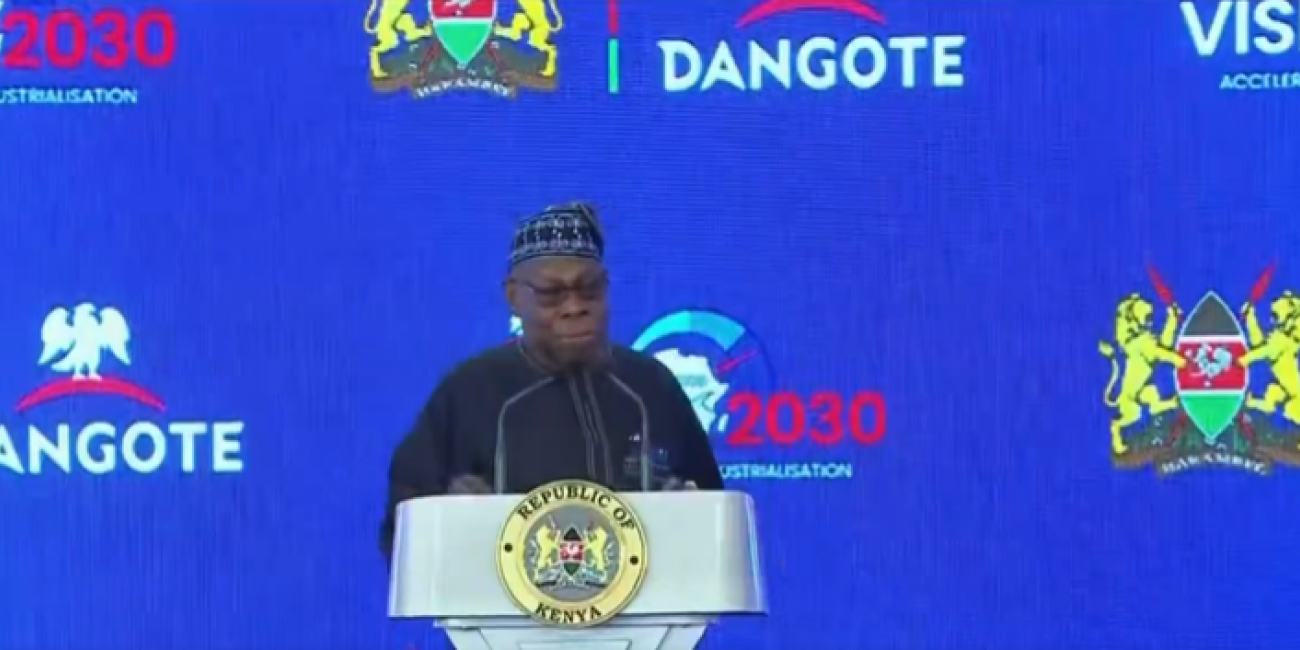
Former President of Nigeria, Olusegun Obasanjo, has described Aliko Dangote as his “boss”, crediting the businessman’s industrial achievements to the policies and encouragement provided by his administration.
Obasanjo said this while speaking at the groundbreaking ceremony of the Dangote East Africa Refinery in Lamu, Kenya, where he recalled his recent visit to the Dangote refinery and the businessman’s acknowledgement of the role he played in his transition from cement importation to production.
He said, “About two months ago, three months ago, I visited the refinery which you visited last week. And I just couldn’t stop being surprised what Aliko did. But then Aliko embarrassed me.”
According to Obasanjo, Dangote had gathered his workers during the visit and publicly attributed part of his success in cement production and the eventual development of his refinery to the policies and encouragement of the former president.
He said, “He got all his workers together in that refinery and said, without telling me, and there, said, all of you working here, all of you, the man you have to thank is this man, that’s me. I didn’t have anything to do with his refinery or what it is.
He said, without this man, I would not have been in cement production.“And it is the cement production that provided the encouragement, the inspiration for the refinery. So, thank you. They all shouted and thanked me.”
Obasanjo said Dangote had expanded the opportunities created by his administration beyond Nigeria, particularly through cement production across Africa, and was now replicating the model in the petroleum refining sector.
“May God continue to expand your coast. And you are my boss. You will continue to be my boss.”
Business
Minister Tasks Charcoal Merchants on Sustainable Forestry
The minister gave the charge at the flag-off of the 2026 Operation One Million Trees Tree Planting Programme organised by the Association for Forest Conservation and Green Industrial Charcoal Merchants at the Faculty of Renewable Natural Resources, University of Ibadan.

•Charcoal merchants and other stakeholders in the forestry sector
The Minister of Environment, Balarabe Abass Lawal, has charged charcoal merchants and other stakeholders in the forestry sector to embrace sustainable practices and support the federal government’s efforts to reverse deforestation and restore Nigeria’s degraded forest landscapes.
The minister gave the charge at the flag-off of the 2026 Operation One Million Trees Tree Planting Programme organised by the Association for Forest Conservation and Green Industrial Charcoal Merchants at the Faculty of Renewable Natural Resources, University of Ibadan.
The programme, which brought together forestry practitioners, charcoal merchants, environmentalists, students, regulators and other stakeholders, is aimed at promoting afforestation and encouraging responsible management of Nigeria’s forest resources.
Speaking at the event, the minister described tree planting as one of the most practical measures for combating climate change, reversing deforestation, restoring biodiversity, controlling desertification and strengthening the resilience of the nation’s ecosystems.
The Chairman of the Association for Forest Conservation and Green Industrial Charcoal Merchants, Mr Adeshola Adebowale Idowu, emphasised that the event carried a clear message for everyone involved in the charcoal business and, indeed, every Nigerian.
Idowu said stakeholders should develop the habit of replacing trees removed from the environment, encouraging Nigerians to plant trees around their homes and communities.
He advocated a practice of planting several trees for every tree cut down, stressing that trees remain indispensable to human existence because many products used by society are derived from them
( THISDAY)


Naira Rates To Dollar, Pound ,Euro… Friday, October 2

Obafemi Hamzat promises to end ‘unauthorised levies’ in Lagos if he is elected

President Tinubu, Other Political Leaders Watch MKO Documentary

Tech Expert, Zuckerberg trains with UFC champions, Adesanya, Alexander

Organ Trafficking: Ekweremadu bags 10 years in UK prison

SAINT OBI: Between his marriage and his death
-
 Business23 hours ago
Naira To Dollar, Pound, Euro… Rates Friday, October 1
-
 News23 hours ago
Nigeria @ 66: President Tinubu says next phase of reforms’ll cut cost of living
-
 News3 days ago
BREAKING: Court Order Threatens Dangote Kenya Refinery Launch
-

 News2 days ago
FG Declares October 1 Public Holiday to Mark Independence Day Anniversary
-

 Business23 hours ago
Court orders NMDPRA to continue issuing fuel import licences to Matrix Energy, AA Rano, AYM Shafa
-

 News2 days ago
Atiku Demands Release of 5 Arrested Over ‘Tinubu Must Go’ T-Shirts
-

 International2 days ago
Plane Makes Emergency Landing After Pilots Fight in Cockpit
-
 News22 hours ago
FG launches new digital postcodes