
News
Economic Reforms: I Have No Cabal Or Sponsors To Compensate —Tinubu

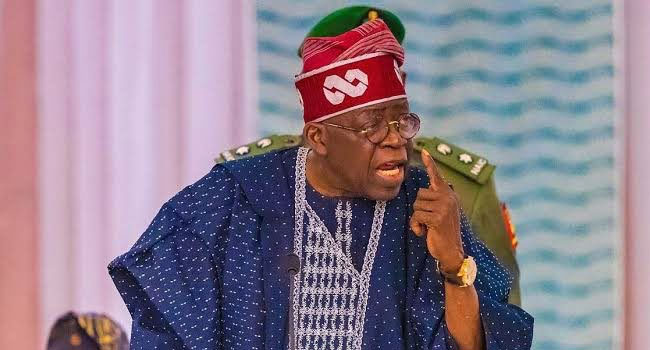
President Bola Tinubu has allayed fears of manipulation by any interest group in the ongoing economic reforms, saying his campaign was self-sponsored, without strings, or indebtedness to any individual or institution.
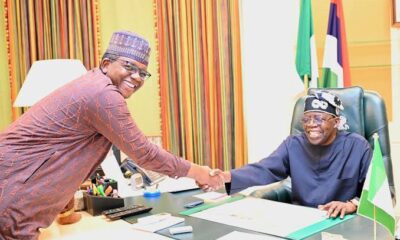
The President, who received a delegation of Islamic leaders led by Sheikh Bala Lau, at the State House on Thursday, said his victory at the polls was purely by divine intervention, careful planning, and diligence in getting support from Nigerians.
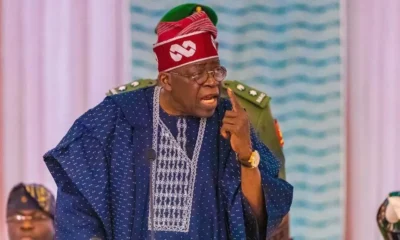
“I have no cabal. I have no sponsors. The money I spent on the elections was my personal fortune. At some point, the odds were against me; banks were locked. But Allah, the Almighty God, said I will be the President.
Mine is to now follow the leading and teaching of the Almighty God.
“One of the most potent elements of defence is a good conscience. It is also a defence against corruption.“What should be uppermost in our minds is the future of our children.
We have a lot to teach them on what it takes to be a good citizen and what it takes to be a responsible citizen,’’ the President stated.
President Tinubu said protests, fuelled by anger and hate, could degenerate into violence and set the country backwards.
“We are reworking the social welfare scheme to reach the ward level, which is the closest to our people. We will ensure that we re-establish connection with the wards, again, so that we can give allowances to the poor and the vulnerable.
“The student loans will pay for school fees. There will be monetary support for the education of our children. Consumer credit will support citizens in buying cars and houses, and they can repay them gradually.
“We have increased the minimum wage by more than 100 per cent,’’ the President said.
President Tinubu said the sponsors of protests place their selfish ambitions above the national interest.“The sponsors of protests do not love our country.
They have no love for the nation. They do not understand citizenship. They have alternative passports.“They are in different parts of the world holding meetings virtually.
“We do not want to turn Nigeria into Sudan. We are talking about hunger, not burials. We have to be careful. We should be careful with premature politics; politics of hate, and anger.
“The internet has made it possible to hold meetings in artificial settings. They hold meetings and sponsor anger,’’ the President told the religious leaders.
In his remarks, the leader of the delegation, Sheikh Bala Lau, assured the President of support with prayers and more sensitization.“Peace is paramount for us in the country.
Abraham first asked God for peace and guidance,’’ Sheikh Lau noted.
While speaking, the traditional rulers called for calm over the planned nationwide protest to demonstrate against the prevailing economic hardship in Nigeria.
The protest which is billed to begin from August 1st, 2024 has garnered traction on social media.
“We will listen to our youths because they lead the future. The power and the strength of Nigeria are certainly with the young people,” the Dein of Agbor, HRM Benjamin Keagborekuzi said after the meeting.
“We feel your pain.
I’m a young person myself. It’s been 24 years that I’ve been back and it’s been 24 years that I’ve sadly seen the nation going in a very unpalatable direction.
But by God’s grace, I think if you would give us the chance, this protest, I know that it’s catching you very, very high in the net.
But if you give us the chance, let us not destroy our own country. ”On his part, the Emir of Zazzau Ahmed Bamalli said the country’s leaders are worried about the planned protest but called “on our people to exercise patience and to listen to the words of wisdom”.
“Well, the message we are taking back to our people is to be calm, to exercise patience, and also to listen to the words of wisdom coming from the traditional rulers and from the governors because we have spoken to the President and he has given us the blueprint of what he has been doing over time,” he said.
The Ooni of Ife Oba Adeye Enitan Ogunwusi also followed a similar line but called for caution so the protest would not be hijacked.
“We traditional rulers are not engaged in people, especially the youth coming out to start looting to start breaking down law and order. We are parents, we are traditional rulers, we are closer to them,” he said.
“We are going to go back home and continue to engage them.
It is very difficult to build, but it is the easiest to destroy. We are all stakeholders in this country. We should be stronger as a nation together, than stronger individually.”
Thursday’s meeting is part of a last-minute push by the President Tinubu administration – which has come under severe criticism over its policies – to avert the planned protest.
Following the removal of fuel subsidy and the floating of the naira since the inception of the Tinubu government, the cost of living has soared, prompting the administration to reel out a raft of measures including a new minimum wage and the distribution of palliative. He has also called for patience.
But these efforts, many argue, are yet to do much in addressing the challenges.
In the wake of the planned protest scheduled to be held nationwide, security agencies have warned the organisers who have remained faceless to shelve the demonstration.
They fear it may be hijacked by criminal elements, and turning violent like the EndSARS protest of 2020.
Several groups have also pulled out of the scheduled demonstration, but proponents argue that it is the citizens’ right to protest perceived ill-treatment from the government.






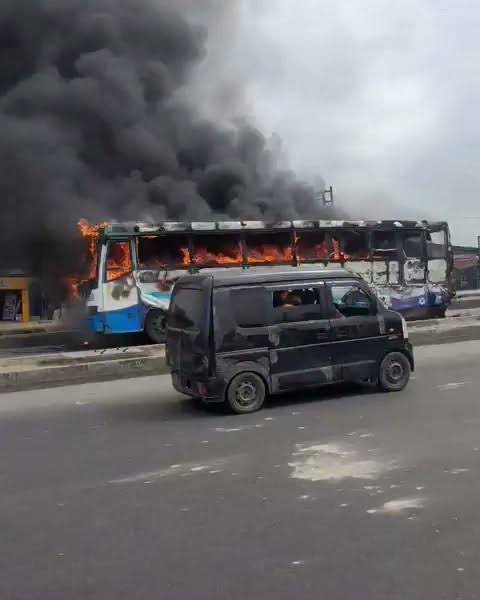
An angry mob has set a Bus Rapid Transit (BRT) bus on fire after it reportedly crushed a commercial motorcyclist to death at Ogolonto Bus Stop along Ikorodu Road in Lagos State.
The incident occurred on Friday, October 16, 2026. Eyewitness accounts and social media reports indicate that the motorcyclist was riding alone along the restricted BRT lane when the collision happened. He died at the scene.
Enraged residents and youths then attacked the bus driver and set the vehicle ablaze. Police officers and officials of the Lagos Neighbourhood Safety Corps (LNSC), who were nearby, intervened promptly and rescued the driver unharmed.
The identity of the deceased motorcyclist and the exact circumstances of the crash had not been officially confirmed at the time of filing this report. It was also unclear whether any arrests had been made in connection with the burning of the bus.
News
ARISE News Wins Seven Honours At Nigerian Broadcasters Merit Awards
The awards recognised the network’s achievements in television journalism and programming, with ARISE News winning the Best TV Channel (Viewer’s Choice) category.


• ARISE News Anchor and host of What’s Trending Ojy Okpe was named Best Newscaster (TV – Female)
ARISE News has emerged as one of the major winners at the just ended Nigerian Broadcasters Merit Awards (NBMA).
ARISE News won seven honours across television broadcasting, news reporting, presentation and production during the ceremony.
The awards recognised the network’s achievements in television journalism and programming, with ARISE News winning the Best TV Channel (Viewer’s Choice) category.
The network’s flagship breakfast programme, The Morning Show, also won the Best TV Talk Show award, further strengthening its recognition in television broadcasting.
ARISE News Anchor and host of What’s Trending Ojy Okpe was named Best Newscaster (TV – Female).
Rufai Oseni was named Nigerian Broadcaster of the Year (Male), while Vimbai Mutinhiri-Ekpeyong received the Nigerian Broadcaster of the Year (Female) award.
The recognition extended to the network’s newsroom, with Ovieteme George winning Best TV News Reporter (Male) for his contributions to television news reporting.
Behind the camera, Sam Adeyemi received the Best Camera Operator/Cinematographer award, recognising his work in television production and visual storytelling.
News
Meta removes 3.7 million accounts in West Africa scam crackdown
The joint operation led to 28 arrests, identified more than 30 suspected scam centres and rescued 117 people allegedly trafficked and forced to work in scam compounds in Ghana.
Meta, the parent company of Facebook and Instagram, has removed more than 3.7 million Facebook and Instagram accounts, pages and groups linked to suspected scam networks operating in West Africa.
The joint operation led to 28 arrests, identified more than 30 suspected scam centres and rescued 117 people allegedly trafficked and forced to work in scam compounds in Ghana.
The company announced the crackdown in a statement on Tuesday, October 13, 2026. It involved 14 technology companies and law enforcement agencies from 10 countries.
The United Kingdom’s National Crime Agency coordinated the operation with the US Department of Justice, the Federal Bureau of Investigation and other agencies. Nigerian authorities were involved.
Other countries included Ghana, Australia, Canada, New Zealand and India.Tech companies that took part included Google, Microsoft, OpenAI, Coinbase, Starlink and Adobe.
Meta said the partnership let participants share intelligence across digital platforms, countries and financial systems to identify criminal networks.


JUST IN: Mob Sets BRT Bus Ablaze After Motorcyclist’s Death in Lagos

BREAKING: DSS Arrests Fugitive Maina Son, Hands Him to EFCC

BREAKING: 5 Arrested Over Imo NYSC Abduction

BREAKING: Lagos Govt Declares Today, Thursday Work-Free to Mark 2026 Ìṣẹ̀ṣe Day

Tech Expert, Zuckerberg trains with UFC champions, Adesanya, Alexander

Organ Trafficking: Ekweremadu bags 10 years in UK prison
-

 Business2 days ago
NAFDAC scolds fake manufacturers: “You are killing Nigerians in order to make money”
-
 Business2 days ago
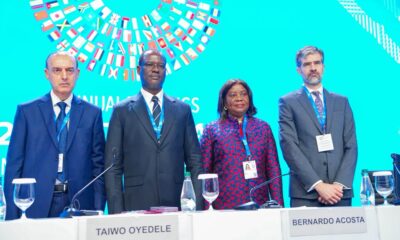
Oyedele Chairs G-24 Call for Fairer Global Financial System, Affordable Development Financing
-
 Business2 days ago
Naira Exchange Rates For Thursday, October 15
-

 Business3 days ago
BREAKING: Shell to Exit Nigeria’s Domestic Gas Distribution Business
-
 Business1 day ago
Germany plans tax on sugary drinks
-
 Politics2 days ago
Exclusion of candidates from INEC list: CD cautions INEC against manipulation by politicians
-
 Sports2 days ago
CAF Increases Annual Funding for Member Federations to $700,000
-
 Business1 day ago
WEF could appoint Lagarde as its next chair, sources say