
Business
Diesel Costs Bite: LAMATA Accelerates Shift To CNG, Electric Buses
The move comes as diesel prices have more than doubled, rising from about N950 per litre at the beginning of the year to between N1,950 and N2,100 per litre, depending on the source.

Lagos is accelerating its transition away from diesel-powered public transport as the Lagos Metropolitan Area Transport Authority (LAMATA) begins phasing out diesel buses from its regulated fleet, amid a surge in diesel prices that has pushed operating costs sharply higher.
LAMATA is targeting clean-energy propulsion for 52 per cent of its Bus Rapid Transit (BRT) fleet by 2050, with compressed natural gas (CNG) and electric vehicles (EVs) taking the place of conventional diesel buses under a policy that took effect at the beginning of 2026.
The Managing Director and Chief Executive Officer of LAMATA, Mrs. Abimbola Akinajo, disclosed this weekend, during the handover of 20 additional high-capacity CNG buses under the Presidential Initiative on CNG and EVs.
The latest delivery brings LAMATA’s CNG fleet to about 170 buses, following the deployment of approximately 150 CNG buses before the new vehicles were received.
The authority also operates high-capacity and medium-capacity electric buses.
Akinajo said some of the new CNG buses would be deployed on the busy Ikorodu–Tafawa Balewa Square corridor, where passenger demand remains high.
“We will only work with CNG or EV buses, and this has been the policy since the beginning of the year,” she said.
The move comes as diesel prices have more than doubled, rising from about N950 per litre at the beginning of the year to between N1,950 and N2,100 per litre, depending on the source.
For LAMATA, the shift is therefore not only an environmental policy but also a cost-management strategy aimed at shielding commuters and transport operators from the impact of rising fuel expenses.
Akinajo said regulated public transport fares had not been increased, partly because the lower operating costs of CNG and electric buses were helping to contain the pressure on operators.
“Regulated public transport fares have not increased, and these buses have helped us achieve that,” she said.
Diesel phase-outUnder the new policy, existing diesel-powered buses in the regulated system will be progressively replaced with CNG and electric alternatives.
Akinajo said the long-term direction was for the regulated system to ultimately operate an entirely electric fleet, while the broader clean-energy target provides a pathway towards reducing emissions from Lagos’ transportation sector.
Transportation remains a major source of emissions in the megacity, making the switch to cleaner buses a key component of Lagos State’s long-term ambition of achieving net-zero emissions by 2050.
Business
History of Naira Revaluation and Devaluation (1973–2026) (Part 1)
Why was the naira devalued?
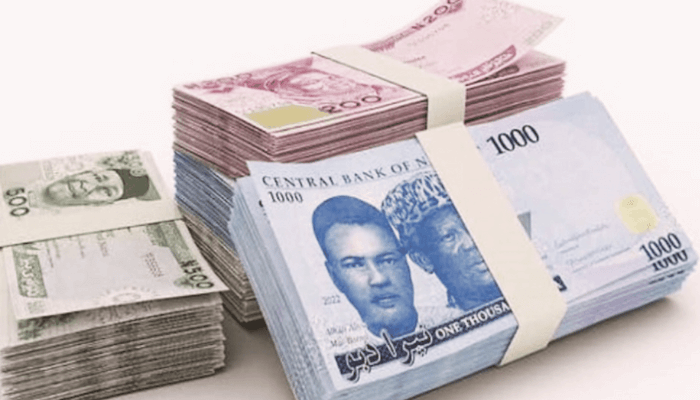
The history of the Nigerian naira is marked by two major developments: periods when the currency gained value or was officially strengthened, and prolonged periods when it lost value against major international currencies, particularly the US dollar.
Since its introduction in 1973, the naira has undergone several exchange-rate policy changes, including fixed exchange rates, currency devaluations, foreign-exchange market liberalisation, attempts to unify exchange rates and market-driven depreciation.
The Central Bank of Nigeria (CBN) has played a central role in managing these changes.
- Introduction of the Naira in 1973
Nigeria introduced the naira on January 1, 1973, replacing the Nigerian pound.
The conversion rate was:
£1 Nigerian pound = ₦2.
₦1 = 10 shillings under the old currency system.
₦1 = 100 kobo.
The new currency was introduced during a period of expanding oil revenues and economic growth.
Nigeria initially maintained a relatively strong, managed exchange rate, supported by foreign-exchange controls and the country’s oil earnings.
The introduction of the naira was a currency change, not a devaluation.- The 1970s: A Relatively Strong Naira
During the 1970s, rising oil revenues strengthened Nigeria’s foreign-exchange position.
The government maintained a controlled exchange-rate system, initially linking the naira to the US dollar before moving to a basket of currencies representing major trading partners in 1978.
The oil boom provided foreign exchange for imports, infrastructure and public expenditure.
However, Nigeria’s dependence on crude oil revenues left the economy vulnerable to fluctuations in international oil prices.
Key development: The naira benefited from a relatively strong external position, although its exchange rate was managed by the authorities rather than determined by an unrestricted market.- The Early 1980s: Mounting Pressure on the Naira
The economic situation deteriorated in the early 1980s as oil revenues weakened and foreign-exchange shortages intensified.
Nigeria faced several economic challenges:
• Declining oil receipts.
• Rising import bills.
• Pressure on foreign reserves.
• Growing external debt and trade arrears.
• Increasing demand for foreign currency.
The government maintained controls on foreign exchange, but the official rate became increasingly disconnected from the rate at which foreign currency could be obtained in the parallel market.
This created pressure for exchange-rate reform.
The crisis set the stage for the introduction of the Structural Adjustment Programme (SAP) in 1986.- 1986: Major Naira Devaluation Under SAP
September 26, 1986, marked a turning point in the history of the naira.
Under the military government of General Ibrahim Babangida, Nigeria introduced the Second-Tier Foreign Exchange Market (SFEM) as part of the Structural Adjustment Programme.
The objective was to allow market forces to play a greater role in determining the naira’s exchange rate.
According to an International Monetary Fund account, the naira’s value was discounted by approximately 66 per cent at the inaugural SFEM auction.
The exchange rate moved from about ₦1.60 per US dollar under the previous administered rate to approximately ₦4.60 per dollar at the initial auction.
Why was the naira devalued?
The policy was intended to:
•Reduce the overvaluation of the naira.
•Improve the allocation of scarce foreign exchange.
•Encourage non-oil exports.
•Improve the competitiveness of Nigerian products.
•Reduce distortions in the foreign-exchange market.
However, the weaker currency also increased the naira cost of imported goods and production inputs.
The 1986 reform began a prolonged period of exchange-rate adjustments.- …To be continued
Business
Obasanjo Accuses Tinubu : “You Made Every Nigerian Poor By 300% Naira Devaluation”
The former President also rejected the argument that Tinubu needed more time to complete his reforms, saying he did not see the economy improving.
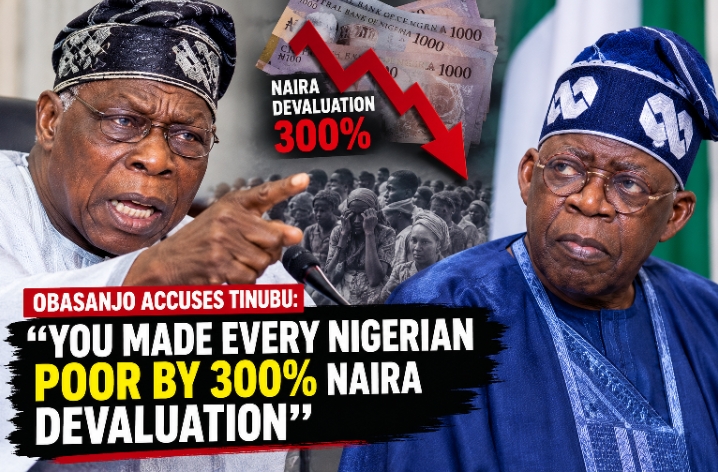
Image: AI generated
Former President Olusegun Obasanjo has accused President Bola Tinubu of making every Nigerian poor by 300 per cent through the devaluation of the naira.
Obasanjo spoke on Wednesday during the Financial Times Africa Summit 2026 in London, United Kingdom.
He said that the naira lost its value overnight due to economic reforms undertaken by the Tinubu administration in 2023.
“We do not live in isolation as a country. We interact with the rest of the world. And overnight, you devalue the currency by 300 per cent. The naira went from N500 to a dollar to N1,500 to a dollar. What that meant was that every Nigerian is made poor by 300 per cent.”
Obasanjo said that had made Nigeria “the poverty capital of the world,” which he said meant the country had the largest number of poor people in the world.
“You cannot say to me that that is good for Nigeria. You cannot say to me that that is good for us in any sense,” he noted.
The former President also rejected the argument that Tinubu needed more time to complete his reforms, saying he did not see the economy improving.
Business
CBN Licences Abbey Bank to Start Full Commercial Banking in November 2026
Adewumi said: “The year 2026 represents a defining moment in the history of Abbey. Our approval to transition to commercial banking is a testament to the work invested in building this institution and the confidence placed in us by our regulators, shareholders, customers and employees.”

The Central Bank of Nigeria (CBN) has approved Abbey Bank Plc to begin operation as a regional commercial bank, effectively from November 2026.
The licence opens retail banking, small and medium-sized enterprise lending, trade finance and corporate banking to the lender.
Abbey Bank had operated as a mortgage bank for more than three decades.
The commercial banking licence was issued in June 2026 after the bank completed its capital-raising process.
Managing Director and Chief Executive Officer Mobolaji Adewumi said the bank began internal discussions on the transition in 2023 and submitted a formal application in 2024.
He said regulatory approval arrived in October 2024.
Adewumi said: “The year 2026 represents a defining moment in the history of Abbey. Our approval to transition to commercial banking is a testament to the work invested in building this institution and the confidence placed in us by our regulators, shareholders, customers and employees.”


JUST IN: Four Pilots Die After Mid-Air Collision of Military Planes in Philippine

JUST IN: Another Nollywood Actor, Dies After Brief Illness

Ebola patient in Abuja showing signs of recovery – FG

BREAKING: Lagos Govt Declares Today, Thursday Work-Free to Mark 2026 Ìṣẹ̀ṣe Day

Tech Expert, Zuckerberg trains with UFC champions, Adesanya, Alexander

Organ Trafficking: Ekweremadu bags 10 years in UK prison
-

 Business2 days ago
Naira To Dollar, Pound, Euro… Today October 23
-

 Health3 days ago
Ebola Outbreak: Don’t Panic, FG Assures Nigerians
-

 Health2 days ago
UPDATE: Identity of Woman Who Flew into Nigeria with Ebola Virus Revealed
-

 Business2 days ago
Obasanjo Accuses Tinubu : “You Made Every Nigerian Poor By 300% Naira Devaluation”
-
Business3 days ago
Dollar to Naira Exchange Rate – Thursday, October 22, 2026
-

 News3 days ago
UNILAG School Teachers Begin Work-to-Rule Over Unpaid Arrears
-

 Entertainment2 days ago
JUST IN: Nollywood Veteran Francis Duru Dies at 57 After Brief Illness
-

 News2 days ago
JUST IN: 1 Dead, 3 Rescued in Fadeyi Building Collapse, Lagos