
Business
Court jails illegal forex dealer two months
The EFCC stated that the defendant pleaded guilty after the charge was read to him.


A Federal High Court sitting in Ikoyi, Lagos, has convicted and sentenced a bureau de change operator, Dabo Malam Ardi, to two months’ imprisonment for engaging in illegal foreign exchange transactions.
The Economic and Financial Crimes Commission, in a statement on its official X account , said that Ardi was arraigned before Justice F. N. Ogazi by the Lagos Zonal Directorate 1 of the EFCC on a one-count charge bordering on illegal foreign exchange transactions.
The charge read, “That you, Dabo Malam Ardi, sometime in 2026 in Lagos State, within the jurisdiction of this Honourable Court, engaged in a foreign exchange transaction other than through the official foreign exchange market and thereby committed an offence contrary to Section 11(1)(a) of the National Economic Intelligence Committee (Establishment, etc.) Act, 1994, and punishable under Section 11(2) of the same Act.”
The EFCC stated that the defendant pleaded guilty after the charge was read to him.
Following the guilty plea, the prosecution counsel, S. I. Suleiman, reviewed the facts of the case and urged the court to convict and sentence the defendant accordingly.
Justice Ogazi subsequently found Ardi guilty and sentenced him to two months’ imprisonment, with an option of an N80,000 fine.


Business
Inflation Retreats, But Has the Cost of Living Fallen?
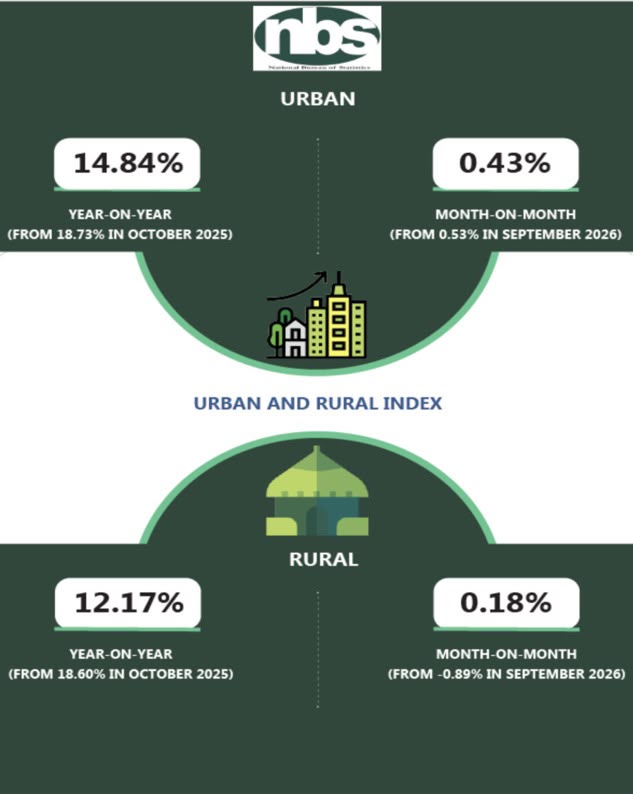
Between April to November this year, the price of a bag of onion rose from N25,000 and N30,000 to as high as N380,000 in Lagos.
By Ochefa
The decline in Nigeria’s headline inflation rate from 31.70 per cent in February 2024 to 14.06 per cent in October 2026, as announced in the NBS report, is economically significant.
It represents a substantial moderation in the rate at which the general price level is increasing.However, its significance goes beyond the headline numbers.
It has implications for household purchasing power, business costs, monetary policy, investment, economic growth and the government’s reform programme.
There are several reasons why this development matters.
A major moderation in price pressures. The decline represents a reduction of 17.64 percentage points, or approximately 55.6 per cent, in the headline inflation rate. In practical terms, the pace of annual price increases has slowed considerably.
For an economy that experienced persistent inflationary pressures following the removal of petrol subsidies and foreign exchange reforms in 2023, this represents an important change in the inflationary environment.
It suggests that the combination of monetary tightening, improved foreign exchange market conditions and other economic adjustments may be helping to moderate price pressures.
However, an important distinction must be made:
Declining inflation does not mean declining prices.
For example, if the price of a bag of rice rises from ₦80,000 to ₦100,000 and subsequently remains at ₦100,000, inflation on that particular item has stopped, but the consumer is still paying ₦20,000 more than before.
Market surveys of food prices across major Lagos markets recorded a reversal in October 2026, with more staples posting price increase than declines, despite a month-on-month fall in Nigeria’s national food inflation rate.
A 50kg bag of both yellow and white maize climbed from N40,000 in September to N55,000 in October, representing a 37.5% month-on-month increase.
Bush mango seed (ogbono) also recorded a sharp increase, rising from N300,000 to N405,000 per big bag, representing a 35% increase.
Yellow garri recorded another significant increase, rising from N18,000 to N23,000 per 50kg bag, representing a 27.78% increase.
While white garri rose from N19,500 to N21,000, representing a 7.69% rise.320g pack of Dano refill milk increased from N3,300 to N3,950, representing a 19.70% rise, while 900g pack of Peak refill milk rose by 17.39%, from N9,200 to N10,800.Bournvita in a 500g/450g jar increased from N4,400 to N5,050, representing a 14.77% increase.Frozen chicken also became more expensive.
The average price of a carton of chicken lap rose from N48,000 to N55,000, representing a 14.58% increase.Other notable increases included:Dry onions rose 10%, from N200,000 to N220,000 in October.70g Golden Penny noodles, up 4.88%, from N8,200 to N8,600.50kg Brown beans, up 4.76%, from N105,000 to N110,000.
Also, between April to November this year, the price of a bag of onion rose from N25,000 and N30,000 to as high as N380,000 in Lagos.
Bush mango seed (ogbono) also recorded a sharp increase, rising from N300,000 to N405,000 per big bag, representing a 35% increase.
Consequently, Nigerians are not immediately feeling the benefits of declining inflation because the accumulated increases in the cost of living remain.
Reacting, Association of Small Business Owners Nigeria (ASBON ) President, Dr Femi Egbesola described the slowdown as encouraging but said market prices have not fallen.
“The situation is consistently coming down, and that’s our prayer.
It shows that we are having macroeconomic change, which is good for the country, and will also engender investments.
It also means that the reforms of government are yielding positive fruits,” he said.
He added: “But beyond that, if you go to the markets, you see that the prices of goods and commodities are still very high. A true test of the success of inflation is actually the reduction in prices. Rather than coming down, you also see that many of these commodity prices are still where they are, and some of them are even going up.”
Egbesola said the gains of reform had not reached the productive sector. He cited a report from last week by the Bankers Association which said 60 per cent of bankers were still struggling. “You also look at it that businesses are still challenged. If you look at the report of last week from the Bankers Association, which said 60 per cent of bankers are still struggling, you know it means that businesses are still dying,” he said.
“And that’s how to really measure whether the reform is working fine, or translated to be effective or not. So when it is not reflected in households and in businesses, it means that there is a gap. And that’s why we are saying to the government that it needs to begin to intervene.”
Also, the Centre for the Promotion of Private Enterprises (CPPE) noted that falling inflation does not mean falling prices.
Said CPPE CEO Dr Muda Yusuf: “Declining inflation does not necessarily imply declining prices. It primarily indicates that prices are rising at a slower rate. This distinction is particularly important for households already struggling with elevated living costs,” he said.
Yusuf said food and non-alcoholic beverages contributed 5.63 percentage points to headline inflation, transportation 1.50 percentage points and housing and utilities 1.18 percentage points. Education and healthcare jointly contributed 1.72 percentage points.
He said these essential categories accounted for about 71 per cent of headline inflation, making affordability critical for low-income households.He stresses that inflation management must be more closely aligned with poverty reduction objectives. ”
Government interventions should prioritise the affordability of food, transportation, housing, education and healthcare, given their disproportionate impact on the poor,” Yusuf said.
Business
Naira Black Market Exchange Rates Thursday, Nov 2026
The black market (parallel market) naira exchange rates is the most searched forex query in Nigeria.

Black Market Rates
₦1460 DOLLAR (USD)
₦1855 POUND (GBP)
₦1545 EURO (EUR)
₦950 CANADIAN DOLLAR (CAD)
₦70 SOUTH AFRICAN RAND (ZAR)
₦350 UAE DIRHAM (AED)
₦190 CHINESE YUAN (CNY)
₦100 GHANAIAN CEDI (GHS)
₦2240 WEST AFRICAN CFA F.(XOF)
₦2180 CENTRAL AFRICAN CFA F.(XAF)
₦820 AUSTRALIAN DOLLAR AUSSIE (AUD)
Business
Why Onion is expensive – Producers
farmers had abandoned some farms last year because the proceeds from their harvests could not cover the cost of harvesting.
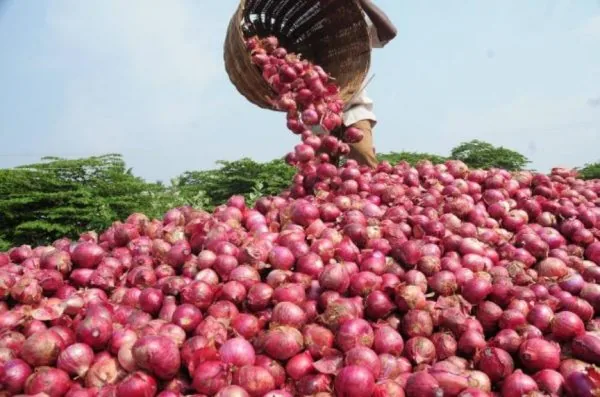
The National Onion Producers, Processors and Marketers Association of Nigeria (NOPPMAN) has given insight on the soaring prices of onion nationwide.
Between April to November this year, the price of a bag of onion rose from N25,000 and N30,000 to as high as N380,000 in Lagos, .
NOPPMAN President, Alhaji Aliyu Maitasamu, said the price increase was driven by poor returns to farmers last season, which forced some of them to abandon their farms, as well as post-harvest losses and fire outbreaks at onion aggregation centres.
He said a report from the association’s vice chairman in charge of the onion section, Alhaji Wadata Musa, indicated that a bag of Goronyo onion was selling for N380,000 in Lagos, while Gada onion was selling for N370,000.
He said the increase represented about 1,000 per cent compared with prices recorded in April.
According to him, farmers had abandoned some farms last year because the proceeds from their harvests could not cover the cost of harvesting.


South Africans Begin Another ‘Operations Flush Out Nigerians’ Protest

Soludo Bets on Tinubu – Shettima Winning Second Term

UPDATE: 17 Kidnap Victims Rescued After Forest Gun Battles in Kogi – Police (Images)

BREAKING: Lagos Govt Declares Today, Thursday Work-Free to Mark 2026 Ìṣẹ̀ṣe Day

Tech Expert, Zuckerberg trains with UFC champions, Adesanya, Alexander

Organ Trafficking: Ekweremadu bags 10 years in UK prison
-

 Business3 days ago
Naira Exchange Rates Tuesday, 17 Nov 2026
-
 Business3 days ago
NGX Acquires 10% Stake in Nairobi Securities Exchange
-

 News3 days ago
Vanguard’s Online Editor, Femi Ajasa, dies at 44
-

 News3 days ago
Kano Gov Yusuf Divorcing Wife Zainab
-

 Business3 days ago
Why Onion is expensive – Producers
-
 Crime7 hours ago
UPDATE: 17 Kidnap Victims Rescued After Forest Gun Battles in Kogi – Police (Images)
-

 News2 days ago
British Airways Flight to Lagos Loses Nose Gear on Heathrow Runway (Video)
-

 News23 hours ago
Lockdown on Lagos/Ibadan highway [PHOTOS] motorists spend whole day in traffic