
Opinions
Bianca Odumegwu-Ojukwu: The Quintessential Nigeria’s Minister of State (Foreign Affairs) By Emeka Monye

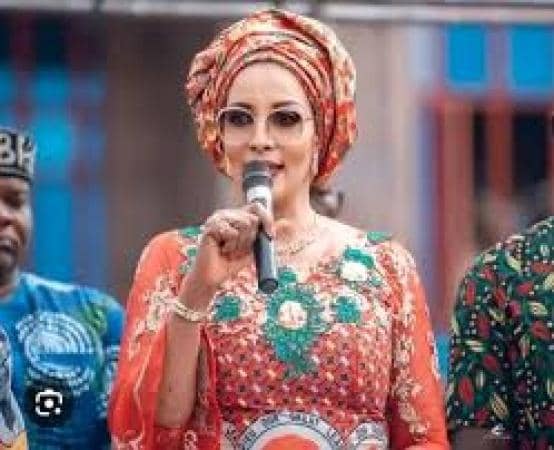
On Monday, October, 21st, 2024, Presidential Bola Tinubu made a policy announcement in a major cabinet reshuffle, among which was the appointment of former beauty queen, Bianca Odumegwu-Ojukwu as Nigeria’s Minister of State, Foreign Affairs.
Mrs Bianca Odumegwu-Ojukwu, by routine, replaced former Women Affairs Minster, barrister Uju Kenedy-Ohaneye, from Anambra state, who had occupied that office since August 2023.
Bar Ohanenye’s removal didn’t come as a surprise.
It was much anticipated because of her many controversies while she held sway in the Ministry of Women Affairs.
Bianca Odumegwu-Ojukwu Ojugwu’s appoinemt though didn’t come with much surprise, but some party members of the All Progressive Congress, APC faulted her appointment, citing some infractions to party membership before one could be offered such a position.
Their argument is that Mrs. Odumegwu-Ojukwu isn’t a full APC member and therefore shouldn’t have been appointed a Minister.
While some APC caucus members in the state acknowledged the president’s prerogative in ministerial appointments, they nonetheless express their concerns about the potential for discord within party ranks of the party, especially as the 2027 general elections approach.
Their arguments appear plausible in principles, and their grievances seem genuine, however beyond party politics and sentiments, Mrs. Bianca Odumegwu-Ojukwu has very much to offer this present administration in terms of image building, brand positioning, goodwill, and building alliances, both domestically and globally for obvious reasons – she is experienced, exposed, skilled, competent, and has built capacity over the years, both in her private and public lives.
Her appointment by the Tinubu-led administration is a testament of her good work and as a woman who has distinguished herself in both private and public sectors in Nigeria.
Bianca is a remarkable figure celebrated not just for her stunning looks but also for her extraordinary achievements across various fields.
She is more than just a beauty queen; she’s a dynamic politician, diplomat, lawyer, and businesswoman.
Mrs. Bianca Odumegwu-Ojukwu has very much to offer this present administration in terms of image building, brand positioning, goodwill, and building alliances, both domestically and globally for obvious reasons
Through her various roles, she has effectively bridged cultures and represented her country with elegance and authority, solidifying her status as a multifaceted leader.
Bianca’s journey is a powerful blend of beauty, intellect, and dedication to public service, making her an inspiring role model for many.
(Saturday Independent ) The widow of former Biafra president Chukwuemeka Odumegwu Ojukwu, she is a multiple international pageant title holder, having won Most Beautiful Girl in Nigeria in 1988, Miss Africa, and Miss Intercontinental.
The former beauty queen once served as a presidential adviser, Nigeria’s ambassador to Ghana and Spain in 2012 during the administration of former President Goodluck Jonathan.
Certainly, reminding one of her distinguished tenure as Nigeria’s Ambassador to Spain, between 2012-2015, is a clear reference point of her exceptional leadership, diplomatic prowess, and dedication to promoting Nigeria’s interests in the global community.
Her successes as Nigeria’s ambassador resonate in many ways, including fostering bilateral relations, enhancing economic cooperation, and showcasing Nigerian culture, certainly serves as a strong foundation for her success in this new role.
Born into the influential Christian Onoh’s family on August 5th, 1967, Bianca Odumegwu-Ojukwu attended the University of Buckingham, University of Nigeria, Nigerian Law School, Alfonso X El Sabio University.
As Minister of State, I have no doubt Mrs Bianca Odumegwu-Ojukwu will bring the skills, experiences, competencies, capacity and exposure to play in contributing to Nigeria’s foreign policy objectives, strengthening international partnerships, and yielding tangible benefits for our nation.
▪︎Emeka Monye Is A Journalist who works With ARISE NEWS.
Opinions
Am I A Thief?
Sometimes, we think being a thief is only about taking what is not ours in obvious ways.
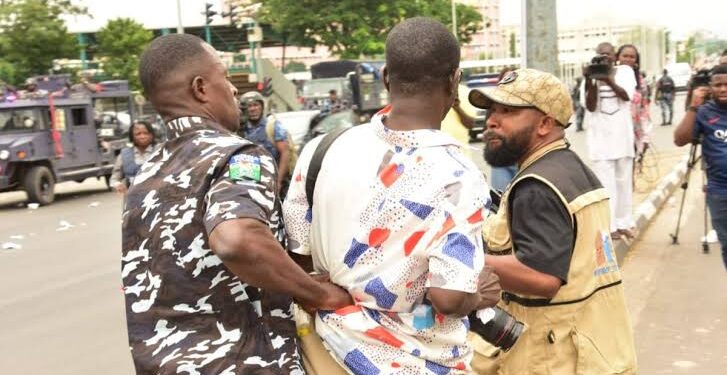
One of our Sudanese brothers once shared a deeply touching story titled “Am I a Thief?”—and honestly, it’s not just a story… it’s a mirror to the soul.
He spoke of two moments that seemed small on the surface, yet carried profound weight.
He had traveled to Ireland for a medical exam. The fee was £309, but without change, he paid £310. It felt insignificant—just £1 extra. He completed his exams and eventually returned to Sudan, probably never thinking about it again.
But then… a letter arrived.
Inside was a check for £1, with a message that pierced deeper than the money itself:
“You made a mistake when paying your exam fees. The fee was £309, but you paid £310. This is your £1… we do not take more than what is rightfully ours.”
Pause for a moment and let that sink in…
The envelope, the stamp, the process—it all costs more than £1. Yet, integrity was not measured by cost, but by principle.
It wasn’t about the money. It was about doing what is right… even when no one is watching, even when it doesn’t “make sense.”
The second moment:
On his daily route between college and home, he would stop by a small grocery shop run by a woman and buy chocolate for 18 pence.
One day, he noticed something different. The same chocolate—same size, same quality—but now there were two prices: 18 pence and 20 pence.
Curious, he asked why.
She calmly explained:
“There were issues in Nigeria, where we get cocoa. Prices have gone up. The new stock is 20 pence, but the old one remains 18.”
He thought logically, like many of us would:
“Then people will only buy the 18 until it finishes, before moving to 20.”
She nodded, “Yes, I know.”
So he suggested what seemed like a “smart” solution:
“Why not mix them together and sell everything at 20? No one will know the difference.”
She leaned closer… lowered her voice… and asked a question that struck like lightning:
“Are you a thief??”
He was stunned. Speechless.
He walked away—but that question followed him… echoed within him… refused to let him go:
“Am I a thief??!!”
Sometimes, we think being a thief is only about taking what is not ours in obvious ways.
But this story challenges something deeper.
It asks:
What do we do with the little things?
The unnoticed moments?
The quiet opportunities to bend the truth… just a little?
Because integrity is not proven in grand gestures.
It is revealed in the smallest decisions—when profit is possible, when shortcuts are easy, when no one would ever know.
And perhaps the real question is not what others call us…but what our conscience whispers when we are alone.

As Nigerians commemorate Democracy Day, the Peoples Democratic Party (PDP) has declared that three decades after the historic June 12, 1993 presidential election, democracy remains under severe threat in the country.
In a strongly worded press statement issued on Thursday, the PDP paid tribute to the freest and fairest election in Nigeria’s history and the sacrifices made by citizens who defended the people’s mandate.
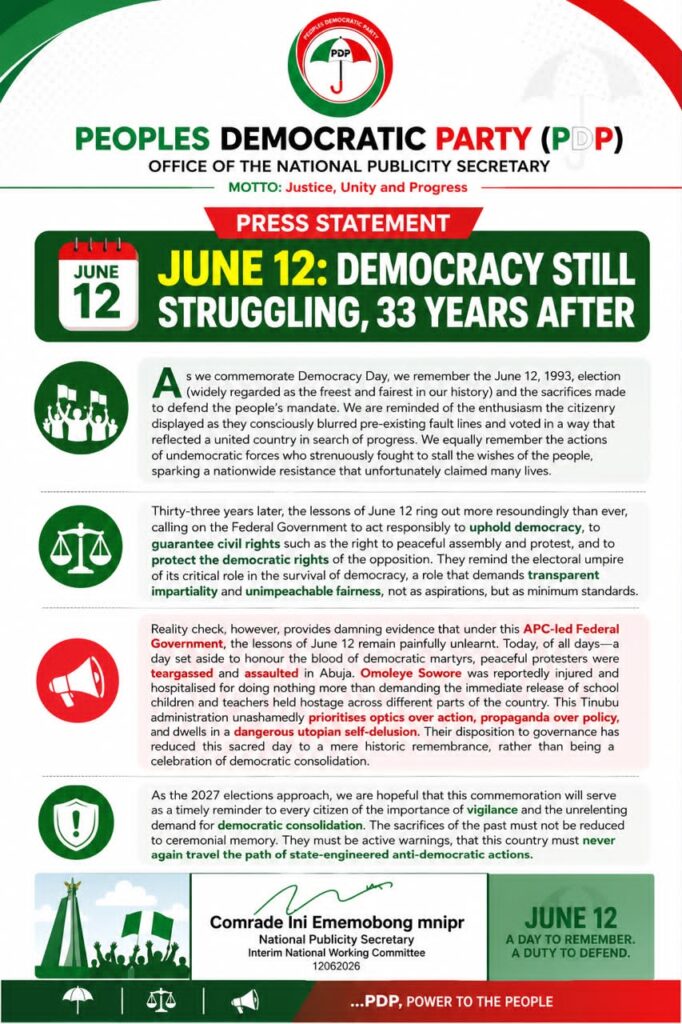
The party recalled the remarkable enthusiasm displayed by Nigerians during the 1993 polls, when citizens transcended ethnic and religious fault lines to vote for national progress.
The statement, signed by Comrade Ini Ememobong, National Publicity Secretary of the PDP Interim National Working Committee, noted that undemocratic forces aborted the popular will, triggering a prolonged resistance that claimed many lives.
“Thirty-three years later, the lessons of June 12 ring out more resoundingly than ever,” the PDP said, urging the Federal Government to uphold democratic principles, guarantee civil rights including the right to peaceful assembly and protest, and protect the rights of the opposition.
The party also reminded the Independent National Electoral Commission (INEC) of its sacred duty to conduct elections with “transparent impartiality and unimpeachable fairness,” describing these as minimum standards rather than mere aspirations.
However, the PDP expressed deep disappointment over what it described as the current administration’s failure to learn from history.
“Reality check, however, provides damning evidence that under this APC-led Federal Government, the lessons of June 12 remain painfully unlearnt,” the statement read. “Today, of all days — a day set aside to honour the blood of democratic martyrs — peaceful protesters were teargassed and assaulted in Abuja.”
The party highlighted the case of activist Omoleye Sowore, who was reportedly injured and hospitalised while demanding the immediate release of schoolchildren and teachers held hostage in different parts of the country.
The PDP accused the Tinubu administration of prioritising “optics over action, propaganda over policy,” and living in “a dangerous utopian self-delusion,” thereby reducing Democracy Day to a mere historic remembrance instead of a celebration of democratic consolidation.
Looking ahead to the 2027 general elections, the opposition party called on all citizens to remain vigilant and unrelenting in their demand for genuine democratic consolidation.
“The sacrifices of the past must not be reduced to ceremonial memory. They must be active warnings that this country must never again travel the path of state-engineered anti-democratic actions,” the PDP warned.
Comrade Ini Ememobong, mnipr is the National Publicity Secretary, Interim National Working Committee of the Peoples Democratic Party.
Opinions
Nigeria Cannot Build Flood Resilience While Destroying Its Wetlands
The next 10 to 20 years are likely to bring even more dangerous combinations of intense rainfall, river flooding, urban flooding, and coastal flooding/erosion.
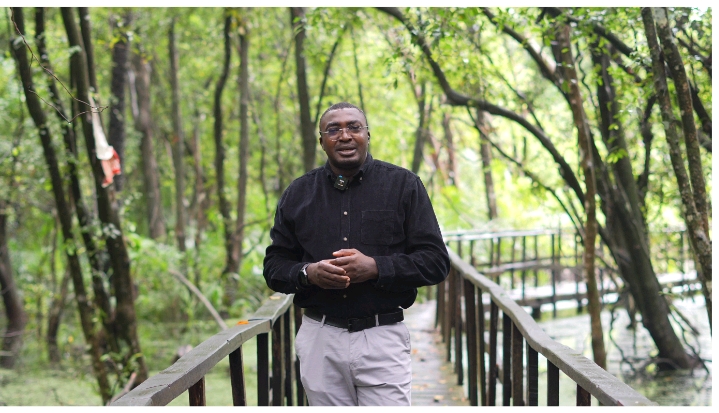
By DrJoseph Onoja
Every rainy season in Nigeria now arrives with a familiar sense of anxiety. Roads disappear beneath floodwaters, homes are submerged, businesses are disrupted, and lives are displaced.
What was once considered a seasonal inconvenience has become a recurring national emergency.
But Nigeria’s flooding crisis is no longer simply about rain.It is the result of a dangerous collision between climate change, environmental degradation, and weak urban planning.
Climate change is intensifying rainfall patterns across Africa, but human activities like deforestation, wetland destruction, poor drainage systems, and uncontrolled development on floodplains are multiplying the scale of destruction.
The uncomfortable truth is this: flooding in Nigeria is becoming structural.
Climate change may trigger the rainfall, but environmental degradation determines whether rain becomes disaster.
Climate Change Is Intensifying the Risk
Scientific evidence continues to show that extreme rainfall events are becoming more intense across Africa.
According to the Intergovernmental Panel on Climate Change (IPCC), both the frequency and intensity of heavy precipitation events are projected to increase as global warming accelerates.
In cities like Lagos, the impacts are already visible. Urban flooding has become more widespread, with both short-duration high-intensity rainfall and prolonged rainfall events increasing flood risks.
However, climate change alone does not explain the scale of devastation we are witnessing.
Ordinarily, heavy rainfall should not automatically become a disaster.
Healthy wetlands, functional drainage systems, protected floodplains, and well-planned urban infrastructure are designed to absorb and manage excess water.
” In Lagos, this issue is particularly critical. Water bodies, lagoons, creeks, and wetlands cover more than 62% of the state’s land area, while another significant portion remains seasonally flood prone.”
But when these natural and engineered systems fail or are deliberately compromised, communities become increasingly vulnerable.Nigeria’s flood challenge is therefore not only a climate issue. It is also a planning and governance issue.
Nigeria Is Destroying Its Natural Flood Defences
One of the most overlooked aspects of flood resilience in Nigeria is the role of nature itself.
Forests, wetlands, mangroves, and floodplains act as natural flood buffers. They absorb excess water, slow runoff, reduce erosion, and minimize flood peaks.
In many ways, they function as invisible infrastructure protecting communities from disaster.
Yet across Nigeria, these ecosystems are being degraded at alarming rates.
Deforestation reduces the soil’s ability to absorb water, increasing surface runoff and erosion. Sediments washed into drainage systems reduce their capacity and worsen urban flooding.
At the same time, wetlands and floodplains are increasingly being sandfilled and converted for construction and urban expansion.
The irony is embedded in the name itself: floodplains exist to absorb floods.
In Lagos, this issue is particularly critical. Water bodies, lagoons, creeks, and wetlands cover more than 62% of the state’s land area, while another significant portion remains seasonally flood prone.
When these ecosystems are filled, degraded, or built over, floodwater has fewer places to disperse safely. Instead, it ends up in homes, roads, and communities.
Wetlands are not vacant land waiting for development; they are natural infrastructure protecting cities from collapse.
The implications are enormous. Sensitive ecological areas such as the Lekki Conservation Centre continue to serve as natural buffers by receiving, retaining, and absorbing water from surrounding environments.
If such ecological buffers are lost to uncontrolled development, entire communities become significantly more exposed to flooding risks with attendant consequences for human health, livelihoods, wellbeing, infrastructure, and property.
Nigeria’s Adaptation Gap Is Growing
Nigeria is not standing completely still. There are signs of progress.
The Lagos Climate Adaptation and Resilience Plan identify dozens of adaptation projects and estimates financing needs between US$9 billion and US$16 billion by 2035.
This reflects increasing recognition that climate resilience must become a development priority.
But adaptation efforts are still not keeping pace with the speed of urban growth and climate risk.
Rapid urbanization, inadequate drainage systems, weak urban governance, and insufficient climate-resilient infrastructure continue to increase exposure across many Nigerian cities.
The next 10 to 20 years are likely to bring even more dangerous combinations of intense rainfall, river flooding, urban flooding, and coastal flooding/erosion.
Sea level rise will further worsen risks in low-lying coastal cities, especially Lagos.
Without urgent intervention, the economic, social, and environmental costs will continue to rise.
The cost of protecting ecosystems today is far lower than the cost of rebuilding cities tomorrow.
Nature-Based Solutions Must Become National Policy
Nigeria cannot engineer its way out of this crisis through concrete alone. Flood resilience requires a combination of infrastructure investment and ecological protection.
Nature-based solutions must become central to national and subnational climate adaptation strategies.
This means:
- • Protecting and restoring forests, wetlands, mangroves, and floodplains
• Strengthening drainage and storm water systems
• Enforcing risk-sensitive urban planning regulations
• Preventing development on ecologically sensitive areas
• Improving solid waste management to prevent blocked drainage systems
• Investing in low-carbon and climate-resilient growth pathways.
These actions are not optional environmental luxuries. They are essential investments in public safety, economic stability, and national resilience.
The future of flood resilience in Nigeria will depend as much on ecological protection as on engineering.
A Defining Choice for Nigeria
Floods are no longer isolated disasters. They are warning signs. They reveal the growing consequences of ignoring environmental limits while cities expand faster than resilience systems can keep pace.
They expose the cost of treating ecosystems as expendable rather than essential.
Nigeria still has a choice. We can continue reacting to flood disasters after they occur, or we can invest in prevention, resilience, and nature-based infrastructure before the next crisis arrives.
Protecting Forests, wetlands, restoring degraded ecosystems, and strengthening climate adaptation systems are not simply environmental priorities.
They are national development imperatives.The future resilience of Nigeria’s cities may well depend on how seriously we take them today.
• Dr Joseph Onoja , a conservation scientist, is the Director – General of the Nigerian Conservation Foundation (NCF).


Security Forces Rescue 9, Neutralise Terrorist in Kwara

Nigeria’s Enang Presents Credentials to German President Steinmeier (Images)

Zamfara LG Chairman Abduction: Security operatives intensify rescue efforts

Tech Expert, Zuckerberg trains with UFC champions, Adesanya, Alexander

Organ Trafficking: Ekweremadu bags 10 years in UK prison

SAINT OBI: Between his marriage and his death
-
 Business3 days ago
Naira Exchange Rates Thursday, 23 July
-
 Sports3 days ago
Nigeria’s NSC Chiefs Lead Team to 2026 Commonwealth Games in Glasgow
-
 Politics3 days ago
Fashola declares, “I’m not interested in becoming President of Nigeria”
-

 News3 days ago
311 lawmakers say “YES!” to establish state police
-

 Business2 days ago
Naira Exchange Rates Across Black Market, CBN, Commercial Banks Friday, July 24
-
 Politics3 days ago
Timi Frank says Trump’s letter not political ‘endorsement’ of Tinubu
-

 News2 days ago
Soludo’s daughter bags First Class from UK university
-
 News2 days ago
FAAN evacuate 68 Passengers as Enugu Air crash-lands in Benin Airport