
Business
N6.9bn procurement fraud: Federal Government arraigns Emefiele, allies Thursday


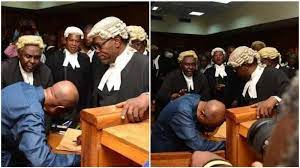
The Federal Government will on Thursday arraign the suspended Central Bank of Nigeria Governor, Godwin Emefiele and his associates for N6.9 billion procurement fraud at the Federal Capital Territory High Court, Maitama, Abuja.
The case is for arraignment and mention.
Emefiele will be arraigned alongside a female CBN employee, Sa’adatu Yaro and her company, April1616 Investment Limited on 20 charges of procurement fraud, conspiracy and conferring corrupt advantages on his associates.
Emefiele, who had been in detention since he was suspended from office on June 9 by President Bola Tinubu, was accused of conferring corrupt advantages on Yaro, a director in April 1616 Investment Ltd.
The offence is contrary to section 19 of the Corrupt Practices and Other Related Offences Act 2000.
If convicted, Emefiele may be sentenced to five years imprisonment without an option of a fine.
The section read, “Any public officer who uses his office or position to gratify or confer any corrupt or unfair advantage upon himself or any relation or associate of the public officer or any other public officer shall be guilty of an offence and shall on conviction be liable to imprisonment for five years without an option of fine.’’
In the charges signed by the Director of Public Prosecutions, Federal Ministry of Justice, Mohammed Abubakar; Deputy Director, Public Prosecution, Mrs N Jones-Nebo and eight other ministry officials, the three accused persons were alleged to have bought a fleet of over 98 exotic vehicles and armoured buses valued at about N6.9bn.
Some of the vehicles bought between 2018 and 2020 included 84 Toyota Hilux vehicles, 10 armoured Mercedes Benz buses, three Toyota Landcruisers and one Toyota Avalon car.
Corrupt advantage
Count one read, “That you, Godwin Ifeanyi Emefiele, male, adult, sometime in 2018 within the jurisdiction of this honourable court did use your position as Governor of the Central Bank of Nigeria to confer a corrupt advantage on Sa’adatu Ramallan Yaro, a staff member of the Central Bank of Nigeria by awarding a contract for the supply of 37 (Nos.) Toyota Hilux Vehicles at the cost of N854,700,000 only to April 1616 Investment Ltd, a company in which she is a director and thereby committed an offence.
“Statement of the offence: Conferring corrupt advantage contrary to section 19 of the Corrupt Practices and Other Related Offences Act 2000.’’
The Federal Government further accused Emefiele of conspiracy to confer corrupt advantage on the second defendant contrary to sections 26 (c) and 19 of the Corrupt Practices and Other Related Offences Act 2000 and punishable under Section 19 of the same Act.
“That you, Godwin Ifeanyi Emefiele, male, adult, Sa’adatu Ramallan Yaro, female, adult, and April 1616 Investment Ltd, sometime in 2019 within the jurisdiction of this Honourable Court did conspire amongst yourselves to use the office of Mr. Godwin Ifeanyi Emefiele as Governor of the Central Bank of Nigeria to confer a corrupt advantage on Sa’adatu Ramallan Yaro, a staff of the Central Bank of Nigeria by awarding a contract for the supply of 1 (No.) Toyota Landcruiser V8 at the cost of N73,800,000 only to April 1616 Investment Ltd., ‘’ the charge stated.
Emefiele was said to have also conferred a corrupt advantage on Yaro by awarding a contract for the supply of one Toyota Avalon at the cost of N99.9m to her company, April1616 Investment Ltd., in 2019.
The suspended governor was also accused of awarding a contract for the supply of another Toyota Landcruiser V8 for N77.050m to the third defendant in 2018.
Emefiele’s associate
The ex-CBN governor was said to have conspired with Yaro to confer corrupt advantages on the CBN staffer by awarding to her a contract for the supply of two Toyota Hilux Shell specification vehicles at the cost of N44.2m sometime in 2020.
Emefiele was further alleged to have awarded another contract to Yaro and her firm for the purchase of one Toyota Landcruiser VXR valued at N96m in 2020.
Yaro was similarly accused of fraudulent acquisition of property for getting a contract from the CBN for the supply of 47 Toyota Hilux vehicles at the cost of N1,085, 700,000 and thereby committed a punishable offence.
Count 10 read, “That you, Sa’adatu Rammala Yaro, female, adult, sometime in 2018 within the jurisdiction of this honourable court while being employed at the CBN knowingly held directly a private interest as director in April1616 Investment Ltd., in a contract awarded to the said company, for the supply of 47 Toyota Hilux vehicles at the cost of N1,085, 700,000 and thereby committed an offence.’’
Count 11, “That you, Sa’adatu Rammala Yaro, female, adult, sometime in 2018 within the jurisdiction of this honourable court while being employed at the CBN knowingly held directly a private interest as director in April1616 Investment Ltd., in a contract awarded to the said company, emanating from the CBN where you are employed, for the supply of 10 Mercedes Benz armoured buses at the cost of N2,222, 500,00 and thereby committed an offence.’’
Witnesses against Emefiele
Listed as witnesses against the defendants were the CBN Director of Procurement, Stanley Alvan; CBN Head of Procurement, Mike Agboro, Tahir Jafar, David Usman and “any other witnesses to be supplied later in the additional proof of evidence.’’
Meanwhile, a Federal High Court in Lagos has fixed the ruling on the application to withdraw the illegal possession of firearms charges against Emefiele for Thursday.
Justice Nicholas Oweibo fixed the date after listening to the arguments of the DPP, Abubakar and Emefiele’s counsel, Joseph Daudu SAN.
At the last adjourned date, the matter was slated for a hearing of pending applications seeking to stay the execution of the bail and application compelling the complainant to obey the court orders.
But when the matter came up on Tuesday, the DPP made an oral application to the court to withdraw the charges against Emefiele.
He stated that the application was informed by emerging facts and circumstances that required further investigations and urged the court to grant the application.
Abubakar said the application was pursuant to sections 174 (1) (c) (2) and 108 (2) (4).
But the defence counsel disagreed with the prosecution’s oral application, arguing that because the government was in disobedience of the court’s order granting Emefiele bail, its application should not be taken.
He said, “There is no application before the court, there is no doubt and I am not disputing the facts that the state can withdraw any charge before the court against any person.”
Daudu further said that in the past the argument was that there was no Attorney General of the Federation who could handle the case.
He cited section 174 (3) of the Constitution that the AGF has power that can be devolved to any of its officials.
The senior lawyer stated, “We have an application that the AGF has flouted the court order which says the respondent/ defendant should be remanded at the Nigeria Correctional Service but they are not obeying the order.
“The court granted order of substituted service to be published in three national dailies and after they brought an application of stay of execution of the bail and we say unless they obey, that order section 174 (1) can only be by nolle prosequi (I do not want to prosecute).
“It must be in writing, I have never heard of the withdrawal of a case without a nolle prosequi; for the interest of justice we need to prevent abuse of legal processes.’’
“Every application they brought against any citizen of this country under section 174 is nolle prosequi; the government cannot come before the court orally for that. It’s to be by nolle prosequi. At this point in time, there is no application before the court.
“I urge the court to reject the application and order the learned DPP to go on with today’s business,” he maintained.
While responding to the defence argument, Abubakar submitted that nolle prosequi was different from withdrawal and cited section 108 of the Administration of Criminal Justice Act 2015.
The judge had on July 25 admitted Emefiele to N20m bail on two-count charge of illegal possession of firearms and ammunition and ordered his remand at the Ikoyi Correctional Centre, pending when he is able to perfect his bail conditions.
But the Department of State Security operatives rearrested the embattled bank chief after fighting off NCoS officials on the court’s premises.




Business
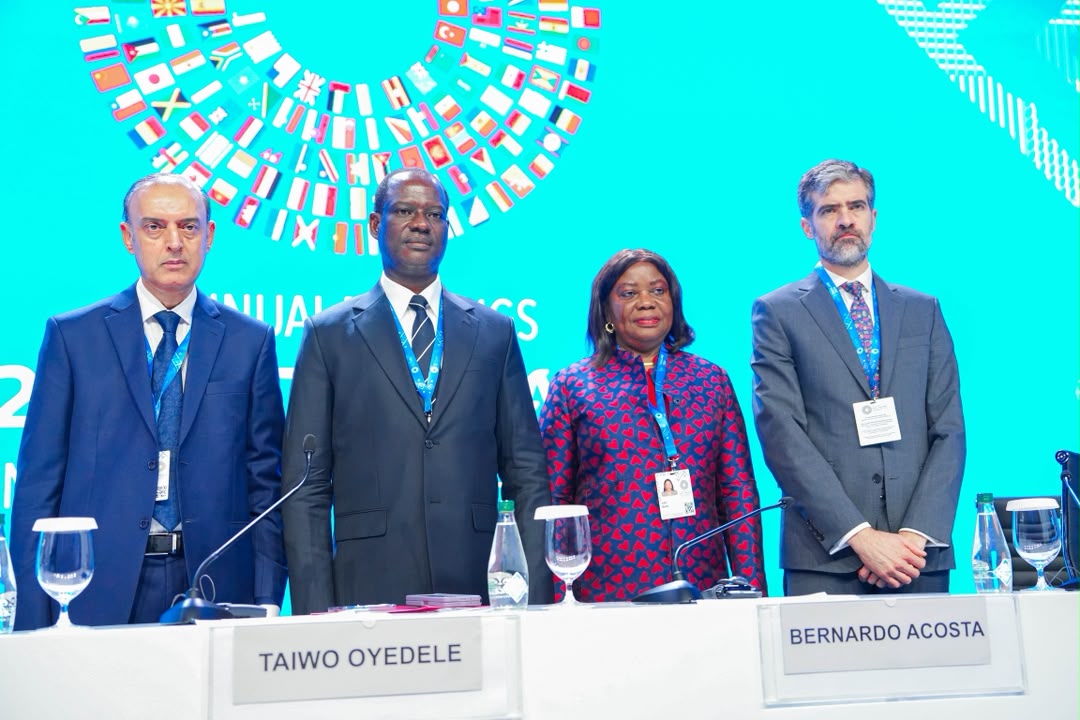
Oyedele Chairs G-24 Call for Fairer Global Financial System, Affordable Development Financing
The meeting concluded that domestic reform alone will not shield developing economies from external shocks — affordable finance, effective debt resolution, fairer representation in international institutions, and sustained cooperation are equally necessary.

Business
NAFDAC scolds fake manufacturers: “You are killing Nigerians in order to make money”
He warned that the circulation of counterfeit drinks posed a serious public health concern, urging suspected manufacturers to abandon the illegal trade.

“You are killing Nigerians in order to make money,which is not good.”
That’s the National Agency for Food and Drug Administration and Control (NAFDAC) scolding Nigerians caught in the act of counterfeiting drinks.
The occasion was at Zamfara Plaza, BBA Trade Fair Complex, along the Badagry Expressway, Ojo, Lagos State.
The Assistant Director of the Investigation and Enforcement Directorate of NAFDAC, Mr Kunle Ojo, who led the enforcement said the agency caught some of the suspects in the act and recovered drums, filters, packaging materials, a heating device and other equipment allegedly used in the illicit production process.
The suspects, identified as Okafor and John, were arrested during an enforcement operation in a two-storey building where equipment and materials allegedly used to repackage and produce counterfeit alcoholic and energy drinks where discovered.
The raid, according to NAFDAC, followed credible intelligence and surveillance on suspected counterfeiters operating within the Trade Fair International Market.
He warned that the circulation of counterfeit drinks posed a serious public health concern, urging suspected manufacturers to abandon the illegal trade.

Shell has agreed to sell its entire interest in the Shell Nigeria Gas Group, which runs a domestic natural gas distribution network, to Nigerian energy firm Vaaris Energy Limited.
The deal, announced on Tuesday, October 13, 2026, covers Shell Petroleum B.V.’s full stake in the business. Shell Nigeria Gas, established in 1998, operates about 170 kilometres of pipelines across Ogun, Abia and Rivers states and supplies more than 130 industrial and commercial customers. Financial terms were not disclosed. Completion remains subject to regulatory approvals and other conditions.
Shell said the business will continue operating as normal and serving customers until the transaction closes. The company does not participate in upstream production, LNG or international gas trading through this unit.
Elohor Aiboni, Shell’s Country Chair in Nigeria, said: “Shell Nigeria Gas has served industrial and commercial customers in Nigeria for more than 25 years, supported by the commitment and expertise of its people. We believe this agreement provides a much stronger platform for the business’ next chapter under new ownership. Shell continues to focus on strategic Deepwater and Integrated Gas positions in Nigeria.”
The sale forms part of Shell’s broader strategy under CEO Wael Sawan to simplify its portfolio and concentrate on higher-return assets. It follows the company’s completed exit from onshore oil production in Nigeria, when it sold the Shell Petroleum Development Company to the Renaissance consortium in 2025.
Vaaris Energy is a privately held Nigerian company with interests across the oil and gas value chain and an existing operational presence in the country.


Sanwo-Olu Appoints Olatunbosun Ogunbanwo, 5 Others as Perm Secs

Exclusion of candidates from INEC list: CD cautions INEC against manipulation by politicians

Oyedele Chairs G-24 Call for Fairer Global Financial System, Affordable Development Financing

Tech Expert, Zuckerberg trains with UFC champions, Adesanya, Alexander

BREAKING: Lagos Govt Declares Today, Thursday Work-Free to Mark 2026 Ìṣẹ̀ṣe Day

Organ Trafficking: Ekweremadu bags 10 years in UK prison
-

 Business3 days ago
Nigeria’s ₦33bn Fruit Import Bill Exposes Missed Opportunities in Jos
-

 Business3 days ago
Naira To Dollar, Pound ,Euro …Rates For Monday, October 12
-
 Politics3 days ago
BEWARE: Fake 2027 Gov’ Candidates List Circulating Online — INEC Raises Alarm
-
 News3 days ago
Forbes Scores GTBank Best Employers 2026
-

 Politics3 days ago
2027: 119 Women Jostle For State’s Governors
-

 Business2 days ago
Dangote Refinery IPO Attracts N8.61trn in Subscriptions, Four Times Offer
-

 News3 days ago
BREAKING: Fire Engulfs First Bank Branch Along Abuja-Keffi Road
-

 Business3 days ago
Afreximbank Hails Africa Credit Rating Agency