
Politics
Court of Appeal President Swears in 375 judges for 2027 election tribunals
Justice Dongban-Mensem, emphasised that the credibility of democracy depends not only on the conduct of elections but also on the existence of impartial, effective, and timely mechanisms for resolving electoral disputes.


The President of the Court of Appeal, Justice Monica Dongban-Mensem, inaugurated today 375 judges to serve on tribunals that will hear 2027 general elections petitions filed by aggrieved parties across the country.
In her address on the occasion held at the Body of Benchers Complex in Abuja, she disclosed that the 375 tribunal judges were nominated from various courts and judicial institutions across the country.
“Of this number, 138 are returning members with previous Tribunal experience, while 237 are newly nominated members,” she added.
She urged the judges to be mindful that the judiciary will be subject to considerable public scrutiny owing to their actions.
Justice Dongban-Mensem, emphasised that the credibility of democracy depends not only on the conduct of elections but also on the existence of impartial, effective, and timely mechanisms for resolving electoral disputes.
said the inauguration of the tribunal judges highlighted a collective commitment to constitutional democracy, the rule of law, and the integrity of Nigeria’s electoral process.




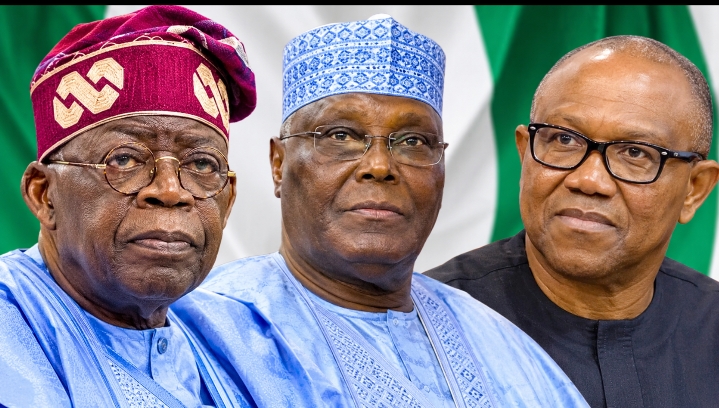
Cover image: The top three contenders
Ohibaba.com staff writer exclusively reports that as the 2027 elections approach, Nigerians need more than public declarations of peace from politicians.
Nigeria’s political environment is becoming increasingly charged as political parties intensify their campaigns ahead of the 2027 general elections.
Against this backdrop, questions are emerging about the effectiveness of the National Peace Accord signed by political parties and presidential candidates to promote peaceful, issue-based campaigns and discourage electoral violence.
The accord, facilitated by the National Peace Committee (NPC), was signed on August 18, 2026, ahead of the commencement of presidential and National Assembly campaigns.
Among the presidential contenders are President Bola Ahmed Tinubu of the All Progressives Congress (APC), former Vice-President Atiku Abubakar of the African Democratic Congress (ADC), and former Anambra State Governor Peter Obi of the Nigeria Democratic Congress (NDC).
They are among 18 presidential candidates cleared by the Independent National Electoral Commission (INEC) for the 2027 election.
The political parties and their candidates pledged to conduct peaceful campaigns, avoid inflammatory rhetoric, reject hate speech and misinformation, and refrain from personal attacks capable of escalating political tensions.
However, developments since the signing of the agreement have raised concerns about whether politicians are genuinely committed to its provisions.
A PEACE ACCORD WITHOUT CONSEQUENCES?
There is no doubt that the National Peace Accord has contributed to creating a framework for dialogue among competing political parties and candidates.
By bringing political rivals together to publicly commit themselves to peaceful elections, the initiative provides an opportunity to promote political tolerance, discourage hostility and strengthen democratic participation.
However, Nigeria’s experience with previous elections suggests that signing peace agreements does not necessarily translate into peaceful political conduct.
The 2023 general elections provide an important example.
The joint election observation mission of the International Republican Institute (IRI) and National Democratic Institute (NDI) documented widespread political violence during the 2023 election cycle, noting that it was more violent than the 2019 cycle.
The European Union Election Observation Mission also raised concerns about electoral violence and the failure to ensure accountability for perpetrators.
These findings raise a fundamental question: What happens when political parties and their supporters violate the commitments they have publicly made?
The problem appears to extend beyond the absence of peace agreements to the weakness of enforcement and accountability mechanisms.
Although arrests have been reported following previous incidents of electoral violence, questions remain about the transparency of investigations, prosecution of offenders and eventual sanctions.
Without consequences, the accord risks becoming a ceremonial exercise in which politicians make promises without being held accountable for their actions.
CAMPAIGN RHETORIC AND THE POLITICS OF PERSONAL ATTACKS
Recent campaign activities have also raised questions about the commitment of political leaders to issue-based electioneering.
On November 6, 2026, President Tinubu and Vice-President Kashim Shettima took their party’s re-election campaign to Akwa Ibom State, where they criticised opposition presidential candidates Peter Obi and Atiku Abubakar.
While Tinubu questioned Obi’s leadership record as former governor of Anambra State, Shettima challenged Atiku to account for the political structures, successors and enduring institutions he had built during his decades in public service.
Although political candidates have the right to scrutinise the records and policies of their opponents, such exchanges raise questions about the distinction between legitimate political criticism and rhetoric that could undermine the spirit of peaceful, issue-based campaigns.
Political competition should provide voters with an opportunity to compare candidates’ records, policy proposals and development programmes rather than degenerate into exchanges that heighten political hostility.
ASABA ATTACK: ANOTHER TEST FOR THE PEACE ACCORD
More recently, the reported attack on participants in the One Million Man March organised by the Obi/Kwankwaso (OK) Movement in Asaba, Delta State capital, has brought the issue of electoral violence into sharper focus.
The Delta State Coordinator of the movement, Mr Favour Emerue, called for an immediate investigation into the incident, alleging that armed hoodlums disrupted the peaceful procession and attacked participants with dangerous weapons.
According to him, one dead, several supporters sustained varying degrees of injuries and were receiving medical attention in hospitals across the state.
He also alleged that several campaign vehicles were vandalised during the incident.
Emerue described the attack as an assault on democratic participation and citizens’ constitutional rights to freedom of assembly and association.
The incident, which requires an independent investigation, raises serious concerns about the safety of political supporters and the ability of security agencies to protect citizens participating in lawful political activities.
It also presents another test for the National Peace Committee and the security agencies responsible for ensuring peaceful electioneering.
If political supporters cannot freely participate in campaign activities without fear of intimidation or violence, the fundamental principles underpinning the Peace Accord are undermined.
THE BIGGER QUESTION FOR 2027
The effectiveness of the National Peace Accord should not be measured by the number of politicians who sign it but by the extent to which its provisions are respected and violators are held accountable.
At the August signing ceremony, Peter Obi argued that Nigerians should punish politicians who violate the peace agreement through their votes.
Other opposition figures also expressed reservations about whether previous peace accords had achieved meaningful results beyond public declarations of commitment.
The concerns are not without historical justification.
The National Peace Committee itself has an important responsibility to monitor compliance, document violations and publicly identify political actors whose conduct contradicts their commitments.
However, the committee cannot single-handedly guarantee peaceful elections.
Effective policing, independent investigations, credible electoral institutions, impartial security agencies and the prosecution of offenders are equally essential.
Political parties must also take responsibility for the conduct of their candidates, members and supporters.
The government, particularly security agencies, must ensure that all political parties enjoy equal protection and that nobody is allowed to use violence or intimidation to suppress the political participation of others.
“Nigeria cannot continue to organise peace accord ceremonies while electoral violence remains a recurring feature of its democratic process.”
FROM PROMISES TO ACCOUNTABILITY
Nigeria’s National Peace Accord remains a valuable diplomatic and political instrument for encouraging dialogue and peaceful political competition.
However, its effectiveness as a deterrent against electoral violence remains a subject of serious concern.
The recent exchanges between political leaders and the reported attack on the OK Movement’s procession in Asaba illustrate why the commitments made at peace accord ceremonies must translate into responsible political conduct.
As the 2027 elections approach, Nigerians need more than public declarations of peace from politicians.
They need demonstrable commitment to democratic values, respect for opposing political views, protection of voters and supporters, and accountability for those who perpetrate electoral violence.
Ultimately, the credibility of the National Peace Accord will depend not on how many political leaders append their signatures to the document but on whether those who breach its provisions face identifiable consequences.
In summary, Nigeria cannot continue to organise peace accord ceremonies while electoral violence remains a recurring feature of its democratic process.


One person has been killed and five others injured after suspected thugs attacked a political procession organised by supporters of the Nigeria Democratic Congress (NDC) in Asaba, Delta State, on Saturday.
The incident occurred around 12:15 p.m. along Nnebisi Road during a “One Million Man March” organised by the Obidient/OK Movement in support of NDC presidential candidate Peter Obi. Police confirmed the casualties and said the identities of the victims had not yet been established at the time of their initial statement.
According to the Delta State Police Command, officers had received intelligence indicating a likelihood of violence before the event. Organisers were invited to a security meeting, briefed on the risks, and advised against holding an open-road procession. They were instead encouraged to use a designated venue where adequate security could be provided. Police said the organisers ignored the advice and proceeded with the march, after which the violence erupted.
The NDC rejected any suggestion of a mutual clash. In a statement, the party described the incident as a premeditated and unprovoked attack by armed hoodlums wielding sticks, knives, machetes and other dangerous weapons. It said several supporters sustained knife and machete injuries and that dozens of campaign vehicles were vandalised or destroyed. The party called on Delta State Governor Sheriff Oborevwori, the Inspector-General of Police and other security agencies to arrest and prosecute those responsible, including their alleged sponsors.
Former Delta State House of Assembly Speaker and NDC senatorial candidate Victor Ochei accused members of the ruling All Progressives Congress (APC) of orchestrating the attack. The APC dismissed the claims as baseless and politically motivated, insisting it remained committed to peaceful, issue-based campaigning.
Peter Obi condemned the violence, stating that “political violence has no place in a democracy and can never be justified.” The NDC said the attack would not deter its activities and urged supporters to remain calm and avoid retaliation.
The incident comes amid growing concerns over political violence ahead of the 2027 general elections, with similar reports of disruptions and attacks on opposition activities in other states. Police say a full investigation is underway and have appealed for information from the public.
Politics
Governorship candidates Speak On Next Chapter For Lagos
Doherty maintained that government must become the biggest housing developer in the state and provide alternatives to private rental accommodation.
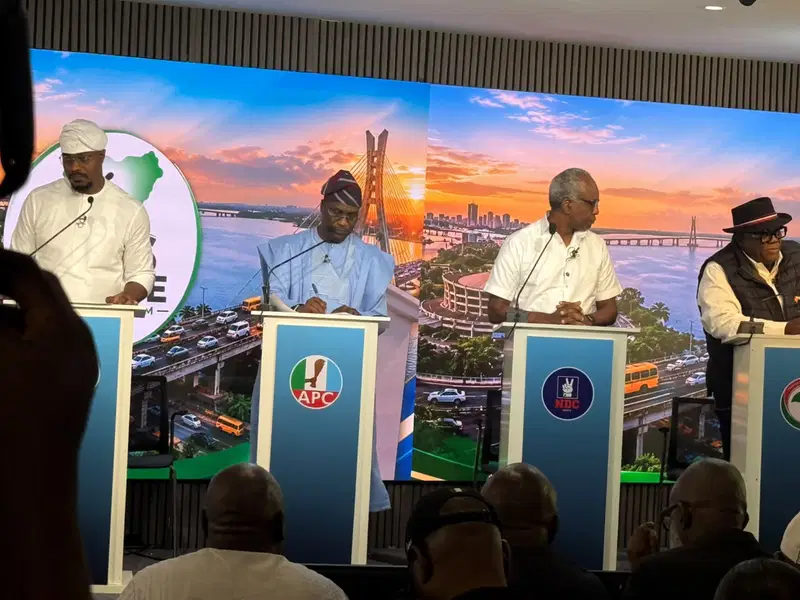
Photo: APC candidate, Obafemi Hamzat; ADC candidate, Gbadebo Rhodes-Vivour, NDC candidate, Funsho Doherty, and PDP candidate, Adedeji Doherty during the 2027 Lagos State governorship debate organised by Vanguard Newspaper ,Channels Television, TVC, Punch Newspapers, and The Cable on Sunday.
Governorship candidates of the African Democratic Congress (ADC), All Progressives Congress (APC), Nigeria Democratic Congress (NDC) and Peoples Democratic Party (PDP) have presented their proposals for addressing some of Lagos State’s major challenges, including housing, transportation, and healthcare, ahead of the 2027 governorship election.
The candidates unveiled their manifestos during the 2027 Lagos State governorship debate organised by Vanguard Newspaper ,Channels Television, TVC, Punch Newspapers, and The Cable on Sunday.
The ADC candidate, Gbadebo Rhodes-Vivour, promised to deliver more than 100,000 housing units if elected, saying his administration would prioritise affordable accommodation for ordinary residents rather than the wealthy.
He said the proposed houses would be allocated transparently to prevent individuals from acquiring multiple units under the scheme.
“The elites, the rich, can do it for themselves.
The government’s role is to lift up people that cannot do it for themselves, and this comes into housing to ensure that we deliver 100,000-plus housing units and make it affordable so that it is transparently allocatable. We are not going to have a situation where one person can own ten units,” Rhodes-Vivour said..
The ADC candidate also promised legislation to protect tenants against arbitrary rent increases, proposing that landlords should give at least six months’ notice before increasing rents, with the increment guided by a stipulated percentage.
The All Progressives Congress candidate, Obafemi Hamzat, who is the incumbent deputy governor, pledged to enforce existing regulations against arbitrary rent increases and the demand for multiple years’ rent in advance.
Hamzat said his administration would ensure compliance with the Lagos State Real Estate Registration Agency Law, stressing that tenants should not be required to pay two or three years’ rent upfront.
“The next chapter for Lagos is to enforce. To make sure people are not asked two or three years ahead, because people don’t get paid two or three years ahead,” he said.
He also said the state had established 24 housing estates in the last eight years, promising to expand access to quality accommodation through increased mortgage facilities and the completion of ongoing housing projects across the state.
The NDC candidate, Funsho Doherty, called for greater government involvement in providing affordable housing, arguing that private developers alone could not meet the accommodation needs of low- and middle-income residents.
He also proposed the establishment of an ombudsman’s office to address what he described as exploitation of tenants to address what he described as exploitation of tenants through excessive agency, legal and other charges.
Doherty said the housing shortage was largely driven by the failure of supply to keep pace with population growth and demand, particularly in the affordable and social housing segments.
He argued that government should take the lead in addressing the gap rather than leaving housing provision largely to private investors.
He emphasised that the last major government-led housing intervention in the state was during the administration of former Governor Lateef Jakande.
The PDP candidate, Adedeji Doherty, proposed that the Lagos State Government should become a major property developer and build houses which residents could rent directly from the government.
He argued that government regulation alone could not force private landlords to reduce rents, insisting that the state should compete with them by providing more affordable accommodation.
“There is no landlord, and there is no government that can control a landlord. What we are going to do is very simple.“We are going to rent those houses ourselves, and then you can come and rent from us if you want to,” he said.
Doherty maintained that government must become the biggest housing developer in the state and provide alternatives to private rental accommodation.
“If they (government) cannot compete with the landlords, then let us forget it,” he said.


JAMB Issue Advisory For 2027 UTME Candidates

Obi Alleges NFF Stops Him From Greeting The Flamingos At Airport, And Why

Court of Appeal President Swears in 375 judges for 2027 election tribunals

BREAKING: Lagos Govt Declares Today, Thursday Work-Free to Mark 2026 Ìṣẹ̀ṣe Day

Tech Expert, Zuckerberg trains with UFC champions, Adesanya, Alexander

Organ Trafficking: Ekweremadu bags 10 years in UK prison
-

 Business2 days ago
Enugu Air Begins London Gatwick flights From December 10, 2026
-
 Politics2 days ago
Tinubu Woos Nigerian Youths At Rivers Rally
-

 News1 day ago
NNPCL Faults NISO’s Claim of No Gas To Power Generating Plants
-

 Sports1 day ago
Manchester City lose ground in EPL title race
-

 Sports2 days ago
Nigeria Wins First U-17 Women’s World Cup By 2:1 Against Japan
-
 Politics12 hours ago
Governorship candidates Speak On Next Chapter For Lagos
-
 Business11 hours ago
Dangote Says Refinery’s IPO Misses 10 Million Investors Target
-

 Business10 hours ago
Cement: Manufacturers Post N5.8tn Nine Months Revenue