
Sports
Who made the FIFA World Cup trophy?
On Sunday, either Spain or Argentina will feel a little of all three as the winner lifts the trophy after the 2026 World Cup final.

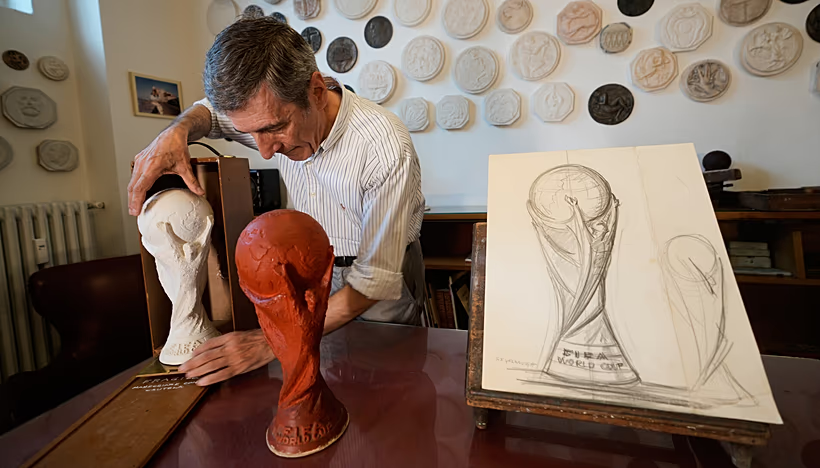
•Silvio Gazzaniga designed his winning entry in his studio in Milan’s Brera.
Here’s how Italian sculptor Silvio Gazzaniga created the FIFA World Cup trophy’s iconic design – and why champions never get to keep it.
The Italian sculptor who designed the FIFA World Cup trophy wanted to capture three sporting emotions in a single spiralling form: the athlete’s struggle, the fan’s jubilation and the moment of victory.
On Sunday, either Spain or Argentina will feel a little of all three as the winner lifts the trophy after the 2026 World Cup final.
Ahead of an action-packed World Cup weekend, here’s what to know about football’s most coveted prize.
The World Cup trophy was designed in Milan
When Brazil took permanent possession of the original trophy by winning its third World Cup in 1970, FIFA launched an open competition for a new design. The winner would be a 50-year-old sculptor from Milan.
Silvio Gazzaniga designed his winning entry in his studio in Milan’s Brera neighbourhood.
His design, now familiar to generations of World Cup fans, features two figures swirling up toward an orb representing the Earth.“
When he started to design the cup, he was sketching a huge number of drawings and finally started to develop the idea to have the world and this symbol that it is like a two DNA spirals, that are moving up,” said the designer’s son, Giorgio Gazzaniga, who was a teenager at the time.
The elder Gazzaniga, who died in 2016 aged 95, trained at Milan’s Brera Academy of Fine Arts before joining trophy maker G.D.E. Bertoni.
He later designed some of football’s best-known trophies, including the UEFA Cup, UEFA Super Cup and Intercontinental Cup.
Gazzaniga’s design topped more than 50 other entries submitted by artists from 25 countries.
Before Gazzaniga came Jules Rimet
The first World Cup trophy, introduced for the inaugural tournament in 1930, depicted Nike – the Greek goddess of victory – and became known as the Jules Rimet Trophy after the FIFA president who founded the competition.
Designed by French sculptor Abel Lafleur, it was made of gold-plated sterling silver and stood on a lapis lazuli base.
Under the original rules, any nation that won the World Cup three times would keep the trophy permanently. Brazil did exactly that in 1970, prompting FIFA to commission Gazzaniga’s replacement.The Jules Rimet Trophy was stolen twice.
The first theft happened in 1966 while it was on public display in England. According to FIFA, a dog named Pickles discovered it beneath a hedge in south London.It was stolen again from the Brazilian Football Confederation headquarters in 1983.
It has never been recovered and is widely believed to have been melted down.
Gazzaniga’s design topped more than 50 other entries submitted by artists from 25 countries. Rather than submitting sketches, he also produced a full-size plaster prototype, allowing judges to assess the trophy as a finished object, according to his son.
“There is the world, which stands above all else, there is the athlete’s exertion, there is the athlete’s movement within the metal, and the athlete’s body is rough, rugged, for it has suffered, had to fight, and struggled for victory,” the younger Gazzaniga said.
That victory is expressed through arms that resemble the wings of Victory, capturing not only the athlete’s triumph but also the jubilation of the fan,” he added.Gazzaniga’s family has preserved his office at a new location in Pioltello, on the outskirts of Milan, including drawings, the original prototype submitted to FIFA and a wax cast.
Earlier this year, Milan officials unveiled a commemorative plaque outside Gazzaniga’s former studio on Via Alessandro Volta 7, where he designed the iconic trophy.
Why champions don’t keep the trophy
The World Cup trophy hoisted by the winning side at the end of the final is 36 centimetres tall and cast in 18-carat gold.
It sits on a base featuring two rings of green malachite, symbolising the playing fields.Unfortunately for the winners, it goes back to FIFA after the tournament.
The organisation keeps the original trophy at its Swiss headquarters between World Cups.
The winning team receives a gold-plated replica. And FIFA no longer lets three-time winners keep the original, either.
First lifted by West Germany captain Franz Beckenbauer after the 1974 World Cup final, Gazzaniga’s design has remained football’s ultimate prize ever since.
• Culled from FIFA
Sports
Eguavoen appointed interim Super Falcons coach ahead of 2028 Olympic qualifiers
Former Super Falcons defender Ayisat Yusuf—who earned 68 caps and featured at the 2008 Beijing Olympics—also joins as an assistant coach, alongside veteran goalkeeper trainer Olatunji Baruwa.
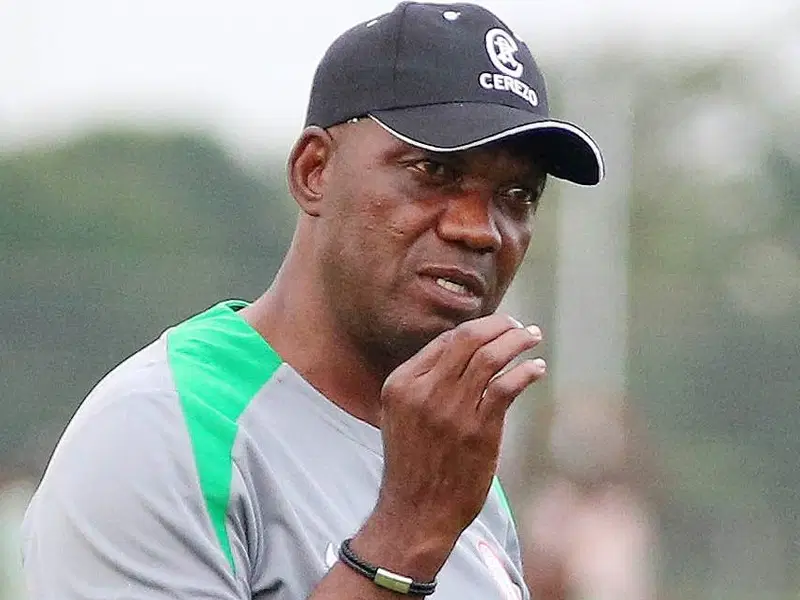
• Augustine “Cerezo” Eguavoen
Former Super Eagles head coach Augustine “Cerezo” Eguavoen has been appointed to lead Nigeria’s Super Falcons on a temporary basis as the search for a permanent manager continues.
His immediate assignment is navigating the 2028 Olympic Games second-round qualifying tie against Comoros this October.
The Vanguard reported that Eguavoen ‘s immediate assignment is navigating the 2028 Olympic Games second-round qualifying tie against Comoros this October.
Eguavoen brings top-tier experience to the role, having previously guided the Super Eagles to a bronze medal at the 2006 Africa Cup of Nations in Egypt.
The interim technical crew is Nasarawa Amazons head coach Christopher Danjuma, who recently led the Falconets at the 2024 FIFA U-20 Women’s World Cup.
Former Super Falcons defender Ayisat Yusuf—who earned 68 caps and featured at the 2008 Beijing Olympics—also joins as an assistant coach, alongside veteran goalkeeper trainer Olatunji Baruwa.
The 10-time African champions will kick off their campaign against Comoros, who advanced after a staggering 30-0 aggregate win over Sudan.
Both legs of the fixture will take place at the Remo Stars Stadium in Ikenne-Remo on October 9 and 13, 2026.
Sports
Falconets lose World Cup opener to Spain
Spain, who won the competition in 2022, controlled much of the encounter at the Arena Sosnowiec and took the lead in the 13th minute through Marisa García.
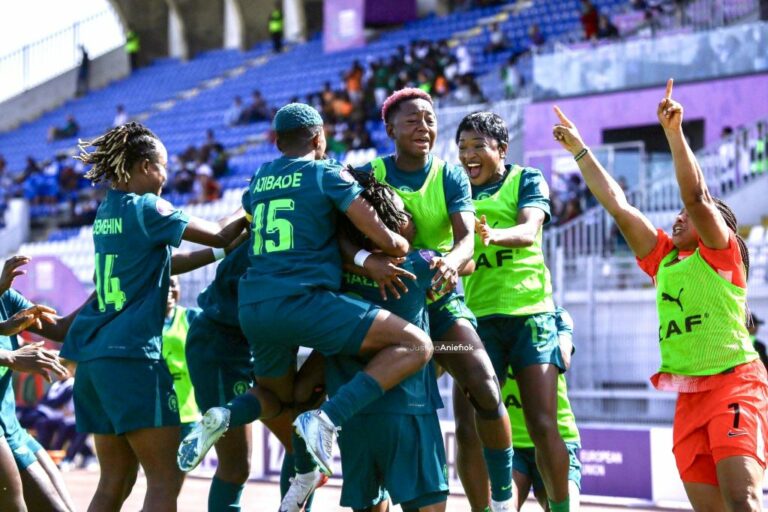
Nigeria’s Falconets lost their 2026 FIFA U-20 Women’s World Cup opening match to Spain by 2-0 in the Group F opener in Poland on Monday.
Spain, who won the competition in 2022, controlled much of the encounter at the Arena Sosnowiec and took the lead in the 13th minute through Marisa García.
The goal came after Noemí Bejarano worked her way down the flank before sending a low ball into the box, with García finishing to put Spain ahead.
Nigeria struggled to create clear chances in the first half and had to wait until the 37th minute for their first attempt, with Kafayat Mafisere shooting wide from distance.
The Falconets returned from the break with greater attacking intent, with Precious Oscar and Victory Lucky introduced as Nigeria sought an equaliser.
However, Spain remained dangerous, and goalkeeper Laia López kept out Nigeria’s attempts as the European side maintained its advantage.
Sports
Infantino To Seek Re-Election As FIFA President In 2027
If re-elected, the 56-year-old Swiss would remain FIFA president until 2031.
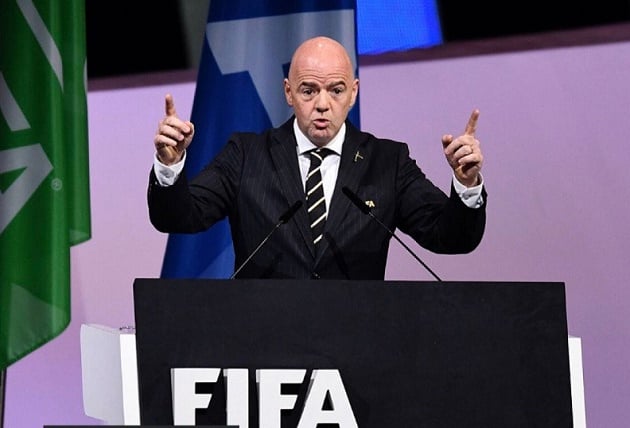
FIFA says Gianni Infantino will stand for re-election in 2027.
If re-elected, the 56-year-old Swiss would remain FIFA president until 2031.
Infantino, who has served as FIFA president since 2016, has faced growing pressure following his controversial proposal to sell stakes in FIFA competitions to private investment firms.
The plan triggered widespread criticism across the football community, with UEFA threatening to boycott FIFA competitions, including the World Cup, in opposition to the proposal.“Of course, nothing has changed. Mr Infantino will be standing for re-election,” FIFA said in a statement.
The confirmation comes after Infantino declined to answer questions about his political future when questioned by reporters at the Women’s Under-20 World Cup in Poland on Saturday.


Macron Hosts Tinubu for Private Dinner at Élysée Palace (Photos)

Madonna Returns To MTV Video Music Awards, After 23 years

Emir Sanusi mobilises Kano People “Buy Dangote Refinery’s Shares Now”

Tech Expert, Zuckerberg trains with UFC champions, Adesanya, Alexander

Organ Trafficking: Ekweremadu bags 10 years in UK prison

SAINT OBI: Between his marriage and his death
-
 Business3 days ago
Textiles was my biggest business mistake — Dangote
-

 International3 days ago
JUST IN: All Occupants Survive as Aircraft Crashes, Catches Fire
-
 Business2 days ago
Naira Exchange Rates To Dollar, Pound, Euro…Wednesday, 16 September 2026
-

 International3 days ago
Millions affected as floods strike India
-

 Entertainment2 days ago
EXCLUSIVE: Veteran Nollywood Actor, Olu Jacobs Dies at 84
-
Entertainment2 days ago
Olu Jacobs: His Life and Times
-
 Health1 day ago
Ondo ‘Monkey Tail’ herbal drink kills 49
-

 Business1 day ago
Nigerians Speak As Petrol sells N1,500/litre