
Business
CBN Holds Benchmark Interest Rate at 26.5% Amid Renewed Inflation Concerns


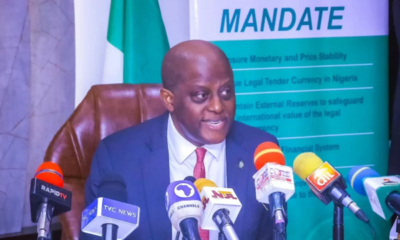
The Monetary Policy Committee (MPC) of the Central Bank of Nigeria (CBN) has retained the Monetary Policy Rate (MPR) at 26.5 per cent, maintaining the current stance after its two-day meeting that ended on Wednesday, May 20, 2026.
CBN Governor Olayemi Cardoso announced the decision, noting that the committee voted unanimously to hold all key parameters unchanged. The asymmetric corridor around the MPR remains at +500/-450 basis points, the Cash Reserve Ratio (CRR) stays at 45 per cent for commercial banks and 16 per cent for merchant banks, while the liquidity ratio is retained at 30 per cent.
The hold comes as headline inflation rose for a second consecutive month to 15.69 per cent in April 2026, up from previous levels, driven largely by food inflation at 16.06 per cent and higher transportation costs. Cardoso emphasised the need for a cautious and vigilant approach to anchor inflation expectations and safeguard macroeconomic stability.
This decision aligns with analysts’ expectations ahead of the 305th MPC meeting and follows the first rate cut in years implemented in February 2026, when the MPR was reduced by 50 basis points to the current 26.5 per cent.
The CBN Governor highlighted ongoing reforms, exchange rate stability, and efforts to improve food supply as factors supporting the disinflation process, even as global and domestic risks persist. The next MPC meeting is expected in July.
The retention signals the apex bank’s priority on taming inflation while monitoring the impact of previous policy actions on the broader economy.




Business
CBN reduces interest rate to 23% on market stability
“We are in a position of stability. The tightening we have done in the past has worked. FX pressure has receded. Capital market growth is because of the FX market stability. Investor confidence has come back. We have nothing to fear. This is a reset and a recalibration. No better time to do it than now when things are stable.”


The Central Bank of Nigeria (CBN) has cut the Monetary Policy Rate (MPT) from 26.5 percent to 23 percent, saying that with the current stability in the market, there was no better time to adjust the rate than now.
Olayemi Cardoso, CBN’s governor, made the revelation while addressing the media on Tuesday, after the committee’s 307th meeting in Abuja.
His words, “We are in a position of stability. The tightening we have done in the past has worked. FX pressure has receded. Capital market growth is because of the FX market stability. Investor confidence has come back. We have nothing to fear. This is a reset and a recalibration. No better time to do it than now when things are stable.”
Mr. Cardoso said that the past tightening actions had achieved increased resilience demonstrated by the Nigerian economy, reflected by the moderating inflation, robust external reserve buffers, improved external sector fundamentals, and strengthening investor confidence.
According to the CBN boss, “Members observed that the moderation in inflation indicated the effectiveness of previous policy tightening measures, sustained exchange rate stability, and improved inflation expectations.”
Mr. Cardoso put the nation’s Gross External Reserves at 55.25 billion as of September 18, 2026, the highest in the last 18 years, and sufficient to finance approximately 11.3 months of import of goods and services.
.
Business
President Tinubu Urges Africa to Stop Exporting Raw Minerals
The dialogue, themed, “From Resources to Wealth: Continental Cooperation for Mineral Value Addition, Data Sovereignty, Innovative Financing and Critical Minerals Security,” focused on transforming Africa’s mineral wealth into sustainable economic growth.
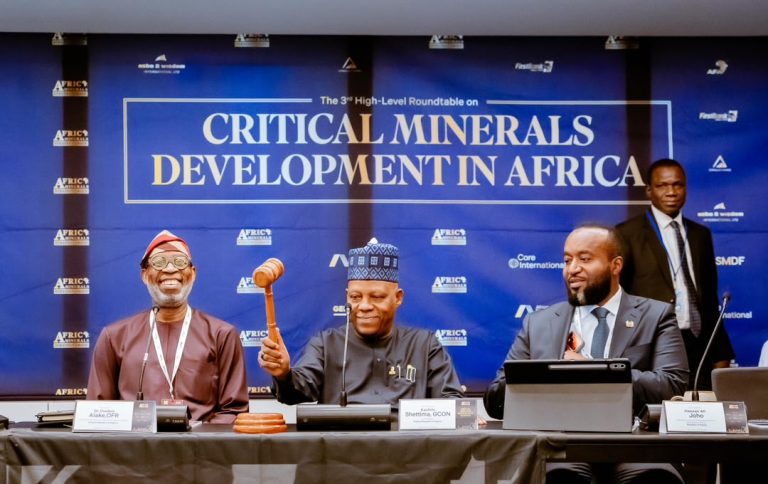
Photo: The President was represented by Vice President Kashim Shettima, alongside AMSG Chairman and Minister of Solid Minerals Development, Dr Dele Alake.
President Bola Tinubu has called for a fresh continental push to end the historical exploitation of Africa’s critical mineral resources, urging African nations to unite and halt the export of raw materials.
President Tinubu made the call in New York, United States, during the Africa Minerals Strategy Group (AMSG) High-Level Roundtable on Critical Minerals Development in Africa, held on the sidelines of the 81st Session of the United Nations General Assembly (UNGA).
He called for an aggressive alliance among African countries to ensure that the continent transitions from a mere supplier of raw minerals to a hub for local processing, manufacturing and value addition.
The President was represented by Vice President Kashim Shettima, alongside AMSG Chairman and Minister of Solid Minerals Development, Dr Dele Alake.
The dialogue, themed, “From Resources to Wealth: Continental Cooperation for Mineral Value Addition, Data Sovereignty, Innovative Financing and Critical Minerals Security,” focused on transforming Africa’s mineral wealth into sustainable economic growth.
President Tinubu told African leaders and other stakeholders that “the continent could not claim to be wealthy while its children wallowed in poverty amid mines that enrich the world.”
He noted that critical minerals such as cobalt, copper, lithium and rare earth elements had become indispensable to global supply chains and economic security.
According to him, the answer to the deprivation “must be processing, refining, batteries, components, African technologies and competitive skills”.
Business
Fans shown 65,000 junk food ads at World Cup
Coca-Cola had the highest number (21,893), followed by McDonald’s (13,915), Powerade (12,777), and Lay’s – the crisps manufacturer known as Walkers in the UK – (12,087).

Football fans were shown a “constant bombardment” of advertisements promoting junk food and drinks during matches at the 2026 Fifa World Cup, according to a new study.
BBC reported that researchers at the University of Bristol and University of Oxford created an AI tool to analyse ads which were visible to television viewers during live play in the tournament’s 104 matches, mostly displayed on pitchside advertising boards and around stadiums in the USA, Canada, and Mexico.
They found that logos and products for brands that produce junk food and drinks – defined by the UK government as being high in fat, salt or sugar – were displayed 65,722 times in total.
And the study also found that those adverts were visible for 28.1 hours’ time across the tournament, or just over 16% of the total time that matches were being played.
The ads were all shown on the international feed of matches during play – meaning they were visible to every viewer in every country broadcasting matches – and do not include ads shown during pre-match coverage, half-time commercial breaks, or the controversial in-match hydration breaks.
The model used by the researchers estimated that there were an average of 576 visible ads for junk food and drink shown during each individual match.
Coca-Cola had the highest number (21,893), followed by McDonald’s (13,915), Powerade (12,777), and Lay’s – the crisps manufacturer known as Walkers in the UK – (12,087).
All four brands are official partners of world football governing body Fifa, with the Powerade energy drink owned by the Coca-Cola company.
In response to the findings, Fifa argued that the vast majority of its revenue is put back into football, including on projects promoting health and wellbeing in which thousands of people participate.


CBN reduces interest rate to 23% on market stability

BREAKING: Lassa fever kills 259, infects 1,086 in 24 Nigerian states — NCDC

Mbappé Leaves Nike To Promote Swiss Sportswear Brand On

Tech Expert, Zuckerberg trains with UFC champions, Adesanya, Alexander

Organ Trafficking: Ekweremadu bags 10 years in UK prison

SAINT OBI: Between his marriage and his death
-

 International9 hours ago
Trump launches ‘Trump TV’ as US networks halt White House coverage
-

 News9 hours ago
Independent Panel Begins Probe into 37 Deaths in Civil Defence Custody
-
Business1 day ago
CBN, MOF sign pact to align monetary, fiscal policies
-

 Business12 hours ago
Dangote Whets Investors Appetite Ahead 2028 Fertiliser IPO
-

 Business9 hours ago
Fans shown 65,000 junk food ads at World Cup
-

 Health11 hours ago
Nigerian hospital successfully performs kidney cancer surgery via tele-robotic
-
 Business11 hours ago
Naira To Dollar, Pound, Euro…Rate Today, September 22
-

 Business10 hours ago
Gambia Orders Nigerian Banks To Replace Foreign Staff by December 2026