
News
Court to Decide on Motion to Restrain NASS from Ibas’ Budget

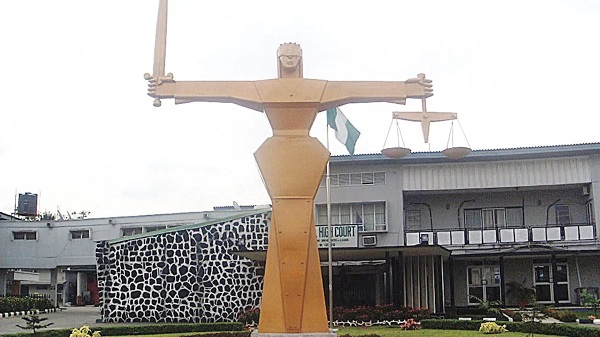
The Federal High Court in Abuja on Wednesday, fixed July 18 for ruling on a motion seeking to restrain the National Assembly from approving budgets or appointments of the Rivers State Government under the current Sole Administrator, Vice Admiral Ibok-Ete Ibas (rtd).
Ibas was appointed as Rivers’ Sole Administrator by President Bola Tinubu following the six-month suspension of Gov. Siminalayi Fubara.
Justice James Omotosho fixed the date after counsel for the applicants, Ambrose Owuru, and the defence lawyer, Mohammed Galadima, presented their arguments for and against the motion for interlocutory injunction.
The News Agency of Nigeria reports that the suit, marked: FHC/ABJ/CS/1190/2025, was instituted by some indigenes of Rivers and a group, the Registered Trustees of Hope Africa Foundation.
Other plaintiffs are King Oziwe Amba, Chief Julius Bulous, Chief George Ikeme, Chief Amachelu Orlu and Prince Odioha Wembe.
They had dragged the National Assembly and the Clerk of the National Assembly to court as 1st and 2nd defendants.
The applicants sought “an order of interlocutory injunction restraining the defendants “from further interference, approving, supporting and engaging in any legislative activities, including approving, appointing or budgets of Rivers State Government.”
They argued that this was in furtherance of the alleged illegalities and unconstitutionally forwarded proposed state budget by Ibas, “arising from the unconstitutionally prohibited ‘voice vote’ not provided for under the constitution pending the hearing and determination of the substantive suit by this honourable court.”
NAN observes that while the main suit was filed on June 19, the motion for interlocutory injunction was filed on June 24.
The plaintiffs’ lawyer, Owuru, while arguing the motion, prayed the court to restrain the defendants from further acting on any requests from the emergency government in the state pending the determination of the substantive suit.
Owuru contended that the declaration of a state of emergency in Rivers was without the required legislative approval because the voice votes adopted by the National Assembly in approving the emergency rule were unconstitutional.
The plaintiffs stated, in a supporting affidavit, that since they filed the suit, the activities of the defendants “have centred on approvals of illegal appointments and budget made and forwarded by the illegal administrator foisted on the applicants’ Rivers State in the midst of protests and rising restiveness in the state.“
The respondents, in spite of all the illegality and unconstitutionality of the foisted state of emergency on Rivers outside the clear provisions of the 1999 Constitution prohibiting state of emergency in any part of the federation, failed to invite or request such within a reasonable time.
”The respondents have engaged in constituting committees to run and spend funds of the applicants’ Rivers.”
They said, unless the court grants their application, the defendants would continue in “the illegalities and unconstitutionality of their invented ‘voice votes’ in place of the actual constitutionally approved two third votes to support the state of emergency in Rivers State.”
According to them, the grant of this application will protect and preserve the applicants’ legal rights to be governed by an elected government of their choice in the present democratic setting in Nigeria.
In his counterargument, lawyer to the National Assembly and its clerk, Galadima, urged the court to reject the motion for interlocutory injunction, arguing that it was without merit.
In the affidavit filed by the defendants, they argued that the facts deposed to in the plaintiffs’ supporting affidavit to the motion “are contrived falsehood and calculated misrepresentation of the facts as they occurred.”
They argued that there had never been any illegality in their actions and that there is no breach of the constitution as alleged by the applicants.
The defendants also faulted the plaintiffs’ claim that the emergency rule was a violation of their fundamental rights to be governed by a democratically elected government.
The National Assembly and its Clerk said they would be seriously prejudiced by the grant of the motion as it would create pandemonium and confusion in governance in Rivers.
They added that the grant of the motion would not be in the interest of justice.Justice Omotosho fixed July 18 for the ruling.
NAN reports that the Senate had, on June 25, passed the 2025 budget of Rivers, totaling ₦1.485 trillion, following the third reading of the appropriation bill on the floor.
NAN









News
Sanwo-Olu Appoints Olatunbosun Ogunbanwo, 5 Others as Perm Secs
Ogunbanwo brings nearly three decades of experience in public service, strategic communication, public relations and information management.


•Mr. Olatunbosun Ogunbanwo
Lagos State Governor, Mr. Babajide Sanwo-Olu, has appointed Mr. Olatunbosun Ogunbanwo, Director of Public Affairs at the Lagos State Ministry of Health, as a Permanent Secretary in the State Public Service, alongside five other senior officers.
The five other senior officers appointed as Permanent Secretaries as conveyed by the Head of Service (HOS), Mr. Bode Agoro, in Circular Ref. No. CIR/HOS/’26/071, dated October 13, 2026, are Dr. Olawale Mahadiyu Adegbite, Director of Medical Services, Health Service Commission; Mrs. Folashade Aina Thomas-Orogan and Mr. Adebayo Mubashiru Haroun, both Directors, State Counsel at the Ministry of Justice.
The rest are Mrs. Olayinka Margret Oye-Bamgbose, Director of Administration and Human Resource at the Lagos State University Teaching Hospital (LASUTH) and Mrs. Bilquees Toyin Adekoya, Principal/Director of Education at Education District VI.
The appointments, which take effect from October 13, 2026, were aimed at reinvigorating the State’s policy implementation apparatus and strengthening public service delivery.
Mr. Olatunbosun Ogunbanwo
Ogunbanwo brings nearly three decades of experience in public service, strategic communication, public relations and information management.
Before his appointment, Ogunbanwo served as Director of Public Affairs at the Ministry of Health and previously held the same position at the Ministry of Agriculture.
He also played key communication roles in Lagos State’s responses to public health emergencies, including Ebola, COVID-19, Lassa fever and diphtheria.

Residents of Igbokoda in Ilaje Local Government Area of Ondo State are grappling with a severe public health and environmental crisis following the crash of a Nigerian Air Force (NAF) ATR-42 aircraft into a swamp near the community.
The aircraft, on a routine mission from Benin City to Lagos, crashed last Monday, killing all 25 people on board. Recovery efforts continue amid difficult swampy terrain, with large sections of the wreckage and human remains still unrecovered.
The traditional ruler of Igbokoda, Oba Afolabi Odidiomo, said residents have been battling an extremely offensive odour caused by decomposing human remains floating in the river. “The odour is extremely offensive. So many parts of the human body are floating around in the river. Some of the bodies have not been recovered. They have decomposed, and it is affecting everything,” he stated.
He warned that the river — the community’s main source of water for drinking, cooking and fishing — has been polluted by the remains and aviation fuel spillage. Residents can no longer safely use the water, raising fears of a disease outbreak.
Ondo State authorities confirmed they are assessing the environmental and public health impact, with plans for decontamination. Recovery teams, including the Navy, Air Force and emergency agencies, are intensifying efforts to retrieve remaining wreckage and remains.
News
UNCTAD Warns Debt Burden Threatens Future of 3.7bn People
UN Secretary-General António Guterres said developing economies were facing mounting pressures from geopolitical tensions, conflicts, trade disruptions, climate challenges, inadequate financing and high debt-servicing costs.

The future of 3.7 billion people is threatened by mounting government debt burdens, the United Nations Conference on Trade and Development (UNCTAD) has warned, urging developing countries to strengthen cooperation in tackling debt-related challenges.
The warning was delivered on Monday in Bangkok during the IMF–World Bank Annual Meetings, where the UN agency called on finance ministers, central bank governors and senior government officials from developing countries to unite under the Borrowers’ Platform to share knowledge, exchange experiences and coordinate their positions on debt issues.
UN Secretary-General António Guterres said developing economies were facing mounting pressures from geopolitical tensions, conflicts, trade disruptions, climate challenges, inadequate financing and high debt-servicing costs.
“Developing countries face a perfect storm with geopolitical tensions and conflicts, trade and climate pressures, a lack of adequate financing and high debt-service burdens,” Guterres said in his address to the platform’s new member states.
He added that the Borrowers’ Platform would provide members with an opportunity to navigate these challenges.
Guterres welcomed participating countries’ commitment to the initiative, stressing the importance of creating a common space where borrowers could exchange advice, share practical tools and approaches, and strengthen their collective advocacy on international debt issues.
According to UNCTAD, 31 developing countries have formally joined the platform, while several others have expressed interest in the initiative.
Since the platform’s launch in April, participating countries have operated through an interim process led by Egypt as interim chair, with UN Trade and Development serving as its secretariat.


Sanwo-Olu Appoints Olatunbosun Ogunbanwo, 5 Others as Perm Secs

Exclusion of candidates from INEC list: CD cautions INEC against manipulation by politicians

Oyedele Chairs G-24 Call for Fairer Global Financial System, Affordable Development Financing

Tech Expert, Zuckerberg trains with UFC champions, Adesanya, Alexander

BREAKING: Lagos Govt Declares Today, Thursday Work-Free to Mark 2026 Ìṣẹ̀ṣe Day

Organ Trafficking: Ekweremadu bags 10 years in UK prison
-

 Business3 days ago
Nigeria’s ₦33bn Fruit Import Bill Exposes Missed Opportunities in Jos
-

 Business3 days ago
Naira To Dollar, Pound ,Euro …Rates For Monday, October 12
-
 Politics3 days ago
BEWARE: Fake 2027 Gov’ Candidates List Circulating Online — INEC Raises Alarm
-

 Politics3 days ago
2027: 119 Women Jostle For State’s Governors
-

 News3 days ago
Forbes Scores GTBank Best Employers 2026
-

 Business2 days ago
Dangote Refinery IPO Attracts N8.61trn in Subscriptions, Four Times Offer
-

 News3 days ago
BREAKING: Fire Engulfs First Bank Branch Along Abuja-Keffi Road
-

 Business3 days ago
Afreximbank Hails Africa Credit Rating Agency