
Opinions
Nigeria Must Prioritize Local Defense Contractors for National Security and Economic Growth
While Nigeria strives for self-reliance and national security, its defense procurement landscape remains heavily tilted in favour of foreign contractors.


BY BEM IBRAHIM GARBA
Despite the growing capacity among Indigenous defense firms, Nigeria continues to favor foreign contractors.
This pattern threatens long-term national security, economic independence, and local innovation.
While Nigeria strives for self-reliance and national security, its defense procurement landscape remains heavily tilted in favour of foreign contractors.
Despite significant strides in capacity development, manufacturing, design, and operational capability, Nigerian-owned defense companies face systemic bias and limited access to government contracts.
This preference for foreign contractors and solutions incurs costs: economically, strategically, and technologically.
If Nigeria is committed to developing a robust, sovereign, and exportable defense industry, it must start by prioritizing local contractors.
FOREIGN FIRMS STILL GET THE FIRST CALL
Today, many Nigerian companies have developed capacity.
They offer reliable, innovative, and scalable solutions, including the production of sensitive equipment/systems, tactical vehicles, protective gear, and training facilities.
Yet, when the time comes for procurement, tenders and negotiations disproportionately favour foreign companies and suppliers.
These foreign firms are not only awarded high-value contracts but are often given easier access to key decision-makers.
Local companies, by contrast, face endless social and political hurdles: excessive scrutiny, limited engagement from end-users, and a lack of pilot opportunities to prove their systems in the field.
THE COST OF MARGINALISING OUR LOCAL INDUSTRY
The consequences of this procurement imbalance are far-reaching:
Capital Flight:
Nigeria loses billions annually by supporting foreign companies instead of helping Nigerian-owned businesses.
This practice enriches foreigners economically and denies local firms the opportunity to collaborate with international partners, which could enhance technology transfer, experience, and knowledge-sharing.
Job Loss:
Neglecting local defense companies negatively impacts the Nigerian economy and leads to job losses.
Manufacturing opportunities that could employ thousands of Nigerian youth are instead given to foreign factories, resulting in the creation and maintenance of valuable jobs overseas that could have been retained in Nigeria.
Technology Dependence:
Relying on foreign suppliers undermines Nigeria’s ability to develop, control, or modify critical defence platforms.
When Nigerian companies receive support, they are encouraged to strengthen partnerships with foreign technology partners, who can provide training and opportunities for technology transfer.
This strategy is essential for helping Nigerian companies develop the necessary technology more quickly.
Export Inhibition:
Without domestic validation, Nigerian-made defense products face challenges in entering foreign markets.
Nigeria aims to promote exports across all sectors.
For exportation to be successful, our products and solutions must meet international standards.
The export of Nigerian defense products will struggle unless these items are first given a chance to succeed in Nigeria.
We need to develop our local industry, validate our products, and then actively launch them into regional and continental markets.
BRAZIL AND INDIA: CASE STUDIES IN STRATEGIC PATRONAGE
Countries such as Brazil and India have demonstrated how intentional local patronage can foster globally competitive defense industries.
In Brazil, companies like Embraer and IMBEL grew under government-backed contracts and patronage.
The Brazilian Armed Forces committed to buying local, even when products were still under development and maturing.
Today, Brazil exports military aircraft and arms globally and has become a respected defense manufacturer.
Nigerian companies require more than just praise; they need patronage. Securing contracts, creating opportunities, and engaging in long-term planning are essential for our local defense firms to thrive.
India’s ‘Make in India’ initiative transformed its defense sector by mandating local sourcing.
Companies like Bharat Forge, TATA Advanced Systems, and Larsen & Toubro received long-term government backing, which allowed them to scale and improve.
India now produces high-quality drones, tanks, and artillery systems with export potential.
The lesson is clear: Nations that support local firms boost their economies, strengthen national defense, and enhance global influence.
A CALL FOR REORIENTATION IN NIGERIA
Nigerian companies require more than just praise; they need patronage. Securing contracts, creating opportunities, and engaging in long-term planning are essential for our local defense firms to thrive.
We call on the Nigerian Armed Forces, the Ministry of Defence, the Police, and all relevant government agencies to:
Adopt a Local-First Procurement Policy: Allocate a specific percentage of all defense procurement contracts to Nigerian companies.
Award Contracts for Capability and Growth:
Support local businesses by placing genuine orders instead of merely making promises or running pilot tests.
Various procurement models can be utilized to encourage the growth of local companies while minimizing risks for buyers.
We urge the Armed Forces and relevant purchasers to explore these models in the interest of our collective growth.
Foster Strategic Partnerships with Local Leadership:
The federal government, the armed forces, the police, and all other buyers should require foreign companies to partner with Nigerian companies to secure contracts.
Similar to the laws in places like Dubai, foreign companies should not be eligible to secure defense contracts in Nigeria directly.
They must partner with Nigerian defense companies to facilitate knowledge transfer and equity sharing with Nigerian firms.
Create End-User Incentives:
Encourage military and police leaders to implement solutions made in Nigeria and provide rewards for successful adoption.
Establish a Nigerian Defence Development Fund:
The government should create a Nigerian Defence Development Fund to provide long-term capital to local firms for research and development, infrastructure, and certifications.
THE TIME IS NOW
Nigeria’s future security needs to be developed within the country. This requires us to trust our own companies and local initiatives to provide the solutions we need.
Like Brazil and India, we must be willing to support homegrown solutions and products through their early challenges, understanding that true mastery comes with experienced local companies cannot thrive on encouragement alone—they require contracts, partnerships, and a long-term belief from their own country.
We possess the talent, ambition, and drive. What we need now is opportunity.
If Nigeria aims to become a true continental power in defense and technology, the change must begin with a simple decision:
Buy Nigerian, trust Nigerian, and defend Nigerian.
• This article was written by Bem Ibrahim Garba, a defense industry professional and advocate for indigenous industrial growth in Nigeria.


As Nigerians commemorate Democracy Day, the Peoples Democratic Party (PDP) has declared that three decades after the historic June 12, 1993 presidential election, democracy remains under severe threat in the country.
In a strongly worded press statement issued on Thursday, the PDP paid tribute to the freest and fairest election in Nigeria’s history and the sacrifices made by citizens who defended the people’s mandate.
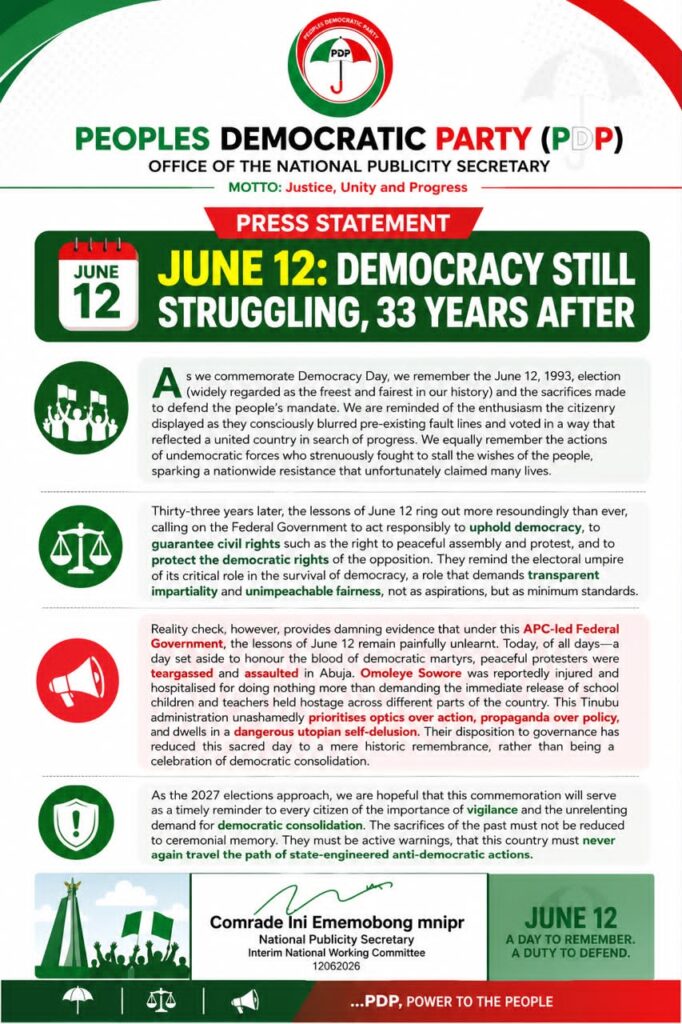
The party recalled the remarkable enthusiasm displayed by Nigerians during the 1993 polls, when citizens transcended ethnic and religious fault lines to vote for national progress.
The statement, signed by Comrade Ini Ememobong, National Publicity Secretary of the PDP Interim National Working Committee, noted that undemocratic forces aborted the popular will, triggering a prolonged resistance that claimed many lives.
“Thirty-three years later, the lessons of June 12 ring out more resoundingly than ever,” the PDP said, urging the Federal Government to uphold democratic principles, guarantee civil rights including the right to peaceful assembly and protest, and protect the rights of the opposition.
The party also reminded the Independent National Electoral Commission (INEC) of its sacred duty to conduct elections with “transparent impartiality and unimpeachable fairness,” describing these as minimum standards rather than mere aspirations.
However, the PDP expressed deep disappointment over what it described as the current administration’s failure to learn from history.
“Reality check, however, provides damning evidence that under this APC-led Federal Government, the lessons of June 12 remain painfully unlearnt,” the statement read. “Today, of all days — a day set aside to honour the blood of democratic martyrs — peaceful protesters were teargassed and assaulted in Abuja.”
The party highlighted the case of activist Omoleye Sowore, who was reportedly injured and hospitalised while demanding the immediate release of schoolchildren and teachers held hostage in different parts of the country.
The PDP accused the Tinubu administration of prioritising “optics over action, propaganda over policy,” and living in “a dangerous utopian self-delusion,” thereby reducing Democracy Day to a mere historic remembrance instead of a celebration of democratic consolidation.
Looking ahead to the 2027 general elections, the opposition party called on all citizens to remain vigilant and unrelenting in their demand for genuine democratic consolidation.
“The sacrifices of the past must not be reduced to ceremonial memory. They must be active warnings that this country must never again travel the path of state-engineered anti-democratic actions,” the PDP warned.
Comrade Ini Ememobong, mnipr is the National Publicity Secretary, Interim National Working Committee of the Peoples Democratic Party.
Opinions
Nigeria Cannot Build Flood Resilience While Destroying Its Wetlands
The next 10 to 20 years are likely to bring even more dangerous combinations of intense rainfall, river flooding, urban flooding, and coastal flooding/erosion.

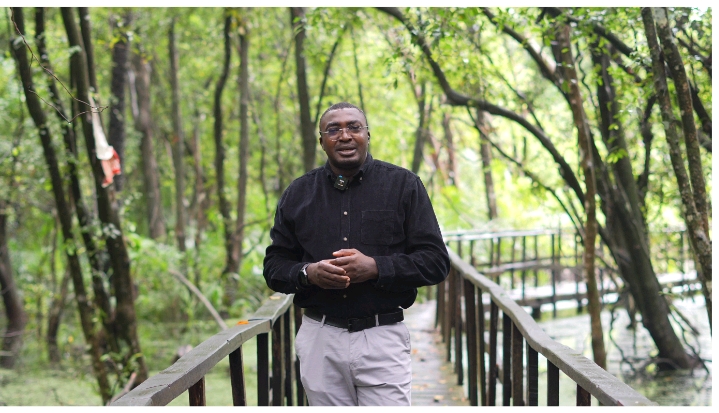
By DrJoseph Onoja
Every rainy season in Nigeria now arrives with a familiar sense of anxiety. Roads disappear beneath floodwaters, homes are submerged, businesses are disrupted, and lives are displaced.
What was once considered a seasonal inconvenience has become a recurring national emergency.
But Nigeria’s flooding crisis is no longer simply about rain.It is the result of a dangerous collision between climate change, environmental degradation, and weak urban planning.
Climate change is intensifying rainfall patterns across Africa, but human activities like deforestation, wetland destruction, poor drainage systems, and uncontrolled development on floodplains are multiplying the scale of destruction.
The uncomfortable truth is this: flooding in Nigeria is becoming structural.
Climate change may trigger the rainfall, but environmental degradation determines whether rain becomes disaster.
Climate Change Is Intensifying the Risk
Scientific evidence continues to show that extreme rainfall events are becoming more intense across Africa.
According to the Intergovernmental Panel on Climate Change (IPCC), both the frequency and intensity of heavy precipitation events are projected to increase as global warming accelerates.
In cities like Lagos, the impacts are already visible. Urban flooding has become more widespread, with both short-duration high-intensity rainfall and prolonged rainfall events increasing flood risks.
However, climate change alone does not explain the scale of devastation we are witnessing.
Ordinarily, heavy rainfall should not automatically become a disaster.
Healthy wetlands, functional drainage systems, protected floodplains, and well-planned urban infrastructure are designed to absorb and manage excess water.
” In Lagos, this issue is particularly critical. Water bodies, lagoons, creeks, and wetlands cover more than 62% of the state’s land area, while another significant portion remains seasonally flood prone.”
But when these natural and engineered systems fail or are deliberately compromised, communities become increasingly vulnerable.Nigeria’s flood challenge is therefore not only a climate issue. It is also a planning and governance issue.
Nigeria Is Destroying Its Natural Flood Defences
One of the most overlooked aspects of flood resilience in Nigeria is the role of nature itself.
Forests, wetlands, mangroves, and floodplains act as natural flood buffers. They absorb excess water, slow runoff, reduce erosion, and minimize flood peaks.
In many ways, they function as invisible infrastructure protecting communities from disaster.
Yet across Nigeria, these ecosystems are being degraded at alarming rates.
Deforestation reduces the soil’s ability to absorb water, increasing surface runoff and erosion. Sediments washed into drainage systems reduce their capacity and worsen urban flooding.
At the same time, wetlands and floodplains are increasingly being sandfilled and converted for construction and urban expansion.
The irony is embedded in the name itself: floodplains exist to absorb floods.
In Lagos, this issue is particularly critical. Water bodies, lagoons, creeks, and wetlands cover more than 62% of the state’s land area, while another significant portion remains seasonally flood prone.
When these ecosystems are filled, degraded, or built over, floodwater has fewer places to disperse safely. Instead, it ends up in homes, roads, and communities.
Wetlands are not vacant land waiting for development; they are natural infrastructure protecting cities from collapse.
The implications are enormous. Sensitive ecological areas such as the Lekki Conservation Centre continue to serve as natural buffers by receiving, retaining, and absorbing water from surrounding environments.
If such ecological buffers are lost to uncontrolled development, entire communities become significantly more exposed to flooding risks with attendant consequences for human health, livelihoods, wellbeing, infrastructure, and property.
Nigeria’s Adaptation Gap Is Growing
Nigeria is not standing completely still. There are signs of progress.
The Lagos Climate Adaptation and Resilience Plan identify dozens of adaptation projects and estimates financing needs between US$9 billion and US$16 billion by 2035.
This reflects increasing recognition that climate resilience must become a development priority.
But adaptation efforts are still not keeping pace with the speed of urban growth and climate risk.
Rapid urbanization, inadequate drainage systems, weak urban governance, and insufficient climate-resilient infrastructure continue to increase exposure across many Nigerian cities.
The next 10 to 20 years are likely to bring even more dangerous combinations of intense rainfall, river flooding, urban flooding, and coastal flooding/erosion.
Sea level rise will further worsen risks in low-lying coastal cities, especially Lagos.
Without urgent intervention, the economic, social, and environmental costs will continue to rise.
The cost of protecting ecosystems today is far lower than the cost of rebuilding cities tomorrow.
Nature-Based Solutions Must Become National Policy
Nigeria cannot engineer its way out of this crisis through concrete alone. Flood resilience requires a combination of infrastructure investment and ecological protection.
Nature-based solutions must become central to national and subnational climate adaptation strategies.
This means:
- • Protecting and restoring forests, wetlands, mangroves, and floodplains
• Strengthening drainage and storm water systems
• Enforcing risk-sensitive urban planning regulations
• Preventing development on ecologically sensitive areas
• Improving solid waste management to prevent blocked drainage systems
• Investing in low-carbon and climate-resilient growth pathways.
These actions are not optional environmental luxuries. They are essential investments in public safety, economic stability, and national resilience.
The future of flood resilience in Nigeria will depend as much on ecological protection as on engineering.
A Defining Choice for Nigeria
Floods are no longer isolated disasters. They are warning signs. They reveal the growing consequences of ignoring environmental limits while cities expand faster than resilience systems can keep pace.
They expose the cost of treating ecosystems as expendable rather than essential.
Nigeria still has a choice. We can continue reacting to flood disasters after they occur, or we can invest in prevention, resilience, and nature-based infrastructure before the next crisis arrives.
Protecting Forests, wetlands, restoring degraded ecosystems, and strengthening climate adaptation systems are not simply environmental priorities.
They are national development imperatives.The future resilience of Nigeria’s cities may well depend on how seriously we take them today.
• Dr Joseph Onoja , a conservation scientist, is the Director – General of the Nigerian Conservation Foundation (NCF).
Opinions
APC And Its Presidential Primary Result, By Emeka Monye
Democracy is not just about winning. It is about winning in a way that the country can recognize as its own.

Fela’s “Government Magic”
Fela Anikulapo-Kuti had a word for it: “Government Magic.”
In the track, the Afrobeat pioneer captured a Nigerian political tradition that predates the Fourth Republic—the sudden transformation of figures, narratives, and outcomes to fit the ambitions of those in power.
He was singing about the 1979 and 1983 elections, but the chorus feels uncomfortably familiar today. The instruments have changed. The stage is bigger.
Yet the choreography of doubt around election results remains.
The political class, as Fela dissected in song after song, has always understood the value of controlling the story before, during, and after the polls.
The Goal
The goal is not just to win, but to win in a way that makes dissent look irrational. When the numbers bend to serve whims and caprices, the public’s faith in the process bends with them.
That is why the credibility of internal party primaries matters. They are rehearsals for the national performance. If the rehearsal collapses into farce, the main show risks losing its audience.
Striking Figure
The recent All Progressives Congress presidential primary result has reignited that old conversation.
According to reports circulating from the party, President Bola Tinubu emerged as the APC candidate for the 2027 presidential election with a tally exceeding 10 million votes.
On its face, the figure is striking. It is also the source of the current controversy. Across social media, videos and screenshots purporting to show the counting process have fueled questions about the arithmetic behind the result.
The clips show delegates and officials tallying votes in what appears to be a linear, one-by-one sequence.
Then, without a visible change in method or volume, the totals jump to figures in the tens of thousands.That kind of progression violates basic expectations of how counting works.
Mechanics of counting
Arithmetic progression moves step by step: one, two, three, four. What people observed looked closer to geometric progression—small, manageable numbers suddenly leaping into magnitudes that do not match the visible process.
To the average voter watching at home, it does not read as a technical anomaly. It reads as a sleight of hand. And in politics, perception is often as consequential as procedure.
The problem is not the ambition of a large turnout. A party primary with millions of participants is plausible if the structure supports it.
The problem is the disconnect between what was seen and what was announced. When the mechanics of counting defy standard arithmetic, the burden falls on the party to explain the method.
Was this an aggregation of state-level results? Were multiple counting centers involved? Was there a digital component that was not visible in the clips? Without that context, the silence becomes an explanation in itself, and not a reassuring one.
Why it matters
This matters because the signal from a party primary extends beyond the party. It sets a tone for the general election that follows.
If internal contests normalize questionable tallies, it becomes harder to draw a line at the national level.
It erodes the cultural expectation that numbers should add up, that observers should be able to follow the process, and that the loser should be able to concede without feeling gaslit.
Once that expectation erodes, every subsequent election starts from a deficit of trust.
Nigeria’s elections history
Nigeria’s history with elections makes this sensitivity unavoidable.
Fela’s “Government Magic” resonated in the 1980s precisely because voters had watched results shift between the polling unit and the collation center.
The trauma of that era did not disappear because new technology arrived. It evolved.
Today, the magic happens in parallel—on the field and on timelines. A video can travel faster than a press statement. A 30-second clip can frame a narrative that a 10-page report cannot undo.
In that environment, transparency is not a luxury. It is risk management.The APC’s position as the ruling party increases the stakes.
When the party in power announces results that strain credibility, the opposition, civil society, and international observers all take note. It feeds into a broader narrative about democratic backsliding that Nigeria has been working to resist.
It also gives ammunition to those who argue that elections are theater and that the outcome is decided long before voters mark a ballot. That is a dangerous argument to validate, even unintentionally.
Generational dimension
There is also a generational dimension. The younger voters who make up a growing share of the electorate are digital natives.
They expect processes to be visible, verifiable, and timestamped.
They are not satisfied with appeals to tradition or authority when the data does not align.
For them, a counting process that leaps from single digits to five figures without an explanation looks less like “strategy” and more like contempt for their intelligence.
That is not a base you want to alienate before a general election. None of this is to say that the APC intended to undermine its own credibility.
Party primaries are complex, high-pressure events.
Aggregating results from 36 states and the FCT, coordinating delegates, managing security, and communicating in real time is not simple.
Mistakes happen. Miscommunications happen. But the response to those mistakes determines whether they become scandals.
A prompt, detailed breakdown of how the 10 million figure was reached—with state-by-state tallies, observer sign-off, and a clear explanation of the counting method—would close the loop. Silence and defensiveness keep it open.
When the party in power announces results that strain credibility, the opposition, civil society, and international observers all take note. It feeds into a broader narrative about democratic backsliding that Nigeria has been working to resist.
The political class would do well to remember that legitimacy is a renewable resource, but only if you invest in it. Every election cycle offers a chance to rebuild trust or deplete it further.
The current moment is a test. If the APC can demonstrate that its primary was both massive and methodical, it strengthens the case for its own mandate.
If it cannot, it hands its opponents a narrative that will outlast the 2027 campaign.Beyond the APC, the broader lesson is for all parties.
The era where results could be announced and accepted without explanation is over.
The public has access to more information, more cameras, and more ways to compare what was said with what was seen. That is not a problem to be managed through messaging. It is a reality to be designed for.
That means building primaries and elections around verifiable processes: clear protocols, independent observation, real-time data release, and audit trails that can withstand public scrutiny.
Leadership also requires admitting when the process has gaps.
A leader cannot succeed without a good support team, but that team must include people willing to say, “This does not look right, and we need to fix it.”
The younger generation watching these events is not asking for perfection.They are asking for honesty. They are asking for a system that respects arithmetic and respects them.
Giving them space in leadership means giving them a process they can believe in, even when they lose.
The danger of ignoring this is not abstract. When vote counting looks arbitrary, voter turnout suffers.
When turnout suffers, governance suffers. When governance suffers, the cycle of disillusionment deepens.
Nigeria cannot afford another decade where elections are seen as rituals rather than decisions.
The country’s challenges—security, economy, education, healthcare—require a public that believes its vote can influence who makes those decisions.
Fela’s critique was not about cynicism. It was about accountability. He held up a mirror to power and asked it to recognize itself. That is still the task.
If the APC’s primary result was legitimate, prove it with the kind of transparency that makes “Government Magic” impossible. If there were errors, correct them publicly and show how the process will change. That is how you turn a moment of doubt into a foundation for trust.
2027 election
The 2027 election will not be decided on social media. But the climate in which it is contested is being shaped there now.
Every unexplained anomaly, every dismissive response, every jump from one to ten thousand without a visible step in between, adds weight to the narrative that the game is rigged.
And once that narrative takes hold, even a perfectly conducted election struggles to overcome it.
The political class has been called upon to ensure that their supporters do not cause mayhem as the country heads for the polls.
That responsibility starts long before Election Day. It starts with how parties conduct their own affairs, how they count their own votes, and how they explain their own results.
Democracy is not just about winning. It is about winning in a way that the country can recognize as its own.
Nigeria needs more people of conscience in positions where they can influence process, not just outcomes. People who understand that a clean process is the best defense against a dirty result.
People who are willing to give the younger generation not just a seat at the table, but a table that is built on rules everyone can see and follow.
If the APC wants its 2027 candidacy to be judged on policy, record, and vision, it must first secure the legitimacy of the path that produced it.
That is not a favor to the opposition. It is a service to the country. Because in the end, the only magic that sustains democracy is the ordinary, unglamorous work of making the numbers add up—and showing your work while you do it.
• Emeka Monye Is A Journalist


Naira Exchange Rates Monday, June15, 2026

Edo Queens Win 2025/26 NWFL Title

World Cup: Japan Holds Netherlands To 2-2 Draw

Tech Expert, Zuckerberg trains with UFC champions, Adesanya, Alexander

Organ Trafficking: Ekweremadu bags 10 years in UK prison

SAINT OBI: Between his marriage and his death
-

 Opinions3 days ago
Democracy Still Struggling 33 Years After June 12, PDP Laments by Comrade Ini Ememobong
-
 Crime2 days ago
Bandits Kill 19 Farmers, Injure 12 Others in Fresh Attack in Zamfara
-

 Crime2 days ago
BREAKING: Retired General Dies in Kidnappers’ Captivity, Demand Release of Gang Members
-

 Sports2 days ago
Balogun: This is something I dreamed of for a long time
-

 Sports7 hours ago
World Cup: Sweden beats Tunisia 5-1
-

 Sports3 days ago
FIFA World Cup Day 2: Canada holds 1-1 Bosnia-Herzegovina
-

 Sports2 days ago
FIFA World Cup 2026 Day 3: Qatar draws Switzerland 1: 1
-
 International7 hours ago
US and Iran to sign historic peace deal June 19 in Switzerland