
Business
Airline Operators Against Aviation Minister To Buy Planes For Nigeria Air


Airline Operators of Nigeria (AON) has strongly kicked against alleged plans by the Minister of Aviation, Hadi Sirika, to procure some aircraft for the Nigeria Air.
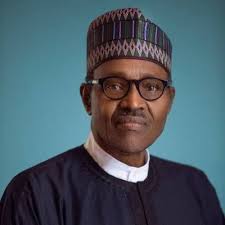
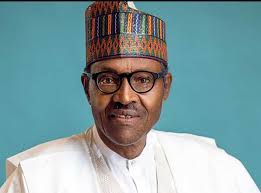
The group, in a letter dated 24th May 2023, addressed to President Muhammadu Buhari, said that the declaration by the minister to procure some aircraft for the Nigeria Air , contravenes a court order not to do so until issues about the establishment process of Air Nigeria are cleared.
The Aviation Minister had in an interview with Channels Tv on Wednesday, disclosed that an aircraft for Nigeria Air will arrive in the country on Friday ahead of the commencement of operations…….
Below is a copy of the letter:



Business
After South Africa, Kenya Cracks Down on Foreign Traders, Retailers
Ruto directed authorities to begin shutting down small businesses operated by foreign nationals from September 7, saying hawking and small-scale retail should be reserved for Kenyans.

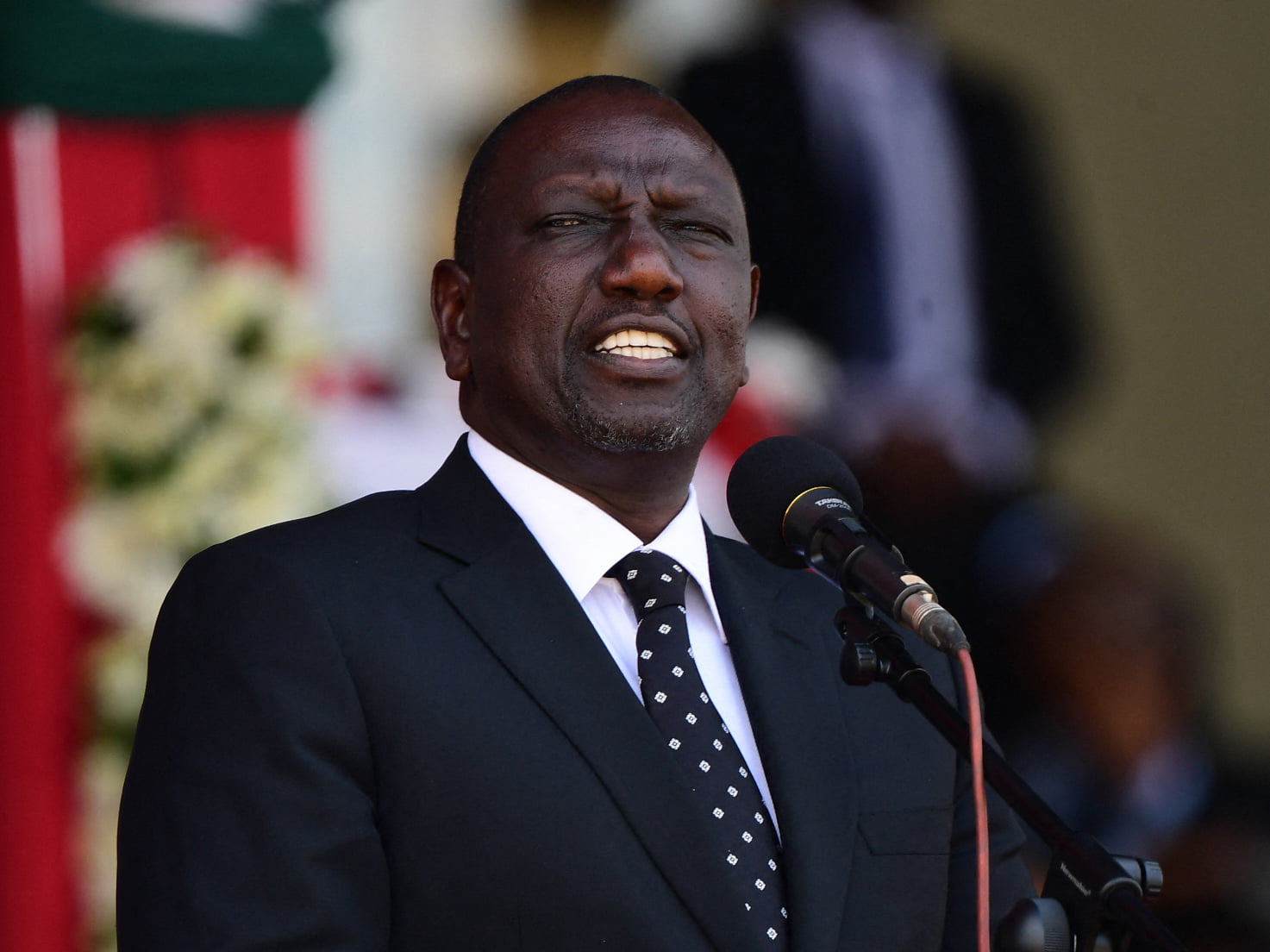
Kenya is beginning a crackdown on foreign nationals operating small retail shops and engaging in hawking, after President William Ruto directed authorities to shut down such businesses from September 7.
Ruto announced this on September 2 while addressing micro, small and medium-sized enterprises, MSME. traders at State House in Nairobi.
He said foreigners should not compete with Kenyans in businesses such as hawking and small retail, while foreign investment was welcome in activities requiring greater capital.
Ruto directed authorities to begin shutting down small businesses operated by foreign nationals from September 7, saying hawking and small-scale retail should be reserved for Kenyans.
He said the government would take administrative action while the Parliament of Kenya considers the proposed Local Content Bill, 2025.
He also directed National Assembly Majority Leader Kimani Ichung’wah and Trade Cabinet Secretary Lee Kinyanjui to accelerate the bill’s passage through Parliament.
Business
NAFDAC Goes After Chinese Logistics Firms Over Products Counterfeiting
Chinese people (counterfeiters) own the logistics companies which they used to bring these (fake goods) things.” NAFDAC said it has been shutting down the logistics companies.

The National Agency for Food and Drug Administration and Control (NAFDAC) has revealed that Chinese counterfeiters now living in Nigeria are behind the proliferation of fake goods in Nigeria.
NAFDAC’s Director of Investigation and Enforcement, Martins Iluyomade disclosed that recent investigations found Chinese counterfeiters, previously operating externally, have set up plants and logistics channels inside the country.
How They Operate
He said, “Before, to fake a product, you needed to go to China to bring it. Now, you don’t need to go. They are here (in Nigeria) with us. They are the ones who will identify the product that will be moving, send it to their country (China), and then come here and distribute it to our people (Nigerians) without having to travel, thereby worsening the production, distribution and sale of adulterated, harmful and unwholesome products.
Iluyomade, describing it as a “new trend making it (fake goods situation) look this serious,” noted that NAFDAC discovered the “Chinese people (counterfeiters) own the logistics companies which they used to bring these (fake goods) things.” NAFDAC said it has been shutting down the logistics companies.
Business
Dangote woos ordinary Nigerians to own shares in oil refinery as IPO opens September 14
The IPO comprises 4.1 billion ordinary shares at N525 each and is expected to raise just over N2 trillion, according to Dangote.The businessman said that the minimum subscription would be 10 shares.
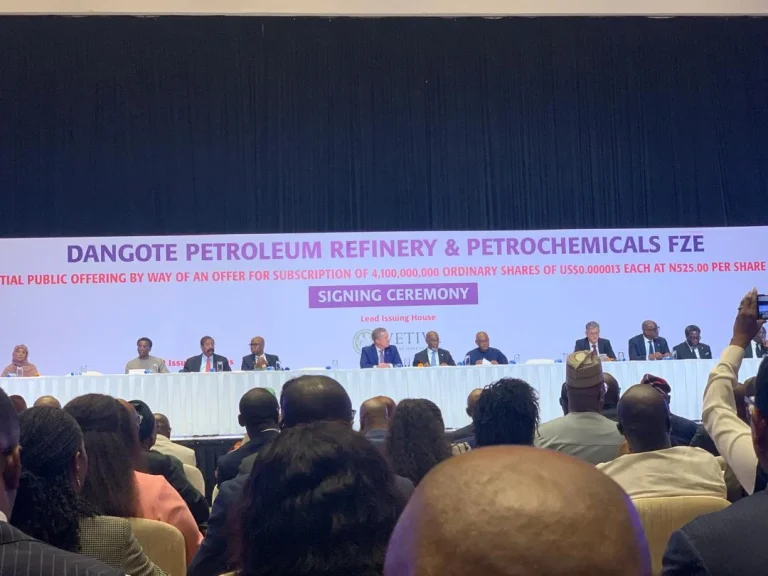
|Lagos: Dangote IPO document signing ceremony held September 7, 2026
Africa’s billionaire industrialist, Aliko Dangote, on Monday said that asides institutional and corporate investors, ordinary Nigerians -drivers, cooks, traders, servants and managers have an opportunity to own shares in the proposed initial public offering of Dangote Petroleum Refinery.
The signed prospectus puts the value of the offer at about $1.6 billion, while the IPO values the refinery at about $49 billion.
The IPO is scheduled to open on September 14 and close on October 13.
Dangote, during the IPO registration documents signing ceremony today, September 7,2026, in Lagos, described the transaction as an “IPO for the people” designed to democratise ownership of the massive industrial facility.
The IPO comprises 4.1 billion ordinary shares at N525 each and is expected to raise just over N2 trillion, according to Dangote.The businessman said that the minimum subscription would be 10 shares.
“But it is not only to fund the expansion of the refinery, of course, it’s a bigger amount. What we are trying to do is to make sure majority of all these my—our drivers, our cooks, our, you know, servants, our managers, everybody, they will have an opportunity to have a stake in this refinery,” Dangote said.
He said the transaction was not solely about raising funds for expansion, adding that the objective was to give people across the continent an opportunity to own shares in the refinery.
“So, this is why we have actually called it the IPO for the people. This is why we say that this is democratizing,” he said.
“There is no segregation on who can own these shares. We want every human living on the continent to be part of this action, and I’m sure they will continue to be happy now, future, and forever.”


Global media leader Annecchino dies at 55

Presidency Loses Media Aide, Onwubuariri

Meet The highest paid world leader

Tech Expert, Zuckerberg trains with UFC champions, Adesanya, Alexander

Organ Trafficking: Ekweremadu bags 10 years in UK prison

SAINT OBI: Between his marriage and his death
-

 Business1 day ago
Dangote Refinery Signs IPO Document Today
-
 Politics1 day ago
Obidient Connect Texas Plans Grand Rally for Obi-kwakwanso October 10
-

 Business18 hours ago
NAFDAC Goes After Chinese Logistics Firms Over Products Counterfeiting
-
 News2 days ago
FG announces two-week traffic delays on Kara–Berger Bridge for repairs
-
 Politics1 day ago
Nigerians better off under military than democracy – Duke
-
 News1 day ago
JUST IN: Traffic Chaos Expected on Lagos-Ibadan Expressway From Tuesday
-

 Sports1 day ago
Infantino To Seek Re-Election As FIFA President In 2027
-

 Sports18 hours ago
Falconets lose World Cup opener to Spain