
Business
Afreximbank terminates credit rating with Fitch
Fitch cut Afreximbank’s credit rating to one notch above “junk” status last year, citing high credit risks and weak risk-management policies, and put it on a “negative outlook” – rating agency terminology for another downgrade warning.

African Export-Import Bank (Afreximbank) has terminated its credit rating relationship with Fitch Ratings.
In an announcement on its website, Afreximbank explained that it’s decision follows a review of the relationship, and its firm belief that the credit rating exercise no longer reflects a good understanding of the Bank’s Establishment Agreement, its mission and its mandate.
The bank maintained that it’s business profile remains robust, underpinned by strong shareholder relationships and the legal protections embedded in its Establishment Agreement, signed and ratified by its member states.
Reuters, in an additional report , said that Afreximbank has been in a battle over whether it must take losses on loans to debt-defaulted countries, including Ghana and Zambia, which turns on whether it enjoys so-called “preferred creditor status”.
Fitch cut Afreximbank’s credit rating to one notch above “junk” status last year, citing high credit risks and weak risk-management policies, and put it on a “negative outlook” – rating agency terminology for another downgrade warning.
It has also said that any weakening of preferred creditor status at institutions like Afreximbank “could lead to negative rating action.”
Business
Governor Otti Commissions Ultimum Manufacturing Plant in Aba
Razzle beverages include Razzl Pamplemousse (a unique and special grapefruit flavour), Razzl Cola, Razzl Orange, and Razzl Lemon.

Ultimum Limited, the manufacturers of Razzl brand of carbonated soft drinks has commissioned its state-of-the-art beverage manufacturing plant in Aba, Abia State.
Razzle beverages include Razzl Pamplemousse (a unique and special grapefruit flavour), Razzl Cola, Razzl Orange, and Razzl Lemon.
Located in the Osisioma Industrial Layout, the new plant was commissioned by the Governor of Abia State, Dr. Alex Chioma Otti.
Otti described the investment as a clear signal of economic revival and growing investor confidence in Abia State.
“This investment confirms that we are creating the right conditions for businesses to grow, thrive, and succeed. Investors will always go where there is clarity, stability, and opportunity.
Our focus has been to build that environment, and today’s commissioning shows that the strategy is working,” he said.
The Chairman of Ultimum Limited and representative of the investor group, Mr. Whalen Kadji, emphasized the company’s long-term commitment to Aba and Nigeria.
“We did not come here by chance. We came because of the energy and entrepreneurial spirit of Aba. This city has always been a center of enterprise, and we believe strongly in its future.
This plant is more than an investment in beverages; it is an investment in people, in jobs, and in the growth of local industry. We are here for the long term, and this is just the beginning of what we intend to build here.”
The Managing Director of Ultimum Limited, Mr. Austin Ufomba, described the plant as a bold step in the company’s journey.
“Ultimum Limited started with a simple idea, to build world-class products right here in Africa,”he said.
Business
Oil price jumps to $106, stocks drop on uncertainty over US-Iran talks
Crude prices rallied more than three percent on Thursday, with Brent crude above $106 per barrel and WTI around $93.

Oil prices jumped and equities slid Thursday as hopes for a peace deal between the US and Iran wavered after Tehran rejected Washington’s bid to wind down the nearly four-week war.
Markets had been buoyed this week by US President Donald Trump’s announcement that strikes targeting Iran’s energy infrastructure would be postponed, adding that the two sides were in peace talks.
But uncertainty over the talks and the virtual closure of the Strait of Hormuz — through which around 20 percent of oil and liquefied natural gas passes — have cast a shadow over market sentiment.
“The market rollercoaster continues,” said Joshua Mahony, chief market analyst at Scope Markets.
Crude prices rallied more than three percent on Thursday, with Brent crude above $106 per barrel and WTI around $93.
( VANGUARD)
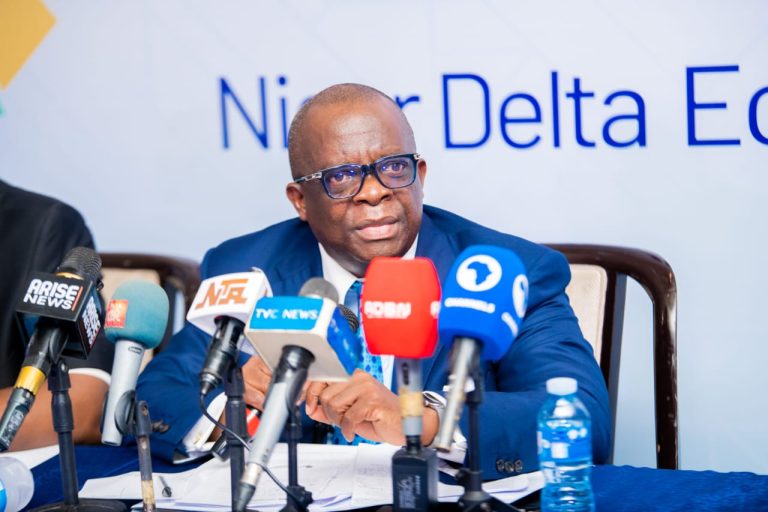
Photo: Ambassador Idaere Gogo Ogan
The Niger Delta Chamber of Commerce, Industry, Trade, Mines and Agriculture (NDCCITMA) has unveiled plans to attract up to five billion dollars structured investments to the oil-producing region in five years.
The Chairman of NDCCITMA, Ambassador Idaere Gogo Ogan, made the disclosure at a pre-summit conference ahead of the Niger Delta Economic and Investment Summit in Port Harcourt, Rivers State.
He said that the initiative would catalyse no fewer than 500,000 direct and indirect jobs as well as spur investments and create wealth.
He said the summit with the theme, “Driving Investment, Innovation, and Industrial Growth in the Niger Delta”, slated for Port Harcourt, would deliberate on investment mobilisation, enterprise growth, industrial expansion, and regional coordination.


Governor Otti Commissions Ultimum Manufacturing Plant in Aba

CAF appoints Nigeria’s Samson Adamu as acting secretary general

JUST IN: Kwankwaso Set to Join ADC on Monday

Tech Expert, Zuckerberg trains with UFC champions, Adesanya, Alexander

Organ Trafficking: Ekweremadu bags 10 years in UK prison

SAINT OBI: Between his marriage and his death
-

 News2 days ago
Kano Deputy Governor Resigns
-

 Crime3 days ago
Vietnam Police Dismantle Multi-Billion Dollar Cryptocurrency Fraud Operation
-

 News3 days ago
Abia State Holds State Burial for Renowned Evangelist Rev. Dr. Uma Ukpai
-

 News3 days ago
Soludo Orders Suspension of Absentee Workers After Surprise Secretariat Visit
-

 News2 days ago
El-Rufai’ loses mother, Hajiya Umma
-
 Politics18 hours ago
JUST IN: Kwankwaso Set to Join ADC on Monday
-
 Sports6 hours ago
CAF appoints Nigeria’s Samson Adamu as acting secretary general
-
 Business5 hours ago
Governor Otti Commissions Ultimum Manufacturing Plant in Aba