
News
BREAKING: Wale Edun submits minimum wage cost to Tinubu


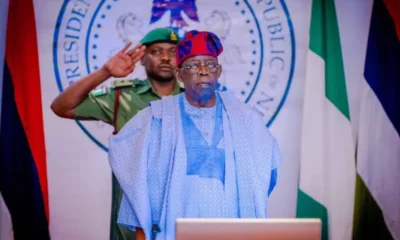
The Minister of Finance and Coordinating Minister of the Economy, Wale Edun, has submitted the projected cost implications of implementing a new national minimum wage to President Bola Tinubu.
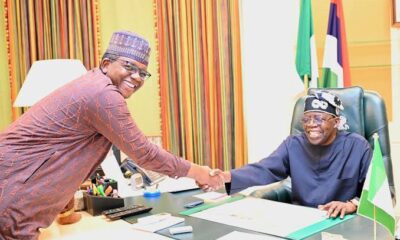
Edun, along with the Minister of Budget and National Planning, Atiku Bagudu, presented President Tinubu with the cost implications of the new minimum wage in his office at the presidential villa in Abuja on Thursday.
Speaking with State House correspondents after meeting with the President, Edun verified the submission and reassured that “there is no cause for alarm.”
Edun’s submission of the cost implication follows a 48-hour ultimatum issued to him by President Tinubu on Tuesday during a meeting with the government negotiation team on the new minimum wage led by the Secretary to the Government of the Federation, Senator George Akume.
Other team members at the meeting included the Ministers of Labour and Employment, Nkeiruka Onyejeocha, and Information and National Orientation, Mohammed Idris, as well as the Group Managing Director and Chief Executive Officer of the Nigeria National Petroleum Company Limited (NNPCL), Mele Kyari.
Recall that organised labour, comprising the Nigeria Labour Congress and Trade Union Congress, had embarked on a nationwide strike on Monday to demand an increased minimum wage for workers and the reversal of the recently increased electricity tariffs.
However, the labour union leadership suspended the strike on Tuesday for five days after signing a commitment with the Federal Government to resume negotiations and come up with a new minimum wage within a week.






News
FG announces two-week traffic delays on Kara–Berger Bridge for repairs
The TRACE Acting Commander, Mr A. Ojerinde, stated that a multi-agency operation including TRACE, the Federal Road Safety Corps, FRSC, Lagos State Traffic Management Authority, LASTMA, and the Nigeria Police Force will be deployed along the corridor to enforce traffic control.

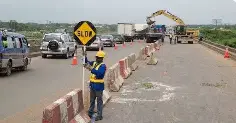
THE Federal Government has alerts motorists and commuters on the Lagos–Ibadan Expressway of possible travel delays, starting Tuesday September 8 for two weeks repair works on the Kara–Berger Bridge
The project, earlier slated to commence in August 2026, was suspended for traffic review following public outcry over short notice and the need for effective traffic management.
The two-week rehabilitation project, directed by the Minister of Works, Senator David Umahi, involves the replacement of deteriorating expansion joints to improve road safety, structural integrity, and long-term traffic flow on the busy corridor.
The project is expected to run through September 22, 2026.
The Ogun State Traffic Compliance and Enforcement Agency, TRACE, alongside the Federal Ministry of Works and key stakeholders, in a statement, warned motorists to prepare for lane restrictions, particularly during peak commuting hours.
The TRACE Acting Commander, Mr A. Ojerinde, stated that a multi-agency operation including TRACE, the Federal Road Safety Corps, FRSC, Lagos State Traffic Management Authority, LASTMA, and the Nigeria Police Force will be deployed along the corridor to enforce traffic control.
Ojerinde, who urged road users to plan ahead, said “Leave earlier than usual to accommodate expected travel delays.
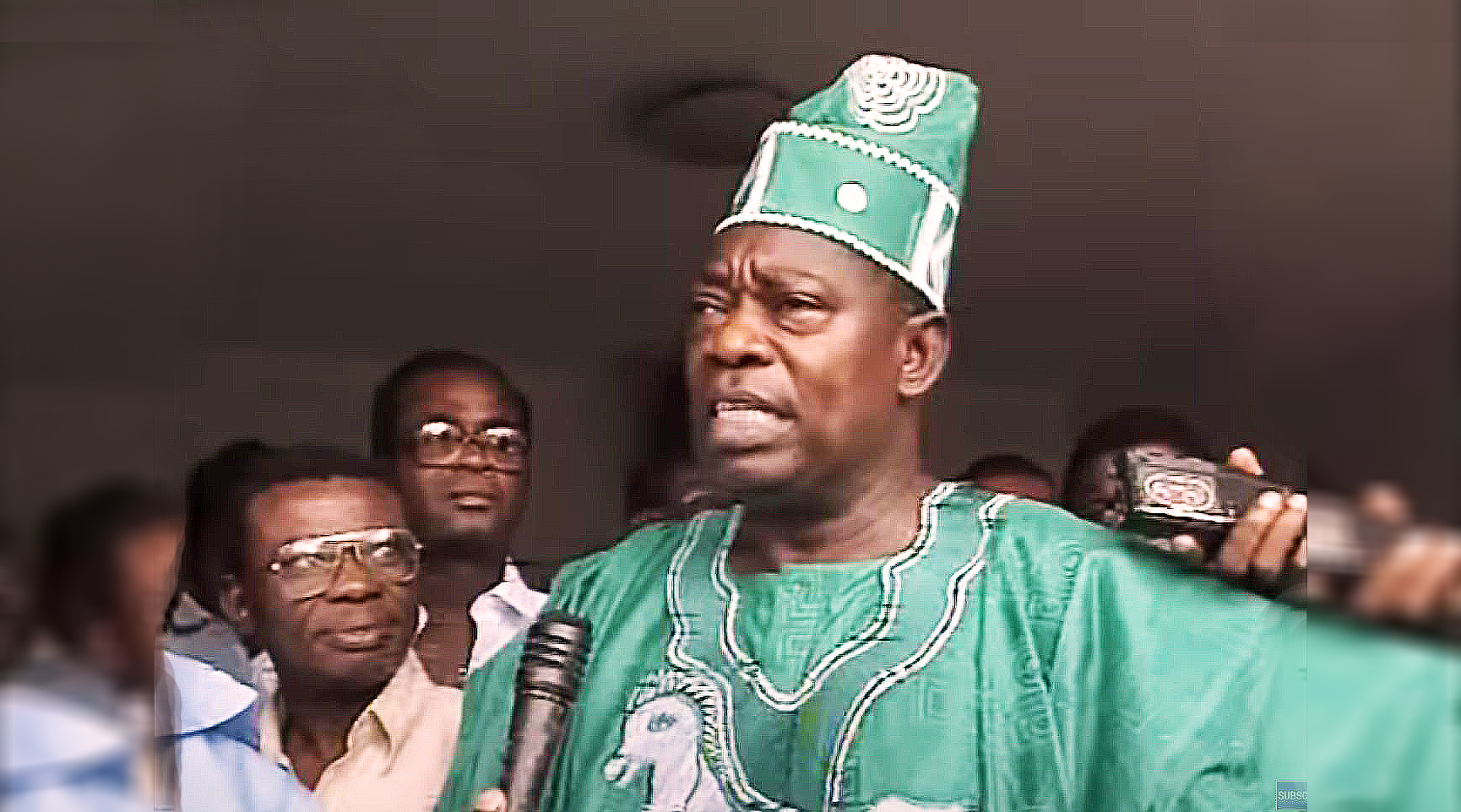
A new documentary on the life and political struggle of the late Chief Moshood Kashimawo Olawale (MKO) Abiola is set to premiere in Nigerian cinemas in October.
Titled MKO, the 108-minute film is directed by Ose Oyamendan and produced with American documentary filmmaker Mark Jonathan Harris. It explores the annulment of the June 12, 1993, presidential election, widely regarded as free and fair, Abiola’s subsequent detention, and the controversial circumstances surrounding his death in custody in 1998.
The documentary features interviews with key figures including former military rulers Ibrahim Babangida and Abdulsalami Abubakar, former President Olusegun Obasanjo, Nobel laureate Wole Soyinka, Abiola’s running mate Baba Gana Kingibe, members of the Abiola family, journalists, and diplomats.
Oyamendan, who worked as a young journalist during the June 12 crisis, has described the film as an investigative documentary that examines Nigeria’s unfinished democratic journey. It had its world premiere earlier this year at the Sheffield DocFest in the United Kingdom.
The Nigerian cinema release is scheduled for early October, with some reports linking the premiere to Independence Day on October 1.
The Joint Admissions and Matriculation Board (JAMB) has released the 2026 Unified Tertiary Matriculation Examination (UTME) results of underage candidates for viewing.
In a statement issued on Saturday in Abuja by the Board’s Public Communication Adviser, Dr Fabian Benjamin, JAMB defined an underage candidate for the 2026 admission exercise as any candidate who will be less than 16 years old as at September 30, 2026.
Benjamin said the results were released primarily to enable candidates and their parents or guardians to know their performance in the examination. However, he stressed that the release does not confer eligibility for admission on all underage candidates.
According to him, the results cannot be used for admission or any other official purpose, except by candidates who satisfy the stringent requirements prescribed for exceptionally performing underage candidates.
Candidates can check their results by sending “RESULT” to 55019 or 66019 using the same SIM card with which they registered for the UTME.
JAMB reiterated that only underage candidates who demonstrate exceptional academic ability and maturity will be considered for admission through a rigorous, multi-stage assessment process. Key requirements include a minimum UTME score of 320, at least 80 per cent performance in relevant Senior Secondary School Certificate Examination (SSCE) subjects where applicable, satisfaction of the Post-UTME requirements of their chosen institutions, and a final assessment conducted by experts.


Nigerians better off under military than democracy – Duke

Infantino To Seek Re-Election As FIFA President In 2027

Dangote Refinery Signs IPO Document Today

Tech Expert, Zuckerberg trains with UFC champions, Adesanya, Alexander

Organ Trafficking: Ekweremadu bags 10 years in UK prison

SAINT OBI: Between his marriage and his death
-

 Business3 days ago
Okin Biscuits Set For Comeback After 17 Years, Targets Revival Of Jobs, Local Manufacturing
-
 News3 days ago
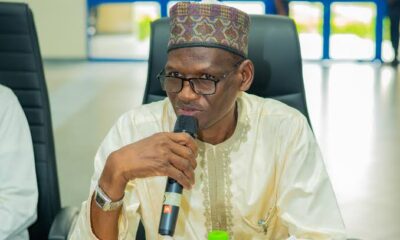
BREAKING: FG Harmonizes Workers’ Salaries
-

 News2 days ago
Arise TV Deputy Head of News Ohi Odiai and Wife Celebrate 17th Wedding Anniversary
-
 Sports3 days ago
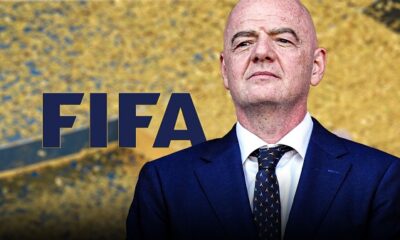
FIFA Accuses UEFA of ‘Smear Campaign’ Against Infantino
-
 Politics3 days ago
ADC unveils 28 governorship candidates for 2027 election
-
 News3 days ago
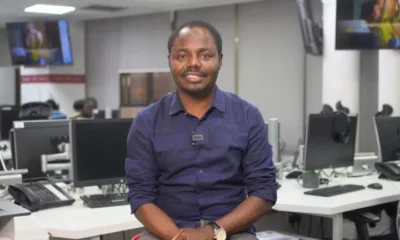
BBC Appoints Kakangi Editor Hausa Service
-
 Business3 days ago
Dangote Foundation Takes Over Aliko Dangote Skills Acquisition Centre Kano
-
 International2 days ago
Trump sends envoys to Russia, Ukraine with new peace plan