
News
Bamanga Tukur, former Adamawa gov, ex-PDP Chair dies at 90
Tukur, who died three days before his 91st birthday, was one of the prominent political figures whose career cut across Nigeria’s military and civilian administrations, the private sector and continental business circles.

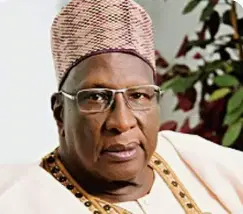
BAMANGA Tukur, former National Chairman of the Peoples Democratic Party, PDP, and former governor of Gongola (now Adamawa)State, is dead, aged 90.
Family’s sources confirmed his death on Saturday, although details surrounding his passing were not immediately made public.
Tukur, who died three days before his 91st birthday, was one of the prominent political figures whose career cut across Nigeria’s military and civilian administrations, the private sector and continental business circles.
Born on September 15, 1935, he began his public service career at the Nigerian Ports Authority, NPA, where he served as General Manager from 1975 to 1982.
He moved into elective politics and won the Gongola State governorship election in 1983, but his tenure was cut short by the military coup in December of the same year.After leaving office, Tukur turned to business and founded BHI Holdings, popularly known as the DADDO Group of Companies.
He later returned to government as Minister of Industries between 1993 and 1995 under the military administration of General Sani Abacha.Tukur also played prominent roles in African business and economic affairs, serving as Executive President of the African Business Roundtable and Chairman of the NEPAD Business Group.
He held advisory positions with several international trade organisations.
In March 2012, he returned to partisan politics when he was elected National Chairman of the PDP with the backing of then-President Goodluck Jonathan.
His tenure, however, was overshadowed by prolonged internal disagreements within the party, culminating in his resignation as national chairman in January 2014.

Apartments available for Rent
2-bedroom flat
Room and Parlour Self-Contained
A room self contain
Contact: +2347067784741
News
ESUT to be renamed after Jim Nwobodo – Mbah
… there is a legal process to follow. ESUT was established by law, and changing its name would require the appropriate legislative steps and engagement with relevant stakeholders.

Governor of Enugu State, Dr. Peter Mbah, has unveiled plans to rename the Enugu State University of Science and Technology (ESUT) after a Second Republic Governor of old Anambra State, Senator Jim Nwobodo.
Mbah made this known during the 3rd Distinguished Personality Lecture of the university delivered by Nwobodo at the Barr. Peter Ndubuisi Mbah Multipurpose Auditorium, ESUT, Enugu, on Thursday.
He said the idea, which was first suggested by the ESUT Alumni Association, was in tandem with his thoughts, describing it as a fitting tribute to the elder statesman, who founded the institution in 1980.
The Governor emphasised that the brainchild of the ex-governor had played a critical role in the human capital development of not just Enugu State, but also the old Anambra State and Nigeria as a whole.
He, however, said that there is a legal process to follow. ESUT was established by law, and changing its name would require the appropriate legislative steps and engagement with relevant stakeholders.
“I intend to begin those engagements and work with the institutions concerned to advance the proposal through the proper process,” he said.
News
South Africans Begin Another ‘Operations Flush Out Nigerians’ Protest
Fani-Kayode described those behind xenophobic attacks as a tiny minority who should not be allowed to define the character of the country’s population.
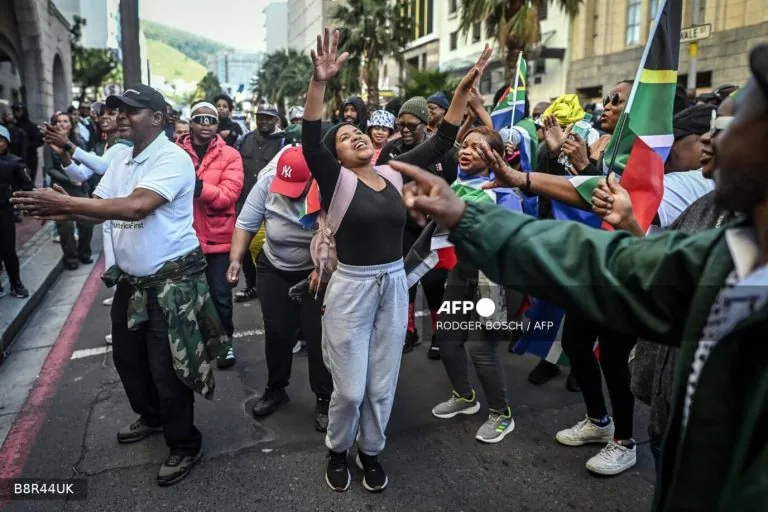
Nigeria’s High Commissioner to South Africa, Femi Fani-Kayode, is sweating to protect Nigerians and Nigeria’s image as protesters, operating under the March and March movement launched a fresh anti-Nigerian campaign, ” The state must ban Nigerians from South Africa. They must ban Nigerians until they stop selling drugs to our people. The rest of Africa, we are fine, but we do not want Nigerians in South Africa anymore. That is what we are saying.”
The protesters on Wednesday led by the group’s leader, Jacinta Ngobese-Zuma, took a particularly confrontational turn in Sunnyside, a Pretoria suburb popularly associated with a sizeable Nigerian community and sometimes described as ‘Little Lagos.
They specifically accused Nigerians of engaging in drug trafficking and contributing to social problems in South African communities.
The demonstration, .Challenging Nigerian residents to explain their presence and influence in the neighbourhood, Ngobese-Zuma questioned how the area acquired the nickname.
“I am being told here that we’ve entered Sunnyside, the home of Nigerians. I am inviting Nigerians to come out, let’s talk to each other. We want to know who gave you this place and called it Nigeria. Who gave you permission to call this place Lagos or whatever you call it?” she asked.She further questioned who had authorised Nigerians to identify parts of South African territory with their home country.
The remarks point to the increasingly hostile rhetoric directed at the immigrant community.
Ngobese-Zuma described the convention as “not sustainable and not feasible”.
She alleged that the presence of migrants was placing additional pressure on public resources and aggravating the frustrations of South African citizens.
The movement said it was taking its grievances to the Department of Home Affairs, where it intended to formally present its demands for tougher immigration controls, restrictions on refugee admissions and accelerated deportation of undocumented foreign nationals.
For his part, the group’s legal representative, Xolani Zuma, went further by demanding an outright prohibition on Nigerians entering South Africa.
The latest demonstration comes amid growing strain in relations between Nigeria and South Africa over recurring xenophobic hostility, the safety of Nigerian nationals and disagreements surrounding the diplomatic representation of both countries.
Only last week, Fani-Kayode, and the South African Presidency were involved in a diplomatic exchange following the exclusion of his prepared speech during the presentation of his credentials.
Fani-Kayode had described the omission as disrespectful to Nigeria.
Although he subsequently said the disagreement had been resolved following the intervention of South African President Cyril Ramaphosa and an invitation from the country’s Department of International Relations and Cooperation.
The envoy also disclosed that he had begun addressing concerns affecting Nigerians in South Africa since assuming office.
Fani-Kayode described those behind xenophobic attacks as a tiny minority who should not be allowed to define the character of the country’s population.
He maintained that the majority of South Africans were decent and accommodating.
He expressed confidence that the two countries could overcome their differences without severing longstanding diplomatic relations.
However, Fani-Kayode had warned that patience was running thin within Nigeria’s corridors of power over repeated attacks on its citizens.He insisted that the country would not abandon its nationals to xenophobic violence.


CAF Chooses Six Venues For Africa Cup of Nations Finals
House For Rent

Armed Men Attack Fmr. Super Eagles Captain, Segun Odegbami in Abeokuta Residence (Images)

BREAKING: Lagos Govt Declares Today, Thursday Work-Free to Mark 2026 Ìṣẹ̀ṣe Day

Tech Expert, Zuckerberg trains with UFC champions, Adesanya, Alexander

Organ Trafficking: Ekweremadu bags 10 years in UK prison
-

 Business3 days ago
Kuda to layoff 40% workforce in Nigeria , six other countries
-
 Sports3 days ago
Armed Men Attack Fmr. Super Eagles Captain, Segun Odegbami in Abeokuta Residence (Images)
-
 News3 days ago
ESUT to be renamed after Jim Nwobodo – Mbah
-
 Business3 days ago
Naira Exchange Rates Today, Friday 20 Nov 2026
-
 Business3 days ago
Fidelity Bank Designates Amuchie Next MD/ CEO
-
 Opinions3 days ago
Dr. Victor Okhai Named Dean of the Osiri University School of Business
-
News1 day ago
House For Rent
-
 Sports11 hours ago
CAF Chooses Six Venues For Africa Cup of Nations Finals