
Business
NNPCL Reaches 1.8m Barrels Per Day Crude Oil Production

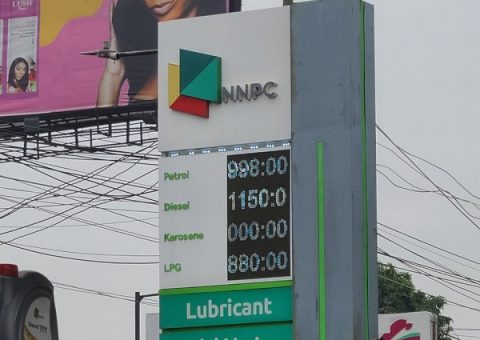
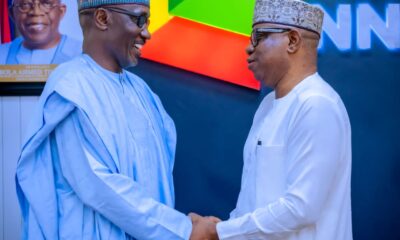
The Nigerian National Petroleum Company Limited (NNPCL) says it has reached the mark of 1.8 million barrels per day of crude oil production.
The state-owned oil company which made the announcement on Thursday, also stated that it is set to hit the two million barrels per day target set by President Bola Tinubu by December 2024.
The company also revealed that it is now producing 7.4 million standard cubic feet of gas to power the gas infrastructure especially the AKK. This is an improvement from 6.1 mmscf earlier in the year.
The NNPCL noted that the accomplishment which aligns with the government’s budget, reflects the dedication of all of its teams over the past weeks.
During an interactive session with the Senate Committee on Finance at the National Assembly in December last year, the Group Chief Executive Officer (GCEO) of the Company, Mr. Mele Kyari, had assured that the projections on crude oil production and price benchmark for the 2024 Budget were realistic and realizable.
Speaking on the dynamics of the market in relation to the projected budget benchmark price of $77.96 per barrel, Kyari said: “With what we see in the market today and potentially in the year 2024 and even beyond the next two years, it is very unlikely to see $70 per barrel oil in the market.
The oscillation we are seeing, sometimes you do see prices coming down to $75 to the barrel and sometimes it goes above it, overall, benchmarks are averages. We think that the proposal by Mr. President around the $77.96 is still realisable in 2024.”
On the crude oil production projection, Kyari had stated: “The number we have is 1.785mbpd.
This is cumulative of all oil produced in the country. This figure is inclusive of all production including crude oil and condensate.
“I need to make this clarification because of the reports in the media that our OPEC quota is 1.5million barrels per day.
The OPEC quota is related only to crude oil. We also do between 250,000 to 300,000 barrels per day of condensate in our production. When you combine the two, the 1.78mbpd is realistic and realisable.”






Business
Takeaways From CIBN 19th Annual Banking and Finance Conference
The large capital raised by banks during the recapitalisation exercise indicated the depth of capital available locally.

By Ochefa
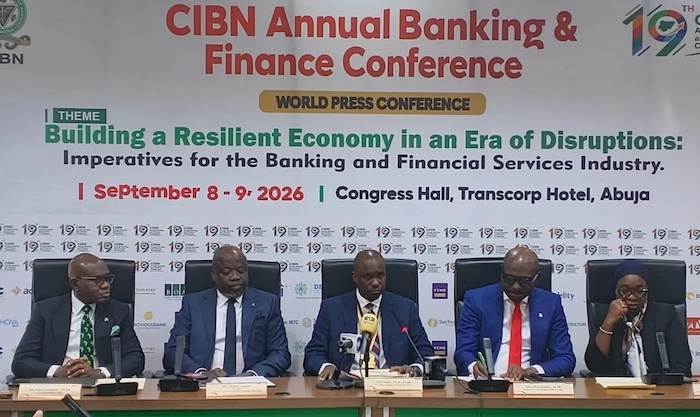
The Chartered Institute of Bankers of Nigeria (CIBN) held its 19th Annual Banking and Finance Conference in Abuja, yesterday.
Themed , “Building a Resilient Economy in an Era of Disruptions: Strategic Imperatives for the Banking and Financial Services Industry,” the conference brought together stakeholders from the banking industry, the World Bank, government officials including economists , business leaders and policy makers.
” The ultimate test of Nigeria’s economic reforms should be their impact on households, businesses and the daily lives of ordinary Nigerians.”
Here are the key points from the discussions:
Dr. Dele Alabi, President and Chairman of Council of CIBN:
•The ultimate test of Nigeria’s economic reforms should be their impact on households, businesses and the daily lives of ordinary Nigerians. Nigeria’s improving macroeconomic indicators will amount to little if they failed to translate into lower living costs, more jobs, higher incomes and better living standards for citizens.
“Macroeconomic progress must, therefore, be felt at the micro level in households, small businesses and the daily lives of ordinary Nigerians. Our task is to build systems that learn, adapt and emerge stronger.”
• Lead Private Sector Development Specialist at the World Bank’s Nigeria Office, Ms Bertine Kamphuis:
Credit to Nigeria’s private sector remain inadequate. She urged banks to channel more financing to sectors with the greatest potential to create jobs, particularly agriculture, manufacturing and MSMEs. According to her, with between three and four million young Nigerians entering the labour market every year, expanding access to productive credit has become imperative.”
• Minister of Finance and Coordinating Minister of the Economy, Mr Taiwo Oyedele:
“Strong bank profits alone are no longer sufficient; financial institutions must contribute more directly to economic growth and the welfare of Nigerians.
“For years, we have measured financial institutions by balance-sheet growth, profitability and shareholder returns. These remain important. But we must increasingly ask: what is the financial system doing for the real economy?
A resilient banking system cannot exist indefinitely where businesses cannot obtain affordable credit, manufacturers struggle to finance expansion, and millions of productive MSMEs remain outside the formal financial system.”
•Central Bank of Nigeria, CBN, Mr. Olayemi Cardoso:
” The large capital raised by banks during the recapitalisation exercise indicated the depth of capital available locally.
Represented by the Deputy Governor in charge of Policy, Mr. Philip Ikeazor, the CBN governor challenged operators in the industry to take advantage of the large capital now available to them to fund the real sectors of the economy, with a view to achieving the rapid growth that would impact on better living standards of Nigerians.
He urged state governments to collaborate with the CBN and the fiscal authorities at the federal level to effectively tame inflation, pledging that with the cooperation of all stakeholders, a single digit inflation was achievable.”
Business
AfCFTA : Nigerian Goods In High Demand In Africa, says Minister
On a trade mission to Botswana with about 11 Nigerian businesses, one of them immediately got an order of 6,000 T-shirts to be supplied there.
The Minister of Trade, Industry and Investment, Dr Jumoke Oduwole, has said that Nigerian goods continue to remain competitive and, in particular, high demand on the continent.
The minister disclosed this yesterday in Abuja at the 2026 Third Quarter meeting of the African Continental Free Trade Area (AfCFTA) Central Coordination Committee (CCC).
She said, ” I think that a lot of Nigerians have the perception that Nigerian goods are not competitive on this continent. Nigerian entrepreneurs have shown that they can compete anywhere in the world, and are doing particularly well in the rest of Africa, and this is demonstrated by our non-oil exports, which have gone up exponentially, and it’s due to the exports of Nigerian goods across the African continent
She said on a trade mission to Botswana with about 11 Nigerian businesses, one of them immediately got an order of 6,000 T-shirts to be supplied there.
Business
After South Africa, Kenya Cracks Down on Foreign Traders, Retailers
Ruto directed authorities to begin shutting down small businesses operated by foreign nationals from September 7, saying hawking and small-scale retail should be reserved for Kenyans.
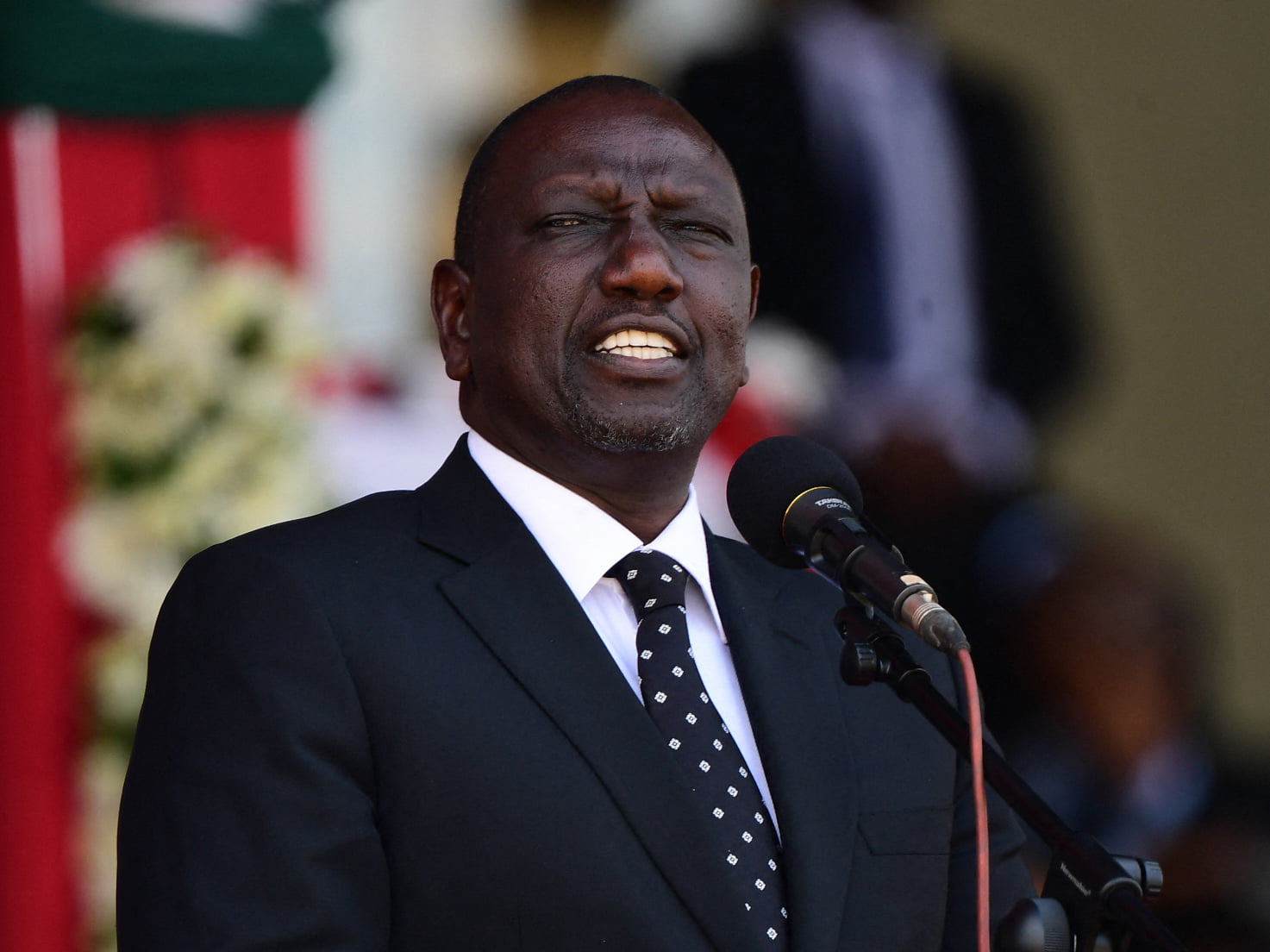
Kenya is beginning a crackdown on foreign nationals operating small retail shops and engaging in hawking, after President William Ruto directed authorities to shut down such businesses from September 7.
Ruto announced this on September 2 while addressing micro, small and medium-sized enterprises, MSME. traders at State House in Nairobi.
He said foreigners should not compete with Kenyans in businesses such as hawking and small retail, while foreign investment was welcome in activities requiring greater capital.
Ruto directed authorities to begin shutting down small businesses operated by foreign nationals from September 7, saying hawking and small-scale retail should be reserved for Kenyans.
He said the government would take administrative action while the Parliament of Kenya considers the proposed Local Content Bill, 2025.
He also directed National Assembly Majority Leader Kimani Ichung’wah and Trade Cabinet Secretary Lee Kinyanjui to accelerate the bill’s passage through Parliament.


Takeaways From CIBN 19th Annual Banking and Finance Conference

Kara Bridge Repairs Cripple Lagos-Ibadan Expressway

Kenya Gives Foreign Traders 90 Days to Formalise Status Amid Xenophobia Fears

Tech Expert, Zuckerberg trains with UFC champions, Adesanya, Alexander

Organ Trafficking: Ekweremadu bags 10 years in UK prison

SAINT OBI: Between his marriage and his death
-

 Business2 days ago
NAFDAC Goes After Chinese Logistics Firms Over Products Counterfeiting
-

 Business2 days ago
Dangote Refinery Signs IPO Document Today
-
 Politics2 days ago
Obidient Connect Texas Plans Grand Rally for Obi-kwakwanso October 10
-

 News2 days ago
FG announces two-week traffic delays on Kara–Berger Bridge for repairs
-
 Politics2 days ago
Nigerians better off under military than democracy – Duke
-
 News2 days ago
JUST IN: Traffic Chaos Expected on Lagos-Ibadan Expressway From Tuesday
-

 Entertainment1 day ago
Ikenga becomes highest-grossing Igbo film of all time
-
 Sports2 days ago
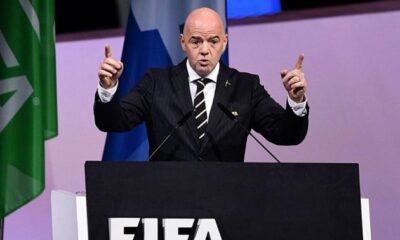
Infantino To Seek Re-Election As FIFA President In 2027